Wednesday, July 21, 2010

Lucius Shepard news from SubPress

To prove that if I come up with an awesome idea, someone else with the means of doing something about the idea will also come up with it: If I was ever put in the position of editing an anthology or collection, I wanted to edit a collection of Lucius Shepard’s Dragon Griaule stories. Shepard is an absolute master and it was a shame that there wasn’t a place to get all of the Dragon Griaule stories in one place.


So, it should come as no surprise that the good people at Subterranean Press will publish just that very collection that I’ve been thinking about for more than a year.


Even though I’m not getting paid for it, good on them and good for us to get all the Dragon Griaule stories in one collection. MUST BUY.

Not five minutes ago I set pen to paper on three different contracts for projects with Lucius Shepard. They include:

– A collection gathering all of his Dragon Griaule stories and novellas, including “The Skull,” a novella original to the volume.
– A collection which will feature four uncollected novellas, including one, “Repairman” written especially for the book.
– A Dragon Griaule novel, titled Beautiful Blood, on which Lucius is already working.

We’ll announce more details and post ordering info as appropriate.

Tuesday, July 20, 2010

starting

I've just started work to put together my Hugo ballot for this year. It's due by the end of the month if I want to actually vote (which I do).

I've been very distracted for the last several months and that's made me a bad blogger. I don't normally talk about anything that smacks of my personal life here, but I'll make an exception in about a month to explain - because the explanation ties into some other things for the future. It's not at all bad, and actually quite good for me, it's just one of several things occupying my mind and focus that has messed with my blogging.

I've also been a distracted reader lately with my monthly counts dropping significantly. It's hurt my Hugo reading, but luckily I've already covered most of the nominated stories. The novels are a problem. I've only read three of them, and I have another on the way from the library (the Sawyer, if you must know). Not sure if I'll be able to jam out the Mieville or the Robert Charles Wilson. On the other hand, I've read the original RCW story the novel is expanded from and, well, it didn't quite ring for me. So we'll see. Some of the other categories might get somewhat short shrift. Which is a shame, because I wanted to be a great and informed voter this year...and my focus has shifted a bit. Shrug. Not much I can do about that now.

(this parenthetical is here just so that each paragraph doesn't begin with the word "I've". Ugh)

Choir Boats E-book

Okay, y'all. I've been sitting on a review copy of Daniel Rabuzzi's debut fantasy novel The Choir Boats for way, way too long. So - maybe you can help assuage my reviewer's guilt and go check out the book.

For folks who like free stuff, The Choir Boats is being offered as WOWIO's July Book of the Month and is available for free download through the end of July.

I can't tell you a thing about it, but this page right here has a bunch of reviews and stuff.

Monday, July 12, 2010

The Blog You Wish Your Blog Could Be

If you think you really want to be reading something awesome but you just don't know what it is, I've got your answer. You want to be reading Rachel Swirsky's guest posts on Jeff VanderMeer's blog about what she is learning at the Launch Pad Astronomy Workshop.

I'm going to cheat just as much as Swirsky did and quote the Launch Pad website:
Launch Pad is a free, NASA-funded workshop for established writers held in beautiful high-altitude Laramie, Wyoming. Launch Pad aims to provide a “crash course” for the attendees in modern astronomy science through guest lectures, and observation through the University of Wyoming’s professional telescopes.
There are twelve students at this year's Launch Pad, and if I'm paying sufficient attention to Rachel's posts the students include: Carrie Vaughn, Kelly Barnhill, Marjorie Liu, and, in Rachel's words

The other class members have an impressive array of backgrounds. We’ve got people who write non-fiction articles, non-fiction books for kids, fantasy novels, erotica novels, Buffy the Vampire novels, hard-science fiction short stories and novels, non-fiction about science fiction, who write movies and tv and video games (including the man who wrote the dialogue for Spore… oooh, shiny), comic books, graphic novels, who fact check for magazines, who edit anthologies and novels and articles, who publish anthologies and novels and articles, and teach writing or teach science, who try to launch commercial projects to the moon… lots of variety, although the preponderance of us have written science fiction or fantasy at some point.

What Rachel is writing about is the science of what she's learning. It's kind of the cliff notes version of actually going to Launch Pad (not as awesome as reading the book, but you get a general sense of what just happened).

If you don't read Jeff's blog on a regular basis (and you should), you'll want to check out the Launch Pad tag on the posts, and that'll keep you up to date. Take this recent post from Swirsky on stuff in our solar system. Interesting as hell. This is why you want to be following her posts over this next week. It's smart stuff taught by really smart people and reported by a smart person. Smart all around.

Check it out. It's probably the coolest thing I'm going read this week.

Sunday, July 11, 2010

Forthcoming 2010: Q3

This is a couple of months late, but, welcome to the latest installment of "Stuff I'm Looking Forward To This Year". As always, I take my information from the Locus Forthcoming list, plus a little bit of extra research when I'm aware of things that should be on the Locus list and are not.

July
Kraken, by China Mieville: I have been slack in my Mieville reading, but a new Mieville novel is always a notable book.

Swords and Dark Magic, by Jonathan Strahan and Lou Anders (editors): A swords and sorcery anthology from two master anthologists and filled (presumably) with absolute goodness. This can't miss. It can't.

The Fuller Memorandum, by Charles Stross: This is the third "Laundry" novel, following The Atrocity Archives and The Jennifer Morgue. I very much enjoy following the adventures of Bob Howard and am curious which writer of espionage novels Stross will pastiche this time (after Len Deighton and Ian Fleming). I have a review copy.


August
Mockingjay, by Suzanne Collins: Both The Hunger Games and Catching Fire were excellent and I can't wait to see how Collins closes out the trilogy.

Shades of Milk and Honey, by Mary Robinette Kowal: An absolutely delightful book from a wonderful author. See my review.

The Way of Kings, by Brandon Sanderson: I'm reading this right now. 200 pages in and it is big and sprawling and fixing to be Sanderson's opus. It's good stuff and very big, broad fantasy.


September
The Living Dead 2, by John Joseph Adams (editor): Who doesn't want more zombies? JJA puts out excellent anthologies and I expect more of the same from this one. The first Living Dead was a reprint anthology, but this time around he blends reprints with original fiction from the likes of Cherie Priest, Robert Kirkman, and Max Brooks.

Bearers of the Black Staff, by Terry Brooks: While Terry Brooks hasn't written a truly "good" Shanarra novel in years, almost decades (Armageddon's Children is really a Word / Void novel), I still read them to see how Brooks pieces things together and in the hopes that he still has one more really good one left in him. The author who wrote Elfstones is still in there, I know he is.

Servant of the Underworld, by Aliette de Bodard: I think this is still making to the US in September. It's de Bodard's debut novel, a historical mystery set in Aztec times. It's a good chance to see what de Bodard is all about and what she can do at novel-length.

Antiphon, by Ken Scholes: Am about to start reading this third novel in the Psalms of Isaak. Scholes is a writer with a load of potential and is one of the hot new voices in secondary world fantasy. While I'm not a fan of the change in cover art (why, Tor, why?), Antiphon is a much anticipated novel. See my reviews of Lamentation and Canticle.

Friday, July 09, 2010

Aqueduct Press

50 books, 6 years, 1 reader at a time. That’s how indie presses do it, generally. You’re that one reader now, so if you like Aqueduct, if you like me are impressed by this achievement, please re-blog the link to the feature and a link to Aqueduct’s main page for those who want to order that way instead, and support this unique publisher with some book sales love.

That's Jeff VanderMeer talking about L. Timmel Duchamp and Aqueduct Press. He's got an interview with Duchamp up at the Omnivoracious blog and it's a good one.

I haven't read as much published by Aqueduct as I would like to, but what I have read has been very, very good. I am just finishing the fourth (of five) Marq'ssan novel from Duchamp and while the narrative can be challenging to read because it often comes across as social and political theory writ large, the story itself is quite compelling. You will want to start with Alanya to Alanya (my review). I've also read the Plugged In chapbook from Duchamp and Maureen McHugh (my review). It's only two stories, but again, quite good.

I blogged about this before, but I still really want to check out Rachel Swirsky's debut collection Through the Drowsy Dark. Swirsky is fantastic.

Larry has posted some of his thoughts, too.

So, basically, I just want to show some support for Aqueduct Press. I really like what they're doing, what they stand for, and the work that they publish. If you're not familiar with Aqueduct, go check them out.

Thursday, July 08, 2010

Night Shade Speaks

Via Genreville, Night Shade Books has issued a statement regarding the allegations of non-payment from Liz Williams, Brendan Halpin, and Elizabeth Moon.

The second paragraph of the official statement:
This has led to some major miscommunication, and sometimes flat-out lack of communication, with our authors, sometimes, even amongst ourselves. We screwed up: Details were missed, one of us assumed another was handling a situation, or a reluctance to deliver bad news turned into an unprofessional excuse to procrastinate. The issues that have come up today, at their core, are really ones of communication. All this could have been avoided through simple phone calls and emails, through us letting people know what was happening.

That's a start. Night Shade has admitted that they have made mistakes, and that's good. It doesn't entirely address all of the issues raised by Williams and Halpin, such as inaccurate royalty statements with factually incorrect information regarding the advance, but that probably shouldn't be part of Night Shade's public discourse anyway.

All that Night Shade should really say is "we were wrong, we messed up, and we will make it right."

Which, essentially, is what they said.

We have already addressed the issues currently at hand involving Elizabeth Moon, Brendan Halpin, and Liz Williams. We have also contacted SFWA, and will be working hand-in-hand with them to find out if any other authors have issues with us, but haven’t come forward yet, and get those problems resolved.

What remains to be seen is whether Night Shade truly will make this right for the authors in question or whether this is something endemic at Night Shade Books. Since both Williams and Halpin have mentioned that they know of other Night Shade authors who are in very similar circumstances, this appears to be a far larger issue for Night Shade than what the thus far public conversation has been about. It's a big problem for Night Shade to resolve. They have publicly acknowledged fault, and that's an important first step.

We'll see if they are also willing to take the next one.

Tuesday, July 06, 2010

Umm, Night Shade?

Nothing stays a secret for long on the internet.

Not that this was supposed to be one.

Over lunch today I ran across this post at Fantasy Book Critic noting that the future of the Detective Inspector Chen series from Liz Williams was very much in question due to issues she was having with her publisher. I didn't read the post carefully at the time, just skimmed it and thought, "that sucks, I like that series".

Until I got home from work and saw that there was perhaps a bit more to the story than I thought. Enter Rose Fox, at Genreville, shining some light with three short paragraphs. Both Liz Williams and Brendan Halpin (aka Seamus Cooper, author of Mall of Cthulhu) have had serious contractual, communication, and financial issues with their publisher, Night Shade Books.

Liz Williams' statement.

Brendan Halpin's statement
.

Now, if you check the dates of those entries, these aren't brand new statements. I think this may have been stoked by a different post from Williams regarding a short story sale she's running to help pay the bills while the financial issues with Night Shade are very much unresolved.

It is worth checking out the various posts to get the direct perspectives from Williams and Halpin. I might otherwise run quotes here but i don't want any context to be lost by poorly selecting exactly which passage to run. It is important to be clear with this and all the information I have is covered by the above posts.

***

I have to say that I'm extremely surprised by this. As I am not a writer, my relationship with Night Shade Books has been a) as a reviewer, and, b) as a consumer.

As a reviewer Night Shade was one of the first publishers willing to send me copies of their books to consider for review and, from this respect, Night Shade has been very easy to work with.

As a consumer I hold Night Shade in the highest regard. The books they publish are top of the line in terms of quality and production value. Shit, they've published Paolo Bacigalupi's first two books, Jonathan Strahan's Eclipse series, Alex Bledsoe's debut novel, a host of John Joseph Adams anthologies, republished Imaro, and...well...from a consumer's perspective, they rock.

***

Until today I would have assumed that Night Shade Books was an example of how a small press can get it right. I would have assumed that, yes, there were the minor hiccups, errors, and issues that crop up as a part of business, but also that those hiccups, errors, and issues were addressed appropriately. Because that is what good people should do.

So, as Rose Fox stated.
This is causing a lot of shock among people who have long seen Night Shade as an exemplary small genre press.
Exactly. This was very much unexpected and, without knowing a lick more than i do from the above linked posts, I am very much disappointed that these two writers are being treated in the manner they claim. I am even more disappointed that a publisher I held in high esteem is at the center of this and is the one harming Liz Williams and Brendan Halpin.

***

With the initial statements a couple of months old, this may be the extent of public statements from those involved and no other writers will come forward with similar stories. If so, I can only wish Williams, Halpin, and anyone else who may be affected or harmed a speedy resolution that is fair and equitable.

If not, well, this is something worth keeping an eye on.

Monday, July 05, 2010

Shadowline, by Glen Cook


Shadowline
Glen Cook
1982

Sometimes a first impression does not serve the reader. The first ten chapters span a scant 32 pages and some two hundred years. More, those ten chapters bounce between different eras with different characters and it is initially difficult to get a handle on the focus of the novel. The initial impression given is that this early novel from Glen Cook, originally published in 1982, just is not as tightly controlled as readers might expect from Cook’s later work. That perhaps Cook is trying to do too much and go too big and this will be a noble failure.

That’s the impression that readers who love the Black Company and the Garrett PI novels but couldn’t appreciate the Dread Empire novels might come away with. That impression would be so very wrong.

Shadowline tells a multi-faceted story which, though initially confusing, ultimately coalesces into a very coherent tale of family and revenge (set a good thousand years in the future and in spaaaaaace). Initially offputting, the jumping around in time and character allows Glen Cook to present the origins of a conflict that should span generations, yet due to life-extending technology, still features the same major players. Cook dances around in time, and gives a number of clues to how things fit together, but the reader doesn’t know how until later.

Who is the crazy old coot called Frog? Why is this minor chapter important? What about the framing chapters of Masato Storm? Much of the focus of the novel is on Gnaeus Storm and the framing chapters are twenty years later. And the bits with the Sangaree, an alien race which keeps humans like cattle? The opening chapters are so disconnected from each other, but patience is rewarded.

Here Glen Cook’s craft and storytelling is in fine form. The characters and disparate story arcs are compelling even when the connections seem tenuous. Shadowline only improves with each passing page and though this is only the first entry of a trilogy, Shadowline feels complete and whole in its own right. This is an impressive novel, complete with generational politics, intrigue, and war spanning the stars. Oh, it’s good.

With Night Shade Books re-releasing the Starfishers trilogy, this is the perfect chance to delve into a fantastic first volume of space opera.


Reading copy provided courtesy of Night Shade Books.

Tuesday, June 29, 2010

Kitty Goes to War, by Carrie Vaughn


Kitty Goes to War
Carrie Vaughn
Tor: 2010


Set within a framing device of one of those conspiracy theories that can be spun out from those late night radio talk shows (one of which Kitty Norville is the host of), Kitty Goes to War is, at its heart, about exploring a different aspect of lycanthropes and what the human impact is.

First, the framing device. On one night of her radio show Kitty explores the theory and rumor that “something weird is going on at the Speedy Mart” and asks for her listeners to call in and report what they know and what they have heard. This leads to a variety of reports of weirdness and also leads to Kitty and the radio station being sued for libel by the CEO of Speedy Mart (he was also mentioned by name on the show). The framing device is the investigation into Speedy Mart and the conflicts which ensue. This ties into a larger conflict and story arc which Carrie Vaughn has been dancing around for several books now. It’s the hint that there is something much bigger out there and that Denver is only a small part of that something which goes far beyond the personal conflicts.

Carrie Vaughn’s slow build of this larger conflict is well done and where she really succeeds is keeping her focus on the smaller personal stories. Framing device notwithstanding, Kitty Goes to War answers the question that has surely been asked over thousands of years or longer: Is there a military application to using werewolves in combat? Given that lycanthropy enhances strength, speed, and endurance, and also bestows an almost magic-like self-healing ability, the answer is assuredly yes. Of course there is.

Please note that Vaughn does not answer whether there *should* be, only whether there is.

Dr. Shumacher, originally introduced in Kitty Goes to Washington and still working for the National Institutes of Health’s Center for the Study of Paranormal Biology, contacts Kitty because there are three soldiers just returned from Afghanistan who need help. The soldiers are, one may have guessed, werewolves and to say that they are not coping well would be a drastic understatement.

Here Vaughn shines. The depiction of Kitty fighting to allow these soldiers a chance at true rehabilitation is touching, as is the varying brokenness of these men turned soldier turned werewolf who have given nearly all to serve their country. Vaughn’s portrayal of the soldiers each suffering from the same trauma but being broken in different ways is important. Vaughn handles this very delicately, but with assurance that she knows what she is doing and what she is writing about.

Despite the title, Kitty Goes to War is not The Great Werewolf War (though that story may come later) and it is not about werewolf soldiers in combat. Werewolf or not, it is a story about soldiers coming home and dealing with their trauma. It is about belonging and healing and hope. The heart of the Kitty Norville novels has always been the small personal stories and, typically, Kitty dealing with a situation that is almost out of her presumed skillset – except that each situation forces Kitty to struggle and grow and overcome. Kitty Goes to War continues Carrie Vaughn’s streak of writing excellent Kitty Norville novels and only leaves the reader wanting More Kitty Now. Alas. The reader must wait.


Reading copy provided courtesy of Tor Books.


Previous Reviews
Kitty and the Midnight Hour
Kitty Goes to Washington
Kitty Takes a Holiday
Kitty and the Silver Bullet
Kitty and the Dead Man's Hand
Kitty Raises Hell
Kitty's House of Horrors

Monday, June 28, 2010

strange conversations you don't expect to have


At this point the name Piers Anthony mostly conjures images of pun-riddled novels and juvenile views of sex in said pun-riddled novels and not a whole lot else.

Which is why I was surprised to find myself in a conversation yesterday at Fourth Street discussing the good parts of the Piers Anthony oeuvre.

I believe it started with someone mentioning that she remembered seeing a note in a volume of the Incantations of Immortality series that Anthony needed to take a break from the series because he needed some fast money and was going to return to Xanth to quick churn out several volumes in quick succession. I would be curious to find out which book that was so I could try to backtrack and figure out which Xanth novels were the cash grab. Regadless, this person said that she immediately lost all respect for Anthony.

I replied that I would have gained respect for the man. At least it was upfront and honest and since we really don’t know what his situation was, it’s hard for me to judge that. Maybe it was medical or family related.

On the other hand, I remember reading an interview with John Grisham where he baldly stated that he had to turn in a new novel every year to eighteen months to be able to “maintain his standard of living” and that just rubbed me exceptionally wrong.

Of course, it is difficult to understand motive on a potentially apocryphal story for Piers Anthony.

What was interesting, though, was the rest of the conversation turned to the stuff Anthony did well. The early Xanth novels before he punned his readers to death. Macroscope came up (nominated for a Hugo, even), as did a couple of other books. I mentioned the Battle Circle trilogy.

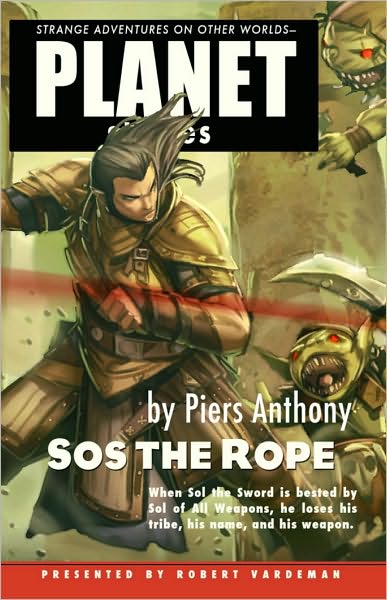
Battle Circle, if you are not aware, is a trilogy comprised of Sos the Rope, Var the Stick, and Neq the Sword. It’s a sword & sorcery type of story, only set on a post-apocalyptic Earth. I haven’t read them since I was a teenager (so, about fifteen years ago), but I remember being entertained by the storytelling. They’re a bit shlocky, if memory serves, but decent enough.

Piers Anthony was my gateway to twenty years of actively reading fantasy and science fiction, starting back when I was in seventh grade and overhearing a couple of kids talking about how awesome and “adult” the Xanth novels were. How the other kids weren’t mature enough for them. I laugh now, but immediately following my family’s move from Staten Island to Minnesota, I had everyday access to the Rush City library and sought out those books and absolutely loved them.

Today I don’t think I could pick up a Xanth novel after book 10 (if not book 7) and make it through, but back then…couldn’t get enough and I was current through everything that was published.

So, it was with weird fondness that I was part of that conversation, remembering back when Anthony was spinning entertaining tales and didn’t require 5-10 pages at the back of each book identifying what ideas came from his readers. The description of Macroscope that was given made me exclaim, “man, that was back when he could still THINK!”, in pure surprise at the inventiveness of it all.

It was a weird conversation, but pretty damn cool.

Sunday, June 27, 2010

Stuff I Really Need to Read in the Next Year

This is my third year attending Fourth Street Fantasy and invariably there is conversation about books and authors I haven't read. The last three years have fairly well identified the areas of my ignorance and when I keep hearing certain names mentioned with deep affection and reverence, it is time that I step up and read these writers.

Roger Zelazny

Diana Wynne Jones

I think that these are the two most glaring absences in my reading history and two which I need to fix. Sooner, rather than later.

The Carpet Makers, by Andreas Eschbach: This isn't one of the names I've been hearing for years, but is instead one of those Jo Walton recommendations and the set up she gave was so damn fascinating that I have to read it. Besides, nearly everything Jo has recommended (usually on Tor.com), I have loved.

Skyler White: And Falling, Fly: This is one of those situations where I previously had little interest in reading the book UNTIL the author was on a panel at a con and I thought what she had to say and how she carried herself was interesting enough that NOW I want to read her book. Luckily, I've had a copy of the book for a number of months now. And Falling, Fly has just pushed up the queue a bit.


I am also reminded of stuff, not specifically because of the con, that I have wanted to read for some time now: Elisabeth Vonarburg, Sheri S. Tepper, Hugh Cook, Peter Watts, Lois McMaster Bujold.

and, of course, more Elizabeth Bear and Steven Brust. Because you can't have too much of them.

Wednesday, June 23, 2010

Taltos, by Steven Brust


Taltos
Steven Brust
Ace: 1988

“Watch Steven Brust. He’s good. He moves fast. He surprises you.” – Roger Zelazny
Taltos is the fourth of Steven Brust’s Vlad Taltos novels and for the first time, I really understood the Zelazny blurb that has graced the covers of the three previous volumes.

As per his norm, Brust is working on multiple levels telling at least two different stories at different times to drive home the main story or theme of the novel. Assuming there is just one. You never know with Steven Brust. You just don’t. What you get out of one of Brust’s novels likely depends on your emotional age, life experience, which of his previous books you’ve read (if any) and how much you remember from them, and whether or not this is your first time reading the book.

This is not to say that a Steven Brust novel demands a steep price for admission or that it requires a learning curve. Brust will trick the reader and suck them in so that they feel comfortable all the while he continues to paint a rich history of a city and a land and tell a story through the nimble narration of a gangster and an assassin for hire AND raises questions of ethics, morality, loyalty, friendship, and love. At first glance all this stuff in the book is simple, but it isn’t.

Taltos is a novel about beginnings.

In the previous novels, Vlad is already well established as a capo in the Jhereg, controls a bit of territory, and has powerful friends. Taltos tells of how that came about.

There are three distinct parts to this novel: the story of how Vlad joined the Jhereg Organization and began his rise of responsibility; the story of Vlad’s first meetings with Morrolan, Sethra Lavode, and Aliera, and his “walking the Paths of the Dead”; and finally and most obscurely, Vlad’s preparation to create and perform a complicated spell / ritual. Of the third, there is no sense throughout most of the novel of what that spell may be for and, more importantly, when it is occurring.

Each chapter begins with a novel excerpt of the spell. The rest of this short novel bounces back and forth between Vlad as a beginning gangster and Vlad’s job for Sethra which eventually takes him to the Paths of the Dead. At times a moment is required for the reader to reorient and fix on which story is being told, but ultimately it is a story of beginnings, and of the shaping of Vlad’s life and career.

It is difficult to describe exactly how Brust “moves fast”, as Roger Zelazny so aptly described him. But, the fact is that there is a nimbleness to Brust’s storytelling. The Vlad Taltos novels are short, yes, but Brust also keeps readers turning the page as fast as they can just to find out what happens next. While Steven Brust is always one step ahead of the reader, he laces the novel with casual detail that later turns out to be anything but. Between the very self aware and quick witted narration of Vlad and the deep emotional politics of human / Draegaran relations, Brust does indeed move fast, but he does so while presenting a smartly written and an often funny story.

While those who have read the three previous Vlad Taltos novels will get a bit more out of Taltos, this is an otherwise excellent place to jump in to the series and see what it is all about. Regardless of whether one is working the series in publication order, chronological order, or just discovering it for the first time, Taltos comes highly recommended.


Previous Reviews
Jhereg
Yendi
Teckla

Tuesday, June 22, 2010

"Ghosts of New York", and Other News

In an amazing bit of title-synchronicity with yesterday’s post, let’s take a brief look at Jennifer Pelland’s “Ghosts of New York”, a post 9/11 ghost story.

“Ghosts of New York” is the lead story in the Dark Faith anthology edited by Maurice Broaddus and Jerry Gordon (following only a poem from Linda Addison). Pelland tells the story of the people who jumped from the Towers on September 11 and in this story they are doomed to repeat their final leap over and over so long as people still remember what happened. Only, it’s not so simple as that.

There is horror and despair here, as there should be. But there is also exploration, revelation, and a touch of not-easy grace. “Ghosts of New York” is a tough story, in part because the event in question is so prominent in the national consciousness and so much more immediate for residents of New York, but also because of the revelations of the other ghosts of New York. It calls to mind other tragedies and questions the power of memory.

As should be expected from Jennifer Pelland, “Ghosts of New York” is quite good and uncomfortably moving.

**

The other news?

Jennifer Pelland has sold her first novel
, Machine, to Apex Books! Congrats to Pelland!

I'm a big fan of her short fiction (have you read "Captive Girl" yet? How about "That Has Such People In It"?) and I'm excited to have the chance to read it sometime maybe next year! This one will surely hit my annual list of the books I'm most excited for.

Monday, June 21, 2010

Ghosts of Manhattan, by George Mann


Ghosts of Manhattan
George Mann
Pyr: 2010

What do you get when you cross steampunk with a pulp-era vigilante hero? The answer is George Mann’s Ghosts of Manhattan. This is a 1920’s New York with prohibition in full swing. The era feels like what we would expect, but other aspects of history are different. The first World War still occurred, but America and England seem to be locked in something of a cold war threatening to go hot. The background is fascinating, but is ultimately a small part of the novel.

With shades of Bruce Wayne and Batman, Ghosts of Manhattan is entirely the story of a man taking the law into his own hands and meting out the justice that the police is unable to. There are gadgets, a dame, and plenty of action.

In only 236 pages, George Mann spins a fast paced urban adventure and introduces an excellent vigilante hero with what readers can hope will be the first volume of a new series. Ghosts of Manhattan is a blast to read and is the perfect book for when you want to kick back and just enjoy the ride. Ghosts of Manhattan is a smartly written modern take on a pulp adventure and is all about enjoying the ride.


Reading copy provided courtesy of Pyr Books

Thursday, June 17, 2010

20 Under 40?

I love looking at lists of promising writers and then watching the comments. Which is why when Omnivoracious pointed out some responses to the New Yorker's list of the top twenty writers under the age of 40, I had to check them out.

You start with the New Yorker’s List, follow that with an alternate list of 20 from The Millions, and then check out some commentary. Or, with this pre-response to the list.

Now, this is generally a SFF themed blog and most of what we read around these parts is in-genre. As such, I haven't read many of the writers on the New Yorker's list (books from Adichie, Freudenberger, and Foer - and probably some individual stories from a couple of the others like Alarcon), and I've scarcely heard of the folks on the list from The Millions.

But I love lists.

And it is worth noting that when The New Yorker ran a Top 20 Under 40 list in 1999, the list contained a number of names that are instantly recognizable today: Sherman Alexie, David Foster Wallace, Michael Chabon, Jhumpa Lahiri, Jeffrey Eugenides, Junot Diaz, Jonathan Franzen, Rick Moody, George Saunders.

Oh, yeah, there's four Pulitzer Prize winners on the 1999 list, not to mention other bits of awesomeness. If this new list is nearly as prescient, you'll be hearing much more the newly anointed.

Did I mention that I love lists?

Wednesday, June 16, 2010

What Doctor Gottlieb Saw

Hey, were you interested in reading Bitter Seeds but just don't have the time to read a complete book?

Or, have you already read the excellent Bitter Seeds and just want more?

I have the answer for both problems.

The answer is "What Doctor Gottlieb Saw", the new short story from Ian Tregillis. It's set in the same world as Bitter Seeds and features Gretel, which, if you've read the book, should immediately compel you to read the story.

Tuesday, June 15, 2010

Through the Drowsy Dark!

Thanks be to Jeff VanderMeer, I was just reminded of something that I forgot!

Rachel Swirsky’s first book is out! Through the Drowsy Dark was published by Aqueduct Press in May, and, well, I’ll let the catalog listing do the talking.
Through the Drowsy Dark collects ten stories and nine poems by Nebula- and Hugo-nominee Rachel Swirsky, "a terrific writer who's been making a name for herself with a string of intelligent, perceptive stories," as critic Jonathan Strahan characterizes her. In Through the Drowsy Dark, Swirsky's characters struggle with too much and too little emotional control, with heartbreak, with grief that has gone deep underground; they search for nothingness, for difference, for oneness. One commits a terrible crime because she believes it's the moral thing to do, while another digs up a dead dog because the very thought of kissing it on the lips makes her clitoris throb. Swirsky's explorations of the heart and mind are fearless—and dangerous fictions indeed.

Stories:
"Those Who Wait Through the Drowsy Dark" -- original to this collection
"Heartstrung" -- Interzone 210 (2007)
"Mirror Images" -- Fantasy Magazine (May 12, 2008)
"Of Passage" -- Flushed (Bannock Street Books, 2009)
"Heat Engine" -- Last Drink Bird Head (Ministry of Whimsy, 2009)
"The Black Angel's Kiss" -- original to this collection
"Detours on the Way to Nothing" -- Weird Tales 349 (2008)
"Defiled Imagination" -- original to this collection
"The Debt of the Innocent" -- Glorifying Terrorism (Rackstraw Press, 2007)
"No Longer You" (with Katherine Sparrow) -- Interzone 229 (2009)

Poems
"A Season with the Geese" -- Abyss&Apex (2007)
"Pomegranate" -- original to this collection
"Remembering the World" -- Electric Velocipede #15-16 (2008)
"Insider Her Heart" -- Ideomancer (2007)
"The Dream Vacation" -- Mothering Magazine (2006)
"The Oracle on River Street" -- Goblin Fruit (2007)
"Dear Melody" -- Sybil's Garage #4 (2007)
"Invitation to Emerald" -- Lone Star Stories (2007)
"The Fate of Hitler's Brain" -- Flashquake (2006)


While I’ve read a fair amount of Swirsky’s earliest stories, I do not believe I have read any of the stories collected here. That’s exciting, because Rachel Swirsky is one of the best young writers working today and she remains one of the names to keep an eye on in the coming years. She is only just now beginning to get the wider recognition her fiction deserves and it’s time to check out her work if you haven’t already.

I suppose you could also check out this page on Swirsky’s website to see what stories of hers are currently available online if you’re inclined to sample before you buy. "A Memory of Wind" was nominated for the Nebula and "Eros, Philia, Agape" is nominated for the Hugo (a story which I felt strongly enough about to put on my own nomination ballot).

I expect to pick up a copy of Through the Drowsy Dark sooner rather than later.

Monday, June 14, 2010

Bitter Seeds, by Ian Tregillis


Bitter Seeds
Ian Tregillis
Tor: 2010


Folks, it is time to check out the debut novel from Ian Tregillis, Bitter Seeds. If you’ve been following the Wild Cards series, you will likely recognize the name as a contributor to the recent triad of books (Inside Straight, Busted Flush, Suicide Kings), but with Bitter Seeds Tregillis offers up a very strong story of an alternate World War II.

Bitter Seeds is a different sort of alt-history novel than one would envision from, say, Harry Turtledove. Tregillis plays the war straight and doesn't deviate quite as far from history, but instead introduces a couple of slight twists that adds another facet to the conflict. Bitter Seeds presupposes that the German attempt to genetically modify humans into “super” men was successful. These super-soldiers, having undergone a lifetime of hardship and modification, are able to manipulate their bodies to produce a form of telekinesis, precognizance, flight, or, the case of one soldier, pyrokinesis. One ability per person. With these super-soldiers, Tregillis appears to be taking some of the lessons learned working on the more realistic super-heroes of Wild Cards and dials the realism up one more notch to make these individuals products of scientific engineering.

On the more supernatural side, the Allies have access to a form of witchcraft – though while the term and forms are familiar, the end results are not.

Wild Cards 3.0 this is not. Ian Tregillis is not telling a story of witches versus mutants battling it out for supremacy. The storytelling and the realism (if you accept the presuppositions required for entrance) are much tighter and closer to home.

There are three primary viewpoint perspectives in Bitter Seeds. Raybould Marsh can be considered the primary protagonist of the novel (if there truly is such) and is a British intelligence agent involved in Milkweed, a secret branch / team devoted to combating the unnatural aspect of the German threat, and using unnatural means to fight the war. Second is Will, Marsh’s good friend and one who has a heritage of witchcraft. Third is Klaus, one of the German “super soldiers”. Through Klaus the German perspective of the common soldier (or uncommon, as it may be) is humanized. Through Klaus, Tregillis reveals more about the capabilities and limitations of these super-soldiers – which really are little like any “super-soldier” the reader is likely to imagine.

Through these three limited viewpoint perspectives, Tregillis tells the story of Bitter Seeds at not quite a “boots on the ground” level, given that all primary characters would be considered officers, but still from the perspective of individuals not truly in charge of their own destiny trying to do their part to fight with the best of their abilities against the enemies of their nation. Bitter Seeds is just above the mud action that still gets the characters dirty.

Bitter Seeds requires a little bit of time to acclimate to and figure out what story is being told and how, but once the reader immerses into this fight, Bitter Seeds will stand as one of the better novels of 2010 and an excellent debut to what will hopefully be a long career for Ian Tregillis. Bitter Seeds is the first volume in the Milkweed Triptych and while it is the first of three novels, the story told here is complete and allowing for closure while still allowing that stories and lives do not just end when the last page is turned.

Can't wait for the next book.


Reading copy provided courtesy of Tor Books.

Thursday, June 10, 2010

The Way of Kings excerpt

Folks, you're going to see this all over the place and normally I don't post a lot of promotional stuff, but I've been digging on Brandon Sanderson since Elantris and it isn't a stretch to say that Sanderson is THE breakout writer of high fantasy today. Where Sanderson is reaching a much wider audience than anyone (including Sanderson himself) could have ever imagined is through picking up the torch from Robert Jordan and finishing The Wheel of Time. His own work, though, continues to improve and impress.

The Way of Kings is the first volume in a proposed ten volume series titled The Stormlight Archive.

There are novels I am as excited about coming out in the next two years, but The Way of Kings certainly is up near the top of the list.

I'm writing this last night (time travel!), but go to Tor.com right now.

Now.

Go.

If that link works, what you are looking at is a three chapter excerpt from The Way of Kings.

If the link doesn't work, it's because I messed up and you will want to use this link and I expect you'll be able to find the excerpt on your own. I believe in you.

Meanwhile, and this is the other thing you will find on a host of other blogs, Tor has graciously allowed blog type folks to post the prelude to The Way of Kings.

So, enjoy. I'm really freaking excited about this book.

(click on the post title to expand and get the prelude)

Tuesday, June 01, 2010

Shades of Milk and Honey, by Mary Robinette Kowal


Shades of Milk and Honey
Mary Robinette Kowal

Tor: 2010

The elevator pitch for Shades of Milk and Honey is “Jane Austen with magic”, and had this not been the debut novel from Mary Robinette Kowal, the elevator pitch would have induced me to run the other way. Screaming. Not a fan of Jane Austen, though Sense and Sensibility wasn’t bad. But, since this is the debut novel from Campbell Award winning writer Mary Robinette Kowal and because I am such a fan of her short fiction and have been for a number of years, I eagerly (if nervously) opened the book.

The elevator pitch is entirely truthful. Shades of Milk and Honey is a novel of society and manners and appears to be set in late eighteenth century England. The heroine of the novel is Jane Ellsworth, a “plain” woman who has resigned herself to a life of spinsterhood (Jane is twenty eight) and hopes for little more than to be able to care for her younger and much more beautiful sister’s children when Melody finds a suitable match. What makes Jane remarkable, however, is her sharp intelligence and her skill at “glamour”. Glamour is the only supernatural element to Shades of Milk and Honey and it is a magic used in society as an art to entertain at parties and is something that is taught to the children of privilege.

The conflict in Shades of Milk and Honey is that of emotion, family, honor, and relationships, much as can be found in the novels of Jane Austen and other writers of that ilk. Mary Robinette Kowal is able to overcome my natural aversion to the form by creating a compelling heroine on whom to hang the narrative. Jane Ellsworth is a character readers will feel they know already. She is a woman of integrity and competence and while she understands propriety and is a woman of her day, she is no shrinking violet. When a dishonorable man attempts to take advantage of Melody’s naivety and only Jane knows something is amiss, it is up to Jane to protect her sister’s honor.

No matter whether one comes into Shades of Milk and Honey as an unabashed fan of Jane Austen or, like me, avoids the stuff like the plague, Mary Robinette Kowal has delivered a debut novel to satisfy any and everyone. Shades of Milk and Honey is silky smooth and beautifully written. Kowal uses, on occasional, the style, spelling, and formality of Austen-era fiction, but does so in a modern manner to ease the reader through the novel. It works and works to the point that not only can I recommend Shades of Milk and Honey to readers who would never otherwise pick up this book, but I can also state that after finishing Shades of Milk and Honey readers will be ready for Glamour in Glass now and won’t want to wait for next year.


Reading copy provided courtesy of Tor.

Sunday, May 23, 2010

Score!

Yesterday I hit up Uncle Hugo's for the first time in a couple of months and while I didn't have luck in finding the quite rare and expensive Death Draws Five (the only Wild Cards book I don't own), or the next volumes in sequence from Steven Brust (Vlad Taltos series) or Glen Cook (Garrett PI series), I did find some goodness.

First, and most importantly, is a hardcover of Again, Dangerous Visions. I picked up a hardcover of Dangerous Visions a year ago and I said then that if I found a HC of the second volume I'd grab it. And so I did.

Then, I also purchased paperbacks of Sheri S. Tepper's Grass and Hominids from Robert Sawyer.

Wednesday, May 19, 2010

Night Shade to launch Pugilist Press

Night Shade Books is pleased to announce the creation of Pugilist Press, a new imprint that will focus exclusively on contemporary literary fiction with an edge. Night Shade founder Jason Williams will act as publisher and acclaimed editor Juliet Ulman will serve as editor-in-chief.

“Over the past twelve years, Night Shade Books has established itself as one of the leading publishers of fantasy, science fiction and horror, with stable of authors who have been critically hailed for breaking new ground in their genre,” said Williams. “We’re ready now to bring that ground-breaking vision into the mainstream; with Juliet on board, we hope to become the preeminent home for literary fiction that packs a punch.”

[...]

“What we’re looking for is tough literary fiction with a certain honesty and texture to it,” Ulman explained. “Think Cormac McCarthy, Harry Crewes, Gustav Hasford, Lionel Shriver, Dennis Lehane, Ernest Hemingway. Writers whose stories are extremely well-crafted, but who deal in a narrative style and subject matter that is direct, gritty, and often painful. Those are the voices that Pugilist hopes to bring to market.”
Source.

Awesome. On the heels of The Windup Girl winning the Nebula Award for Best Novel, Night Shade announced the creation of a new, lit-fic imprint. First, this means they are doing well enough to expand. Second, they have a focus for the direction they want to take this imprint and with the names they are using to describe what they want to do, I think Pugilist Press is going to be one to watch.

It doesn't hurt that Night Shade itself should be considered one of the premier science fiction and fantasy publishers and brings that pedigree to this new venture.

I'll be looking to see what Pugilist Press brings out in 2011 and beyond.

Monday, May 17, 2010

Regenesis, by C. J. Cherryh


Regenesis
C. J. Cherryh
DAW: 2009


“Who killed Ariane Emory?”

That is the question readers are told to expect the answer to, and depending on how long ago one last read Cyteen, it is an answer many readers have been waiting to learn for up to twenty years. The murder of Ariane Emory was a central and pivotal event in Cyteen and the identity of the killer was the main lingering question from that novel.

Jo Walton had a post on Tor.com about the murder, in preparation for reading Regenesis for the first time. Then, she read the book and was wholly unsatisfied with the answer to the question and somewhat with the book itself.

Readers familiar with Cyteen can be assured that the question of who killed Ariane Emory will be answered in Regenesis. They cannot be assured that they will like the answer.

While “Who killed Ariane Emory” is presented as being the central question of Regenesis, I am not entirely sure that the answer matters. Oh, it matters from a sociological perspective because the “why” is more important than the “who” because the murderer was never apprehended or identified and is, possibly, still alive and at large twenty years later when Ariane Emory II, the clone of Ariane Emory Senior, is maturing and coming into her own power – power that will eventually be the Directorship of Reseune itself. Ari II is constantly at risk, both personally and politically and the “why” of Ariane Senior’s murder may be vital to her Ari II’s survival.

The core of Regenesis, however, is not specifically about uncovering the answer to that question. The core of Regenesis is a brief period in the life of Ariane Emory II and her associates as she comes into public power and authority and attempts to navigate an extraordinarily complicated and perilous political situation on Cyteen.

Regenesis is a novel of conversation about power, about genetics, about family, and about ambition (among other things). The most thrilling passages were long conversations between two characters (often Ari and Yanni) that could come across as massive info dumps but still manage to convey tense political drama and danger. Because Cherryh frequently presents the third person limited perspective of Ari, the reader knows that a wrong answer could lead Ari down a path where she needs to eliminate (in some manner) the other person. Tense.

This is not an action laden novel and there are only a few scenes that could be construed as “action” or even just physically tense. So much of Regenesis is built into the psychology of the people in Ari II’s personal orbit and this is where the drama lies. Will the younger Ariane live long enough to assume the power of Ariane Senior? Will she be able to continue to find her own path or will circumstances turn her as cold as Ariane I could be? Will history repeat itself?

The cloning of Ariane and a couple of other individuals suggest that, at the very least, the people in charge of Reseune believe in the Great Man Theory and that these individuals are inherently important to society and that without them, their world will falter.

This is an interesting theory and a way to consider the actions of Reseune. Are they right?

Regenesis is a worthy sequel to Cyteen and while it does answer the question of who killed Ariane Emory, the reason to read this novel is to follow Ari as she begins to assume power in Reseune in her own right. One more thing that is interesting here is that there are passages where Ari II is recording messages for the someday to come Ariane III on the assumption that the cloning program will continue and that, perhaps, the next clone will be based on Ari II and not off Ari I (part of the process is nurturing the replicant with as identical an upbringing to the original as possible).

One can only hope that there will be a third novel in this sequence and that it will focus on a more mature Ariane II (and not jump ahead to Ari III, Cherryh has done Ariane’s coming of age already now). Surely there is a novel in seeing how she changes and how she exercises her power. If it is safe to hope for a third novel, we can only hope that it will not take another twenty years.


Previous Reviews
Cyteen
Forty Thousand in Gehenna

Saturday, May 15, 2010

2010 Nebula Award Winners

Via SF Awards Watch (and watching it live), here are the winners of the 2010 Nebula Awards.

Thanks also to John Ottinger, because if I didn't see his post linking the UStream site, I would have watched via the SFWA site and missed a great chat. Folks, you've got to tell me about this stuff.

Novel
The Windup Girl, by Paolo Bacigalupi (Night Shade Books, Sep09)

Novella
The Women of Nell Gwynne’s, by Kage Baker (Subterranean Press, Jun09)

Novelette
“Sinner, Baker, Fabulist, Priest; Red Mask, Black Mask, Gentleman, Beast”, by Eugie Foster (Interzone, Feb09)

Short Story
“Spar”, Kij Johnson (Clarkesworld, Oct09)

The Ray Bradbury Award for Outstanding Dramatic Presentation
“ District 9” Neill Blomkamp and Terri Tatchell (Tri-Star, Aug09)

Andre Norton Award
The Girl Who Circumnavigated Fairyland in a Ship of Her Own Making, by Catherynne M. Valente (Catherynne M. Valente, Jun09)


From top to bottom, this was easily the most stacked lineup I have seen since I've been following the award (which would be about three or four years, if I'm being honest).

Congratulations to ALL the winners, but especially Kij Johnson and Cat Valente for their extra-awesomeness. Read "Spar". Really.

oh, crap, Nebulas!

I am a bad, bad blogger. Bad.

Normally I will have copious award coverage with a bunch of reviews and posts giving an overview of each category. I managed several story posts, but only one overview. I thought the awards were to be given tomorrow night and i could may quick knock out the story categories, but alas. It is tonight.

I'll post the winners and good luck to all the nominees.

I should be more focused for the Hugos and the World Fantasy Awards.

Thursday, May 13, 2010

Dragon Prince, by Melanie Rawn


Dragon Prince
Melanie Rawn
1988

I have love in my heart for a good number of fantasy novels and series I read in my youth. They were the gateway drugs into a lifetime of reading epic fantasy and into other branches of science fiction and fantasy. Among those novels so important to my teenage years, Melanie Rawn’s Dragon Prince holds a special place of distinction. It has been more than ten years since I last cracked the cover of one of Melanie Rawn’s novels and visited my old friends Rohan and Sioned, since I read Skybowl, the conclusion to the second trilogy and the last time Rawn has given readers entry into this deeply drawn world.

Would the novel hold up to the esteem time and memory have given it? Would I still be so inclined to read the other five novels set in this world?

The short answer is yes.

Oh, and the cover art? That cover is the reason I pay attention to cover art and who the artist is. Michael Whelan’s cover is striking and it made the younger me take notice of his work. I also remember Whelan’s work with Meat Loaf’s Bat Out of Hell II album. They are inextricably linked in my memory.

One thing to note: there is an excellent chance of spoilers in the below conversation. This is my re-read and not whatever I might consider to be a “proper” review. If you are looking to avoid being spoiled for certain events of the novel AND the series (though I’ll try to limit series spoilers), please just know that I think Dragon Price is a fantastic novel and that it remains one of my favorites of the genre, and that you should probably go read it now.

So. Shall we?


Melanie Rawn is not a writer afraid to do terrible things to her characters; her heroes in particular. Let’s just get this out of the way from the start: bad things happen to the characters we care about, and sometimes they do bad things themselves. Dragon Prince opens with concepts of black and white and gradually shades greyer and greyer as the novel progresses. It isn’t so much that the concepts of “Right” and “Wrong” are in question, but that the question of whether it is sometimes necessary to do what is wrong to accomplish a greater good arises. This is made stark late in the novel when, despite all of his dreams and visions for a better future, Rohan is confronted with his capacity for barbarism while still holding to a dream of a more civilized world.

Much of Dragon Prince is a political dance as, through the first half of the novel, Rohan plays the simpleton to gain concessions from the High Prince Roelstra and cleverly builds advantage for the Desert.

Roelstra, it must be said, is one of the great villains of fantasy literature. His primary concern is power, whether it is exercising it over vassals, coercing others, or acquiring more by devious means, Roelstra is about power and he is not a benevolent ruler. This puts Roelstra in stark contrast with Rohan. Rohan wishes to build peace by law and ultimately change the political power structure of the land, but every step Rohan needs to make he knows that Roelstra will oppose.

This conflict is one of the two primary conflicts of the novel. The second is Rohan’s internal conflict of his desire to be a good man and his growing realization of what he will do to make his world a better place.

One of the more impressive aspects of the novel, besides the parts in between the front and back covers, is the magic system Melanie Rawn developed here. Now, I am not normally one to talk about magic and how it works and how it plays into the novel, but this is fairly inventive. It isn’t called “magic”, but the people with special talents are called Sunrunners. They are able to weave part of their consciousness on the sunlight, communicate over long distances, and use the light of the sun in a variety of other ways. The faradhi are specially trained emissaries to each Princedom and work and serve all over the continent. They report back to Lady Andrade at the Goddess Keep, and with a network of faradhi who can communicate by sunlight, Andrade attempts to manipulate Princes and protect her people and her family.

Dragon Prince is a very strong, powerful, and thrilling debut novel from Melanie Rawn. There is battle, but the beauty of Dragon Prince is in the political scheming at the Rialla and in the goals of Prince Rohan. Power and how it is used is a central concept to Dragon Prince and Melanie Rawn explores it well. This should be considered a must read novel for all fans of fantasy.


One final thing to note is that the trade paper edition of Dragon Prince seems to have done away with the genealogies and extra information I remember fondly from the mass market edition of my youth. I mourn the loss.

Wednesday, May 12, 2010

Thoughts on Nebula Award Nominees: Novels

The Windup Girl, Paolo Bacigalupi (Nightshade)
The Love We Share Without Knowing, Christopher Barzak (Bantam)
Flesh and Fire, Laura Anne Gilman (Pocket)
The City & The City, China Miéville (Del Rey)
Boneshaker, Cherie Priest (Tor)
Finch, Jeff VanderMeer (Underland Press)


With the Nebula Awards to be presented this coming weekend, it is time to start discussing the nominees. We’ll start with the novels because there is no chance I will get to the two I haven’t yet read: Flesh and Fire, and The City & The City. Given that China Mieville’s novel is working on sweeping every genre award it is eligible for, this is the one novel from 2009 which I need to read this year. It is also nominated for the Hugo. I wouldn’t be surprised at this point if it picks up a World Fantasy Award nomination as well. I don’t know anything about Laura Anne Gilman’s novel. I had it out from the library and I ended up returning it unread.

Otherwise, this will be in reverse order of my esteem.


The Love We Share Without Knowing: Stylistically, Christopher Barzak’s novel has more in common with the Lit Fic genre (and Lit Fic can be considered a genre) than it does with the other novels in this category. Barzak touches on feelings of loneliness and isolation in Japan with the cast of characters including both native Japanese and various expatriates. The focus is on the inner life of the characters and quiet interactions. The action is internal.

For whatever reason, and it may have to do with when I read the book, The Love We Share Without Knowing left me empty and not at all interested in the lives and problems of the characters. At no point did I want to know more or care to find out what happened next. This may say more about me than the book, but that’s the reaction.


The Windup Girl: This novel has garnered nominations for the Nebula and Hugo Awards. Paolo Bacigalupi has been praised as being one of the most important new writers working today. I can see why his work is admired and praised, but that is a very different thing than something I like, something I would recommend. The Windup Girl is an impressive work of imagination, but it fails to satisfy.


Boneshaker: (my review) I am just a little bit sad to not select Boneshaker as my choice for the Nebula because I absolutely adore Cherie Priest’s fiction. Boneshaker is one of the standout novels of last year and this spin through a zombie-infested Seattle that-never-was is a superior adventure. Boneshaker is highly recommended and would be my choice for the Nebula if not for…


Finch: (my review) The more distance I get from reading Finch, the more I like it, and I liked it plenty at first blush. VanderMeer’s Ambergris is a nasty place and anytime I talk about the book I want to talk about how VanderMeer is able to convey the fungal rot of the city so perfectly that the reader can almost taste it in the back of her mouth. Finch is a fantastic novel about a detective in the dying city and it demands to be read.


So there we have it. In all honestly, I can see the winner being Boneshaker, The City & The City, or The Windup Girl. I’d love to see Finch pick up the Nebula, but I just haven’t seen as much online conversation about Finch.

Tuesday, May 04, 2010

Elizabeth Bear interviewed at Clarkesworld

In honor of my copy of Bone and Jewel Creatures appearing in my mailbox today, here is an interview with Elizabeth Bear over at Clarkesworld Magazine.

2010 Hugo Voter Packet Available

Via John Scalzi

Folks, if you're a member of this year's Worldcon (or were thinking of becoming one so you can vote for the Hugos), the Voters Packet has been put together and it looks hella complete with just about everything on the ballot.

Again, from Scalzi, here is what the voter's packet includes:

First thing first: This year’s Hugo Voter’s Packet is the most complete ever, to help every AussieCon4 member make an informed vote on the Hugos. In the packet this year you’ll find electronic versions of the following:
Best Novel
* Boneshaker by Cherie Priest (Tor)
* The City & The City by China Miéville (Del Rey; Macmillan UK)
* Julian Comstock: A Story of 22nd-Century America by Robert Charles Wilson (Tor)
* Palimpsest by Catherynne M. Valente (Bantam Spectra)
* Wake by Robert J. Sawyer (Ace; Penguin; Gollancz; Analog)
* The Windup Girl by Paolo Bacigalupi (Night Shade)
Best Novella
* “Act One” by Nancy Kress (Asimov’s 3/09)
* The God Engines by John Scalzi (Subterranean)
* “Palimpsest” by Charles Stross (Wireless; Ace; Orbit)
* Shambling Towards Hiroshima by James Morrow (Tachyon)
* “Vishnu at the Cat Circus” by Ian McDonald (Cyberabad Days; Pyr; Gollancz)
* The Women of Nell Gwynne’s by Kage Baker (Subterranean)
Best Novelette
* “Eros, Philia, Agape” by Rachel Swirsky (Tor.com 3/09)
* “The Island” by Peter Watts (The New Space Opera 2; Eos)
* “It Takes Two” by Nicola Griffith (Eclipse Three; Night Shade Books)
* “One of Our Bastards is Missing” by Paul Cornell (The Solaris Book of New Science Fiction: Volume Three; Solaris)
* “Overtime” by Charles Stross (Tor.com 12/09)
* “Sinner, Baker, Fabulist, Priest; Red Mask, Black Mask, Gentleman, Beast” by Eugie Foster (Interzone 2/09)
Best Short Story
* “The Bride of Frankenstein” by Mike Resnick (Asimov’s 12/09)
* “Bridesicle” by Will McIntosh (Asimov’s 1/09)
* “The Moment” by Lawrence M. Schoen (Footprints; Hadley Rille Books)
* “Non-Zero Probabilities” by N.K. Jemisin (Clarkesworld 9/09)
* “Spar” by Kij Johnson (Clarkesworld 10/09)
Best Related Work
* Canary Fever: Reviews by John Clute (Beccon) (Excerpt)
* Hope-In-The-Mist: The Extraordinary Career and Mysterious Life of Hope Mirrlees by Michael Swanwick (Temporary Culture)
* The Inter-Galactic Playground: A Critical Study of Children’s and Teens’ Science Fiction by Farah Mendlesohn (McFarland) (Excerpt)
* On Joanna Russ edited by Farah Mendlesohn (Wesleyan)
* The Secret Feminist Cabal: A Cultural History of SF Feminisms by Helen Merrick (Aqueduct) (Excerpt)
* This is Me, Jack Vance! (Or, More Properly, This is “I”) by Jack Vance (Subterranean)
Best Graphic Story
* Batman: Whatever Happened to the Caped Crusader? Written by Neil Gaiman; Pencilled by Andy Kubert; Inked by Scott Williams (DC Comics)
* Captain Britain And MI13. Volume 3: Vampire State Written by Paul Cornell; Pencilled by Leonard Kirk with Mike Collins, Adrian Alphona and Ardian Syaf (Marvel Comics) (Link to issues #10 and #11)
* Fables Vol 12: The Dark Ages Written by Bill Willingham; Pencilled by Mark Buckingham; Art by Peter Gross & Andrew Pepoy, Michael Allred, David Hahn; Colour by Lee Loughridge & Laura Allred; Letters by Todd Klein (Vertigo Comics)
* Girl Genius, Volume 9: Agatha Heterodyne and the Heirs of the Storm Written by Kaja and Phil Foglio; Art by Phil Foglio; Colours by Cheyenne Wright (Airship Entertainment) (Link)
* Schlock Mercenary: The Longshoreman of the Apocalypse Written and Illustrated by Howard Tayler
Best Semiprozine
* Ansible edited by David Langford (Links)
* Clarkesworld edited by Neil Clarke, Sean Wallace, & Cheryl Morgan
* Interzone edited by Andy Cox
* Locus edited by Charles N. Brown, Kirsten Gong-Wong, & Liza Groen Trombi
* Weird Tales edited by Ann VanderMeer & Stephen H. Segal
Best Fanzine
* Argentus edited by Steven H Silver
* Banana Wings edited by Claire Brialey & Mark Plummer
* CHALLENGER edited by Guy H. Lillian III (Link)
* Drink Tank edited by Christopher J Garcia, with guest editor James Bacon
* File 770 edited by Mike Glyer
* StarShipSofa edited by Tony C. Smith (Links)
Best Professional Artist
Package includes works by:
* Bob Eggleton
* Stephan Martiniere
* John Picacio
* Daniel Dos Santos
* Shaun Tan
Best Fan Artist
Package includes works by:
* Brad W. Foster (Link)
* Dave Howell
* Steve Stiles
* Taral Wayne
Best Fan Writer
Package includes works by:
* Claire Brialey
* Christopher J Garcia
* James Nicoll
* Lloyd Penney
* Frederik Pohl (Link)
The John W. Campbell Award for Best New Writer
Package includes works by:
* Saladin Ahmed
* Gail Carriger
* Felix Gilman
* Seanan McGuire
* Lezli Robyn

Now, I haven't compared this to the actual ballot, but please note that this reflects what is included, not necessarily the full ballot (but damn, it looks like the full ballot of written works).

I have access to much of the short fiction, but the chance to have all this in one place is just wonderful. While the cost to become a supporting member isn't all that high (something like $50 or $60), it might be just a hair too expensive for some. BUT! Look at what you get for your money.

The print edition of the Jack Vance book is $40. Hope-in-the-Mist is completely sold out. And - you get six full novels. There's value here, folks. Lots of goodness.

Monday, May 03, 2010

Finder

Via Publisher's Weekly, Dark Horse to publish Carla Speed McNeil's Finder.

Interesting news, and welcome. I found a copy of the first TPB sometime last year and have somehow managed to not read it. I’ve been interested in Finder for a while now and this should give me just enough push to give it a shot. Awesome for Carla Speed McNeil to get Dark Horse to commit to her self-published series.

Wednesday, April 28, 2010

Nebula Award Nominee: "Vinegar Peace"

“Vinegar Peace, or, The Wrong-Way Used-Adult Orphanage”
Michael Bishop
Asimov’s: July 2008
Nominated for the Nebula Award: Novelette


Does knowing the barest hint of the author’s real life influence one’s reading of a story? I think it does, and it can color that reading to the point that you can’t be sure if your reading is fully textual or inferred from what little you know of the author. Is the author saying what you think he is saying? Is the story a commentary on his real life or, not?

That’s what I think about when reading “Vinegar Peace”. Very early on the reader is told

That’s why they call it a Wrong-Way, Used-Adult Orphanage, he says. You get into one not because you’ve lost a parent. Your last living child has to die.
If you know that Michael Bishop’s son Jamie was killed in 2007, how do you read this story? Do you read it straight, or is metaphor for the experience of a grieving parent? Is it fair to read “Vinegar Peace” in that manner?

Note that I’m talking around the story. There’s a reason for that. As a story, divorced from any wondering about where it came from, I was completely disinterested in “Vinegar Peace”. I don’t see the appeal or what the Nebula nominators saw in the story, and the weird journey through that new adult orphanage failed to peak my interest.

So, beyond acknowledging the existence of the story on the Nebula ballot, and perhaps unfairly overthinking how “Vinegar Peace” relates to the author’s personal loss and grief (for which Mr. Bishop has my deepest sympathies), I find nothing to say *about* the story itself. All of my questions and thoughts circle the story without getting at the actual text because I have no interest in the text.

Monday, April 26, 2010

upcoming stuff

I've been a bad blogger lately, but I do have some stuff I plan to get up in the near future.

I should have a post on my re-read of Dragon Prince. It is half written and it's fixing to be a long one. I'll also have reviews of Starship: Flagship and The Shadow Pavilion, and then some very brief thoughts on The Windup Girl to resume my award posting.

I expect to talk about the steampunk issue of Weird Tales that recently arrived in my mailbox.

Elizabeth Bear's Bone and Jewel Creatures should hopefully be showing up any day now. I'm pumped to read this one. I also have a shiny new ARC of Mary Robinette Kowal's debut novel Shades of Milk and Honey.


Oh, and Aaron Wilson, he of the former Soulless Machine Review blog, has a nasty little flash fiction story up called "Dog Fight". Gotta support my Minnesota peeps, plus, I like the story.

And, since I'm supporting local peeps and friends - keep the name Kelly Barnhill in the back of your minds for next year. Kelly has her debut YA novel from Little, Brown AND her first (of many, I hope) short story collection from PS Publishing both set to come out next year. Woo!

Wednesday, April 21, 2010

Rule Number Two, by Dr. Heidi Squier Kraft


Rule Number Two
Dr. Heidi Squier Kraft
Little, Brown: 2007

Rule Number Two is sort of my counterpoint to Mass Casualties. Both are memoirs from the medical personnel serving in Iraq. Mass Casualties was from an Army surgeon, Rule Number Two from a Navy psychologist serving as part of a Combat Stress unit. This is just about as far as the two memoirs are similar because where Mass Casualties was personal to the author, Dr. Heidi Squier Kraft’s account is able to bring the emotion of service home to the reader.

The title “Rule Number Two” refers to an episode of MASH where Henry explains to Hawkeye that “when he went to school for commanding officers, he learned that there are two rules of war. Rule number one is that young men die. Rule number two is that doctors can’t change rule number one.” (pg 133)

Dr. Kraft realizes that there may a third rule left unspoken. “War damages doctors, too. They are damaged by rule number two.” (pg 134)

This is the heart of Rule Number Two, the striving to heal and save Kraft’s fellow soldiers and the struggle to remain whole herself.

The seven months of Dr. Kraft’s service brings home both the pride of her service as well as the physical and emotional challenges of her service. Combat Stress brings comfort to the Marines through the trials of tragedy and trauma. Several times Dr. Kraft mentions how the Marines rely on and take care of their doctors, but she makes a point that as important as the Navy doctors are to the Marines, the Marines are equally as important to the Navy docs. These are HER Marines.

Through quick paragraphs every few chapters, Rule Number Two gives readers glimpses into the home life Dr. Kraft left behind to service in Iraq. She left fifteen month old twins in the care of her husband and her parents. These passages are poignant because as restrained as Dr. Kraft is with expressing just how she felt due to the separation, the e-mails from home frames everything else in her narrative.

Rule Number Two is a superior memoir and should be considered a must-read account of service in Iraq. Dr. Kraft brings a non-combat perspective to the reader and she does so with grace and skill.