The blog of the Senior Editor of the NY Times Book Review links some advertisements for books published between 1962 and 1973.
My personal favorite is this one here.
Tuesday, June 12, 2007
reading Amy Hempel
I've heard the name Amy Hempel for a while now. She is a major influence of Chuck Palahniuk and she has been mentioned on his website several times whenever a new collection of stories is published.
This is what Palahniuk had to say about Hempel back in 2002:
When I was looking for some more short fiction recently I ran across three of her stories: Offertory, The Harvest, and Today Will be a Quiet Day. It is in the minimalist style of writing in which we can see how she influenced Palahniuk.
The Harvest, I think, is a far better and much more interesting story than Offertory. It features a woman having suffered a car accident which almost killed her and then she narrates what happens after, learning about what comes next.
Then Hempel twists it. I might have to do some research to find out for sure, and I’m not terribly interested in doing the research is that Hempel throws a twist with the second half of the story. The way the rest reads is that Hempel is explaining the background to The Harvest and tells what the truth is and why the truth would not have worked in fiction, even truthful fiction.
Real technical analysis, here, huh?
This is what Palahniuk had to say about Hempel back in 2002:
Every sentence isn't just crafted, it's tortured over. Every quote and joke, what Hempel tosses out comedian-style, is something funny or profound enough you'll remember it for years. The same way, I sense, Hempel has remembered it, held on to it, saved it for a place where it could really shine. Scary jewelry metaphor, but her stories are studded and set with these compelling bits. Chocolate chip cookies with no bland "cookie" matrix, just nothing but chips and chopped walnuts.
In that way, her experience becomes your experience. Teachers talk about how students need to have an emotional breakthrough, an "ah-hah!" discovery moment in order to retain information. Fran Lebowitz still writes about the moment she first looked at a clock and grasped the concept of telling time. Hempel's work is nothing but these flashes, and every flash makes you ache with recognition.
When I was looking for some more short fiction recently I ran across three of her stories: Offertory, The Harvest, and Today Will be a Quiet Day. It is in the minimalist style of writing in which we can see how she influenced Palahniuk.
The Harvest, I think, is a far better and much more interesting story than Offertory. It features a woman having suffered a car accident which almost killed her and then she narrates what happens after, learning about what comes next.
Then Hempel twists it. I might have to do some research to find out for sure, and I’m not terribly interested in doing the research is that Hempel throws a twist with the second half of the story. The way the rest reads is that Hempel is explaining the background to The Harvest and tells what the truth is and why the truth would not have worked in fiction, even truthful fiction.
I leave a lot out when I tell the truth. The same when I write a story. I'm going to start now to tell you what I have left out of "The Harvest," and maybe begin to wonder why I had to leave it out.I rather liked The Harvest. Offertory did not really do much for me, and Today Will Be a Quiet Day was a good story, but not as good as The Harvest.
Real technical analysis, here, huh?
The Oracle Spoke, by Holly Phillips
The Oracle Spoke
Holly Phillips
Clarkesworld: June 2007
Lt. Caldwell hears his name called deep inside his soul. It is a woman's voice and hearing the voice guides him to find a woman in a hidden room. Cassandra. She appears at first to be nothing more than a common waif, but Caldwell brings Cassandra back to his military camp. There, in front of the General and others, she speaks a prophecy. Or, more precisely, the Oracle inside Cassandra spoke a prophecy. Cassandra herself has no memory of what the Oracle speaks when the Oracle takes over.
Caldwell feels protective towards Cassandra, whom it should be pointed out, is distrustful of most everybody, but it is apparent that Caldwell does not have the same greed of prophecy that others do. Half of the story is told from Caldwell's perspective, the other half from Cassandra's.
A normal usage of an Oracle in fiction is as a nameless, faceless woman who makes pronouncements about the future in often vague terms. What Holly Phillips does here is give a name and a face and a personality to the hose which the Oracle uses. Cassandra is described as speaking with a "ruined voice" and looking like "a skinny, tired out girl". She is broken by the Oracle speaking through her, with no control whatsoever of what is being said or when it is said, or even a memory of what is said. The Oracle Spoke is a sad story, and one which I did not expect much from at the beginning, but midway through the story my interest picked up. It isn't outstanding, but The Oracle Spoke is a decent story with a very strong ending.
Monday, June 11, 2007
Rant: An Oral Biography of Buster Casey, by Chuck Palahniuk
Rant: An Oral Biography of Buster Casey
Chuck Palahniuk
Doubleday: 2007
Subtitled An Oral Biography of Buster Casey, Rant is an experimental novel by author Chuck Palahniuk (Fight Club, Survivor, Haunted). Before the novel ever begins, Palahniuk explains what the oral biography tradition means to this novel. The tradition of oral biography means simply that the story of Buster Casey is told by multiple interviews of people who knew Casey, knew of Casey, and perhaps did not know Casey at all but wanted to be interviewed about Buster Casey. There is no true narrative thread in the sense of the reader seeing the action unfold from the perspective of Casey. Rant is entirely about Buster Casey, but from the viewpoint of others. What this means is that some of the interviewees will contradict with each other and disagree with what others have said about Buster Casey and the situations surrounding his life and death.
So, who is Buster Casey? This is the question which Rant attempts to answer. Early in the novel Buster "Rant" Casey is referred as one of the great mass murderers in history, but what is apparent from early on in the novel is that Rant Casey was a charismatic young man, but he never got far enough away to truly be a mass killer. How exactly, then, is this possible?
The journey Chuck Palahniuk takes his readers on is one of a young man who never quite fit in, but was always exceptionally popular. Oh, and he had rabies. Yes, this is vitally central of the story of Rant.
In the first paragraph I called Rant an experimental novel and it is. The narrative is not straight forward, it jumps around all over in chronology depending on what the interviewees are discussing at the time. Shifting chronology is not necessarily a major issue and it works with the format, but the shifting chronology and the multiple narrator format makes Rant a bit disjointed. Palahniuk spins something of a dystopian future novel, mixes in accidental genocide, time travel, rabies, spider bites, and a rather creative counter culture called Party Crashing (whatever you think it might be, it's not that). The ingredients are all here for something that could be quite good. Palahniuk fails to deliver the goods.
The multiple narrator format can work exceptionally well in fiction. Take Faulkner's As I Lay Dying, Erdrich's Love Medicine as examples of how to do this well. As I Lay Dying is the standard. Now, Chuck Palahniuk is not exactly doing a true multiple narrator format as the format normally requires one narrator per chapter. Rant, as stated earlier and in the subtitle, is an oral biography. The chapters are collected by topic, not by narrator. Each chapter features short paragraphs (or several paragraphs) by each of the participants in the oral biography. Together it forms something of a narrative.
I believe it is the very format of Rant which contributes to Rant feeling disjointed and not at all compelling. Every time a particular point of view or storyline gets intense, it is pulled away by the next narrator. Rant is an interesting fiction experiment, and something that could work in short doses to complement a more conventional novel, but as a complete novel in an of itself, the oral biography in Palahniuk's hands does not work. This is a great disappointment because Palahniuk is capable of some outstanding fiction, lately his output has not lived up to the promise of his earlier work. Still, there is hope because Chuck Palahniuk is an immensely creative storyteller and one who is worth giving many chances to because when the man delivers, he can leave his reader short of breath.
Chuck Palahniuk
Doubleday: 2007
Subtitled An Oral Biography of Buster Casey, Rant is an experimental novel by author Chuck Palahniuk (Fight Club, Survivor, Haunted). Before the novel ever begins, Palahniuk explains what the oral biography tradition means to this novel. The tradition of oral biography means simply that the story of Buster Casey is told by multiple interviews of people who knew Casey, knew of Casey, and perhaps did not know Casey at all but wanted to be interviewed about Buster Casey. There is no true narrative thread in the sense of the reader seeing the action unfold from the perspective of Casey. Rant is entirely about Buster Casey, but from the viewpoint of others. What this means is that some of the interviewees will contradict with each other and disagree with what others have said about Buster Casey and the situations surrounding his life and death.

So, who is Buster Casey? This is the question which Rant attempts to answer. Early in the novel Buster "Rant" Casey is referred as one of the great mass murderers in history, but what is apparent from early on in the novel is that Rant Casey was a charismatic young man, but he never got far enough away to truly be a mass killer. How exactly, then, is this possible?
The journey Chuck Palahniuk takes his readers on is one of a young man who never quite fit in, but was always exceptionally popular. Oh, and he had rabies. Yes, this is vitally central of the story of Rant.
In the first paragraph I called Rant an experimental novel and it is. The narrative is not straight forward, it jumps around all over in chronology depending on what the interviewees are discussing at the time. Shifting chronology is not necessarily a major issue and it works with the format, but the shifting chronology and the multiple narrator format makes Rant a bit disjointed. Palahniuk spins something of a dystopian future novel, mixes in accidental genocide, time travel, rabies, spider bites, and a rather creative counter culture called Party Crashing (whatever you think it might be, it's not that). The ingredients are all here for something that could be quite good. Palahniuk fails to deliver the goods.
The multiple narrator format can work exceptionally well in fiction. Take Faulkner's As I Lay Dying, Erdrich's Love Medicine as examples of how to do this well. As I Lay Dying is the standard. Now, Chuck Palahniuk is not exactly doing a true multiple narrator format as the format normally requires one narrator per chapter. Rant, as stated earlier and in the subtitle, is an oral biography. The chapters are collected by topic, not by narrator. Each chapter features short paragraphs (or several paragraphs) by each of the participants in the oral biography. Together it forms something of a narrative.
I believe it is the very format of Rant which contributes to Rant feeling disjointed and not at all compelling. Every time a particular point of view or storyline gets intense, it is pulled away by the next narrator. Rant is an interesting fiction experiment, and something that could work in short doses to complement a more conventional novel, but as a complete novel in an of itself, the oral biography in Palahniuk's hands does not work. This is a great disappointment because Palahniuk is capable of some outstanding fiction, lately his output has not lived up to the promise of his earlier work. Still, there is hope because Chuck Palahniuk is an immensely creative storyteller and one who is worth giving many chances to because when the man delivers, he can leave his reader short of breath.
Saturday, June 09, 2007
Journal of a Seasoned COBRA Veteran
Journal of a Seasoned COBRA Veteran
Keith Pille
McSweeney's Internet Tendency
After the glory that is 2002's Journal of a New COBRA Recruit, I stumbled across a follow up story where our Recruit has been around the block and has just been promoted to work in the Terrordrome.
Keith Pille
McSweeney's Internet Tendency
We sure seem to have a lot of ninjas on the COBRA payroll.
After the glory that is 2002's Journal of a New COBRA Recruit, I stumbled across a follow up story where our Recruit has been around the block and has just been promoted to work in the Terrordrome.
I was squaring off with that silly sailor they keep on the team, the one who brings his parrot into battle with him. I pretty much had him on the ropes, because he insisted on fighting with a pirate pistol and a set of grappling hooks. That's no match for a laser rifle and a good set of lungs to yell "COBRA!"I think that the Recruit story is stronger and fresher than the Veteran story is, but that is also because the Recruit story was the first one and introduced us to the silliness that is COBRA, but Veteran is still decent enough. It's a quick little story.
Arrived: Subterranean Magazine #4

Forgot to mention the other day that Issue #4 of Subterranean Magazine arrived in the mail. While I have been a regular reader of Subterranean Online since it first began, I have never purchased anything from Subterranean Press (their limited editions books are a bit expensive for my budget, though they look amazing!).
I do not know if Subterranean will continue with their print magazines now that they are putting content available online for free, issue #7 is still at a pre-order and it is supposed to include Vacancy by Lucius Shepard, a story which has already appeared online.
Still, I expect to love issue #4. This is the John Scalzi edited cliche issue. It looks like a lot of fun to read and it also features the first professional sale of Rachel Swirsky, whom you may recognize from this mini review. This is fun, exciting stuff, folks.
Friday, June 08, 2007
Snow for Flowers, by Leslie Claire Walker
Snow for Flowers
Leslie Claire Walker
Chiaroscuro: Issue 32
Seems to be something of a combination of Snow White and Lot's wife turning to salt, but told from the perspective of a woman named Becca sent by the salt woman inside her crystal coffin to find a boy and bring him back.
Not at all what I would have expected, but somewhat satisfying all the same.
Leslie Claire Walker
Chiaroscuro: Issue 32
Seems to be something of a combination of Snow White and Lot's wife turning to salt, but told from the perspective of a woman named Becca sent by the salt woman inside her crystal coffin to find a boy and bring him back.
Here, where once there had been a thick carpet of grass only clumps remained with their claws dug into crumbs of soil. Where once there had been a circle of palms, only stumps crouched, a reminder that this place had not always been below the surface. In the center of the circle lay a pillar of salt who had once been a woman, inside a crystal coffin.Leslie Claire Walker's story has a very serious tone to it. There is a war going on and Becca does not want to go above ground to find the boy, but she will anyway. Snow for Flowers is a strong story, a well written story. It does not provide visceral excitement or provide the thrill of reading that some other stories may provide, but Walker delivers a satisfying story. The journey of Becca in to the war torn world which still views our Snow White as a salvation (or a terror, perhaps, depending on what side of the line one falls on) is one which is interesting and not at all overwhelming in the Snow White / Lot's Wife allusion. That's just the backdrop of the story. Becca’s journey is the story.
All the stories the stone men told talked of how she came to them and brought the war with her to our doorstep. But they called her our salvation. Our answer, our end to war. They treated her like a goddess. They said that I’d not yet lived among them long enough to understand.
Not at all what I would have expected, but somewhat satisfying all the same.
Thursday, June 07, 2007
Studies in Classic American Literature
A co-worker and I have been discussing novels and stories recently. He is just starting to read fiction again and is going through quite a few short stories and the occasional book. I’ve sent him a couple I've rather enjoyed and we’ve talked about some that he's liked. Sadly, he did not quite appreciate The Journal of a New COBRA Recruit as much as I did, but that's because he wasn’t familiar with GI Joe and that familiarity is essential to truly appreciate the story. In return for the four I sent him the other day, he printed out the first chapter (6 pages) of D.H. Lawrence's Studies in Classic American Literature.
Little did he know that in college I spent three years trying to find a copy of that book. My student advisor and English professor put it on a recommended reading list one year and I could never find a copy of it anywhere. By the time I was more than a year out of college I had forgotten about it.
And then the first chapter shows up on my desk this morning and the entire text is available for free online! Who knew?! I didn’t find it at Project Gutenberg, but I never expected About.com to have it, either.
Lawrence writes:
It helps that I agree completely with this point, though I generally would not go so far as to say we need to save a tale from the artist, but rather that the artist has one perception of his work, but there may be other ways to read a story. The is the story the author intended and then there is the story itself which is open to criticism and interpretation and as long as the text of the story supports another reading, that reading is equally as valid as the intent of the author.
Reading that first chapter, this is a bold essay, a bold book. He takes readers to task for not understanding their intellectual shackles and how the bias comes in. Who are the masters and can we identify it in our own thought? The man may have died in 1930, but there is some powerful thinking here which I think may still apply today, though perhaps in a different sort of way. I think I will need to see where Lawrence is taking this idea of finding the American cultural identity to figure out what exactly he means by:
On to the next chapter!!!
Little did he know that in college I spent three years trying to find a copy of that book. My student advisor and English professor put it on a recommended reading list one year and I could never find a copy of it anywhere. By the time I was more than a year out of college I had forgotten about it.
And then the first chapter shows up on my desk this morning and the entire text is available for free online! Who knew?! I didn’t find it at Project Gutenberg, but I never expected About.com to have it, either.
Lawrence writes:
The artist usually sets out – or used to – to point a moral and adorn a tale. The tale, however, points the other way, as a rule. Two blankly opposing morals, the artist's and the tale's. Never trust the artist. Trust the tale. The proper function of a critic is to save the tale from the artist who created it.Outstanding. Simply outstanding.
Now we know our business in these studies; saving the American tale from the American artist.
It helps that I agree completely with this point, though I generally would not go so far as to say we need to save a tale from the artist, but rather that the artist has one perception of his work, but there may be other ways to read a story. The is the story the author intended and then there is the story itself which is open to criticism and interpretation and as long as the text of the story supports another reading, that reading is equally as valid as the intent of the author.
Reading that first chapter, this is a bold essay, a bold book. He takes readers to task for not understanding their intellectual shackles and how the bias comes in. Who are the masters and can we identify it in our own thought? The man may have died in 1930, but there is some powerful thinking here which I think may still apply today, though perhaps in a different sort of way. I think I will need to see where Lawrence is taking this idea of finding the American cultural identity to figure out what exactly he means by:
American consciousness has so far been a false dawn. The negative ideal of democracy. But underneath, and contrary to this open ideal, the first hints and revelations of IT. IT, the American whole soul.I get, more or less how Lawrence came to this, but I don’t know where he is bringing this.
You have got to pull the democratic and idealistic clothes off American utterance, and see what you can of the dusky body of IT underneath.
On to the next chapter!!!
Dead. Nude. Girls., by Lori Selke
Dead. Nude. Girls.
Lori Selke
Strange Horizons: February 12, 2007
We've seen the signs. Live Nude Girls. Typically this is the only advertisement for some sort of Strip club or a "Gentleman's" Club. Live Nude Girls. Well, what if they were Dead Nude Girls? That's the question which Lori Selke answers in her story Dead. Nude. Girls. The club has dancers on stage performing various routines for the patrons of that establishment, but the girls are dead. They look cold to the touch, blue lips, and are simply dead.
Very much recommended.
Lori Selke
Strange Horizons: February 12, 2007
We've seen the signs. Live Nude Girls. Typically this is the only advertisement for some sort of Strip club or a "Gentleman's" Club. Live Nude Girls. Well, what if they were Dead Nude Girls? That's the question which Lori Selke answers in her story Dead. Nude. Girls. The club has dancers on stage performing various routines for the patrons of that establishment, but the girls are dead. They look cold to the touch, blue lips, and are simply dead.
This dead girl is the best stripper he's ever seen. He will tip big.Dead. Nude. Girls. is a story about a man who frequents this particular club and about one of the dead dancers who he takes an interest in. Lily is just like a live girl, except she's not.
All the girls in the club are dead. The sign out front flashes neon, three simple words: Dead. Nude. Girls.
Jim can't bear to look at the other customers. It's bad etiquette in a strip bar, but that's not the reason he avoids their gaze, tries to position himself so that he can't even see them out of the corner of his eye. He doesn't want to know what kind of guy prefers to come to a zombie bar. He doesn't want to remember what brought him here in the first place, before Lily.It's fascinating story of love and undeath and an odd twist on I guess what could be called as the zombie genre, only not so much in the case of Dead. Nude. Girls. Because we know Lily is dead, and a stripper, there is a bit of the grotesque, but like the scene of a car crash we cannot look away. It makes us uncomfortable. And unlike, perhaps, a car crash, we do not want to look away because Selke's story is really good and one which holds the reader's attention until the last word.
Very much recommended.
Wednesday, June 06, 2007
Tradition, by Jo Walton
Tradition
Jo Walton
Lone Star Stories: Issue 21
Jo Walton's two and a half page store in Lone Star Stories is a pleasant little diversion. It features a man on a faraway planet who is not entirely part of the planet’s culture because unlike most of the humans, he had been born artificially. He did not have a family tradition of stories and history and things that have been done by tradition. He married a woman with a very large family and at one family gathering he tries to work out exactly why one particular tradition is the way it is.
It's a pleasant story and the ending is one of those endings which makes the reader smile and nod a little bit. It's a familiar feeling story and a semi-predictable ending, but...you know? It was a nice little story which takes a short amount of time to read.
I'm glad I did.
And reading her journal I am reminded that her novel Farthing is nominated for a host of awards. Perhaps I should read it.
Quick Takes: Brin, Schulz, Atwood
The Uplift War, by David Brin: The Uplift War completes David Brin's first Uplift trilogy (Sundiver, Startide Rising, The Uplift War). There is conflict on the planet of Garth. Humans and their clients, the chims, are fighting for survival on Garth as they face an invasion by the Gubru, an avian race. This small conflict on Garth is a microcosm for the threats the wolfling humans, who claim to have never been uplifted by a patron race, face across the galaxy and home on Earth. Most of the five galaxies are against humanity for being such upstarts and even though the conflict is so big, David Brin chooses to examine the overall conflict by looking at one small aspect of it and that aspect can very well be representative. I think I can tell why The Uplift War won the Hugo, but while this follow up to Startide Rising is very ambitious, it does not work quite as well as Brin's previous Uplift offering. The problem, I think, is in the characters. There is no character which truly stands out. Yes, yes, Fiben is interesting, Robert's transition to Tarzan Boy / Warrior is fine, as is that Atha... alien woman, but somehow the story of chims and humans with the occasional alien, it doesn't hit full marks. The Uplift War is an impressive science fiction novel, but it fails to hit me where I live (the heart, that would be the heart).
The Complete Peanuts: 1963 - 1964, by Charles M. Schulz: As always, happiness is a collection of Peanuts strips. In this collection Schulz introduces a character named 5, Snoopy goes to the hospital, Linus runs for class president, Charlie Brown gets "Little Leaguer’s Elbow", Linus's blanket-hating-grandmother comes to visit, birds carry signs, Linus is aware of his tongue, Charlie Brown's favorite ballplayer Joe Shlabotnik keeps getting sent to the minors, and Charlie Brown just can't seem to get a Joe Shlabotnik baseball card. Good times were had by all, except for the Peanuts gang.

Cat's Eye, by Margaret Atwood: I'm not disappointed, per se, that this wasn't one of Atwood's science fiction offerings (and yes, no matter what Atwood tells us, she has written several science fiction novels). What I'm disappointed in, more or less, is just the story. According to the back cover of the paperback, Cat's Eye is about childhood female friendships and yeah, I suppose it is. Atwood shows the cattiness of girls and tells the story of an older woman who is a "controversial painter", although that part really does not matter, and she flashes back to her childhood and her friendships, such as they were. Actually, there are few true flashbacks because most of the novel is of the child. The perspective is given by the older woman. Cat's Eye just fails to engage or satisfy. There are four hundred or so pages, but they do not feel like they amount to anything or truly build towards anything. A disappointing effort by Margaret Atwood (whom I normally enjoy).
Oh, and that spooky image on the cover of Cat's Eye? The orb in question? It's a marble. How prosaic.
The Complete Peanuts: 1963 - 1964, by Charles M. Schulz: As always, happiness is a collection of Peanuts strips. In this collection Schulz introduces a character named 5, Snoopy goes to the hospital, Linus runs for class president, Charlie Brown gets "Little Leaguer’s Elbow", Linus's blanket-hating-grandmother comes to visit, birds carry signs, Linus is aware of his tongue, Charlie Brown's favorite ballplayer Joe Shlabotnik keeps getting sent to the minors, and Charlie Brown just can't seem to get a Joe Shlabotnik baseball card. Good times were had by all, except for the Peanuts gang.
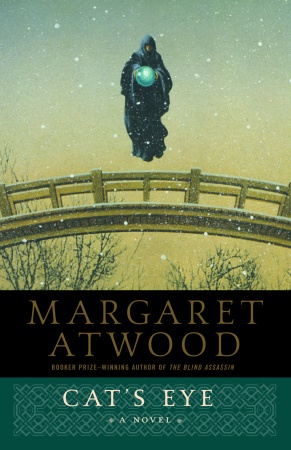
Cat's Eye, by Margaret Atwood: I'm not disappointed, per se, that this wasn't one of Atwood's science fiction offerings (and yes, no matter what Atwood tells us, she has written several science fiction novels). What I'm disappointed in, more or less, is just the story. According to the back cover of the paperback, Cat's Eye is about childhood female friendships and yeah, I suppose it is. Atwood shows the cattiness of girls and tells the story of an older woman who is a "controversial painter", although that part really does not matter, and she flashes back to her childhood and her friendships, such as they were. Actually, there are few true flashbacks because most of the novel is of the child. The perspective is given by the older woman. Cat's Eye just fails to engage or satisfy. There are four hundred or so pages, but they do not feel like they amount to anything or truly build towards anything. A disappointing effort by Margaret Atwood (whom I normally enjoy).
Oh, and that spooky image on the cover of Cat's Eye? The orb in question? It's a marble. How prosaic.
Tuesday, June 05, 2007
Private Detective Molly, by A. B. Goelman
Private Detective Molly
A.B. Goelman
Strange Horizons: June 4, 2007
From the first paragraph we know two things: Private Detective Molly is a science fiction story and it is a detective story with the feel of a pulp dime novel or a Marlowe (or Jonathan Lethem's Gun, With Occasional Music). The narrator is clearly a low rent detective who would be at home with the pulp gumshoes of yesteryear.
Private Detective Molly is pure pleasure to read. We’ve got a child doll programmed as a private detective trying to investigate why it was programmed as a private detective, all for another child and while obeying its programming regarding authority. An outstandingly entertaining story to read.
If A.B. Goelman has written anything else Private Detective Molly is strong enough to make me want to find it.
A.B. Goelman
Strange Horizons: June 4, 2007
From the first paragraph we know two things: Private Detective Molly is a science fiction story and it is a detective story with the feel of a pulp dime novel or a Marlowe (or Jonathan Lethem's Gun, With Occasional Music). The narrator is clearly a low rent detective who would be at home with the pulp gumshoes of yesteryear.
The first thing I see when the persona generator opens is the bedroom ceiling above me. It's a humid afternoon and the paint's peeling off the cracked plaster like some third-rate strip show. It's enough to make me want to stay in the generator.The initially unnamed Private Detective is given a case...why, when the little girl who owns a persona generator attempts to get "Debutante Molly", does she get Private Detective Molly? Private Detective Molly, the story, is loaded with that pulp feeling narration.
I freeze with my hand on the door. Sounds like she's giving me a case. I spin around and look up at her face. "You want me to figure out who froze your dial and why?"A.B. Goelman does two things extremely well in Private Detective Molly. Goelman hits the stylistic narration perfectly and he moves the story along at a brisk pace. Private Detective Molly is a clever twist on the detective story and is loaded with charm and personality.
She nods, tears welling up in her eyes. I'm a sucker for a crying girl. You can call it programming if you want, but I think it's Molly-Doll nature. Just like human nature, but a whole lot more decent.
Private Detective Molly is pure pleasure to read. We’ve got a child doll programmed as a private detective trying to investigate why it was programmed as a private detective, all for another child and while obeying its programming regarding authority. An outstandingly entertaining story to read.
If A.B. Goelman has written anything else Private Detective Molly is strong enough to make me want to find it.
Arrived: Steampunk Magazine #1

Today the first issue of Steampunk Magazine arrived in my mailbox. It was available for free online, and I do enjoy reading short fiction and essays and interviews online, but I do so very loathe reading PDFs. So, I up and ordered the premiere issue.
It's odd. I'm not really a big fan of Steampunk. I've read The Light Ages, which I'm pretty sure falls into the steampunk tradition, and it's not something that quite hits me. I was intrigued by the magazine. Offered for free online, or for cheap in print. I wanted something to hold in my hand if the alternative was to read a PDF.
The magazine itself is only $3, but I didn't take shipping into account and that brought the price up to $5.16. That's fine, but I could have ordered Electric Velocipede for the price, Subterranean, or a couple of other things.
So, I hope it's good. I'll be reviewing the stories and then giving an overview of my thoughts on the magazine itself with some discussion on the other features.
Iconic Covers...

Inspired by this thread on FantasyBookSpot regarding iconic covers in Fantasy. Jay wonders
what image pops up in your mind when you think of iconic cover from your experiences in Fantasy reading. What is that cover that just takes you back?For me, it is this one. Pawn of Prophecy is that book and is that cover (actually, The Eye of the World was my first thought, but the cover of Pawn of Prophecy is really the iconic fantasy book cover of my childhood, or at least my early teenaged years).
Monday, June 04, 2007
Best American Fantasy on NPR

The Ann and Jeff Vandermeer edited Best American Fantasy collection (series editor Matthew Cheney) was mentioned on NPR's All Things Considered today.
Interestingly enough, the recommendation didn't make the main broadcast, but rather is for the online readers. Kelly Link does read from her story "Origin Story" as an online excerpt.
I'm a little disappointed that the collection didn't get a full mention on the radio, but glad all the same that the collection did get focused online and that Kelly Link's reading is included, as well as what looks like might be the full text of the story (or not, I'm not sure, I've never read that story before).
I just gave the 9 minute story a second listen, no mention at all about the collection. Still, check out the website, listen to the Kelly Link excerpt and then enjoy this collection when it comes out.
locus covers small presses, too

This may be common knowledge, but since I only follow Locus Magazine through Bloglines, I may not read carefully enough. I noticed in the 16 new feeds I had from Locus this morning that Locus covers the Small SFF presses as well as the large. Actually, I shouldn't be surprised as Locus is a leading SFF magazine and there is some seriously good work coming off the small presses...but it did surprise me.
What really helped prove to me how much Locus is keeping on top of things...they had a mention of Prime Codex, the debut book from Paper Golem (of which I have a copy for a forthcoming review).
This month's Small Press news also highlights Softspoken, by Lucius Shepard, which I have at home from the library and eagerly anticipate reading, and Generation Loss by Elizabeth Hand.
I also see mention of several small publishers I had never heard of but now wish to find out more about: iUniverse (wow! Apparently this is a print on demand self publisher but it still got mentioned on Locus...), Sam's Dot (they seem to specialize in magazines, but I see several novels listed on Locus), Raw Dog Screaming Press, Haffner Press, Hippocampus Press (seems to specialize in horror type fiction), Avari Press (fantasy), A Midsummer Night's Press (genre poetry).
After going through all of these I'm rather impressed that there are quite a few small presses out there which I have never heard of. Good on them.
Sunday, June 03, 2007
magazines and misc
A list of magazines I currently read or plan on checking out in the near future. Some have free content online
Current Reads:
Subterranean Online: My current favorite. Consistently excellent stories.
Strange Horizons: I like, but hit or miss.
Clarkesworld: Two free stories a month.
Weird Tales: I subscribe and am waiting for the first issue to arrive (the next issue, 345, I believe)
To Check Out for Quality:
Electric Velocipede: I plan on purchasing a single issue and perhaps a chapbook.
Lady Churchill’s Rosebud Wristlet: I'll be ordering issue 20 (my first) in a while.
Subterranean Magazine - the print edition: I just ordered issue #4, the Scalzi cliche issue. $6, no shipping charge
Steampunk Magazine: I ordered issue #1 (they are currently at #2). The issue is only $3, but with shipping $5.16
Darker Matter : free online content.
Heliotrope: free online content, but in PDF format (PDFs don't make for good copy and paste to a word doc).
Hub Magazine
Kaleidotrope
Rabid Transit: Not a zine, but inexpensive chapbooks. Alan DeNiro is part of this whole series.
Anyone know of any other quality zines which provide free online content or are simply worth a few dollars to consider a single issue trial?
more library merger news
The Minneapolis Star-Tribune posted this article on May 31. The Governor dropped a line item veto on $4.5 million in state and local aid for the transition. Of course. He approved the merger, but isn't willing to pay for it.
Someone worried about layoffs on my last post. Now, I might be worried about layoffs because there will be less funds to smooth out the transition.
Someone worried about layoffs on my last post. Now, I might be worried about layoffs because there will be less funds to smooth out the transition.
The mayor of Minneapolis expresses his disappointment.Hennepin County Commissioner Peter McLaughlin said that, without state funds, its unclear how the city and county will pay for the transition to a merged library computer system.
"We're going to go forward," McLaughlin said Thursday. "I think it makes the seas choppier, that's for sure. But I don't think it torpedoes it."
Hopefully the merger can still come together seamlessly and all city and county employees can keep their jobs."It's a one-two punch. An incredibly tough blow," a frustrated Minneapolis Mayor R.T. Rybak said Thursday after losing more than $13 million in expected state aid in addition to the library transition funding.
"I've heard the governor talk about streamlining government to deliver better services; well, this goes against everything he says," Rybak added. "It's hypocrisy."
Saturday, June 02, 2007
Ex Machina, by Margaret Ronald
Ex Machina
Margaret Ronald
Strange Horizons: May 28, 2007
A band of tinkers travel up a mountain following a call which only they can hear. They are seeking a particular building in a valley, but get sidetracked by helping others fix their mechanical equipment. On the mountain they stop at Hollow Base, a military base, and work on equipment there. Judith, the "lead" tinker who claims to not be in charge, is the focus of the story. She tries not to be overwhelmed by her "techsense", which is when all of the details of the technology flashes through her mind to the exclusion of everything else. Certain tinkers are gifted with this "techsense". Judith is warned that the commander is not what he seems to be.
Ex Machina is not the most outstanding story we will read in any given year, but the last nine of the eighteen pages make the story worth reading. There is no true explanation of what techsense is or how it works, but we just have to take it as something that does not need any more explanation other than the fact that it does work. Decent story.
Margaret Ronald
Strange Horizons: May 28, 2007
A band of tinkers travel up a mountain following a call which only they can hear. They are seeking a particular building in a valley, but get sidetracked by helping others fix their mechanical equipment. On the mountain they stop at Hollow Base, a military base, and work on equipment there. Judith, the "lead" tinker who claims to not be in charge, is the focus of the story. She tries not to be overwhelmed by her "techsense", which is when all of the details of the technology flashes through her mind to the exclusion of everything else. Certain tinkers are gifted with this "techsense". Judith is warned that the commander is not what he seems to be.
The room was as bare as the rest of the base, though there were a few traces of personality. Several stools lined one wall, facing the broad desk and its cushioned chair. A broken base station for the communicators trailed wires over the top of the cabinet. Judith bit her lip. Exhaustion and techtrance gnawed at her, and the urge to take the damn thing down and fix it swelled like hunger in her.Ex Machina is a story not about technology, but about those who can truly understand technology and how technology can be misused in the hands of those looking only for personal greed. The first couple pages are tough because the reader attempts to figure out what this techsense is what the main thrust of the story is. Ex Machina only picks up and becomes more immediate midway through the story when Judith and the Tinkers are spending their first night at Hollow Base. At this point more of what is truly occurring becomes clear and the threat is realized.
"He could come back at any minute," she muttered aloud. On the other hand, her techsense whispered, better to do it now than succumb in the middle of a conversation. . . .
She could even see where it was broken. . . .
Ex Machina is not the most outstanding story we will read in any given year, but the last nine of the eighteen pages make the story worth reading. There is no true explanation of what techsense is or how it works, but we just have to take it as something that does not need any more explanation other than the fact that it does work. Decent story.
May 2007 Reading
1. Aztechs - Lucius Shepard
2. A Thousand Deaths - George Alec Effinger
3. Agents of Chaos II: Jedi Eclipse - James Luceno
4. Spring Broke - Nathaniel Welch
5. Shadow Games - Glen Cook
6. Starship: Mutiny - Mike Resnick
7. Blowing My Cover - Lindsay Moran
8. In the Garden of Iden - Kage Baker
9. Into a Dark Realm - Raymond E. Feist
10. Balance Point - Kathy Tyers
11. The Sportswriter - Richard Ford
12. The Astonishing X-Men: Torn - Joss Whedon
13. The Last Colony - John Scalzi
14. The Naked God: Flight - Peter F. Hamilton
Best Book(s) of the Month: Shadow Games, Blowing My Cover. – There’s just something about a good Black Company novel which just satisfies.
Worst Book of the Month: Balance Point
Pleasant Surprise of the Month: Starship: Mutiny – Outside of a Hugo nominated story, this was my first taste of Mike Resnick’s work. I’d probably call this a science fiction beach read, but there’s nothing wrong with that. Good science fiction fun. Made me smile.
Disappointment of the Month: The Sportswriter
Scalzi of the Month: The Last Colony – What? I can’t call out work by one of my favorite authors?
For those keeping score at home, The Naked God: Flight was book #96 for the year.
Subscribe to:
Posts (Atom)