Yesterday I hit up Uncle Hugo's for the first time in a couple of months and while I didn't have luck in finding the quite rare and expensive Death Draws Five (the only Wild Cards book I don't own), or the next volumes in sequence from Steven Brust (Vlad Taltos series) or Glen Cook (Garrett PI series), I did find some goodness.
First, and most importantly, is a hardcover of Again, Dangerous Visions. I picked up a hardcover of Dangerous Visions a year ago and I said then that if I found a HC of the second volume I'd grab it. And so I did.
Then, I also purchased paperbacks of Sheri S. Tepper's Grass and Hominids from Robert Sawyer.
Sunday, May 23, 2010
Wednesday, May 19, 2010
Night Shade to launch Pugilist Press
Night Shade Books is pleased to announce the creation of Pugilist Press, a new imprint that will focus exclusively on contemporary literary fiction with an edge. Night Shade founder Jason Williams will act as publisher and acclaimed editor Juliet Ulman will serve as editor-in-chief.Source.
“Over the past twelve years, Night Shade Books has established itself as one of the leading publishers of fantasy, science fiction and horror, with stable of authors who have been critically hailed for breaking new ground in their genre,” said Williams. “We’re ready now to bring that ground-breaking vision into the mainstream; with Juliet on board, we hope to become the preeminent home for literary fiction that packs a punch.”
[...]
“What we’re looking for is tough literary fiction with a certain honesty and texture to it,” Ulman explained. “Think Cormac McCarthy, Harry Crewes, Gustav Hasford, Lionel Shriver, Dennis Lehane, Ernest Hemingway. Writers whose stories are extremely well-crafted, but who deal in a narrative style and subject matter that is direct, gritty, and often painful. Those are the voices that Pugilist hopes to bring to market.”
Awesome. On the heels of The Windup Girl winning the Nebula Award for Best Novel, Night Shade announced the creation of a new, lit-fic imprint. First, this means they are doing well enough to expand. Second, they have a focus for the direction they want to take this imprint and with the names they are using to describe what they want to do, I think Pugilist Press is going to be one to watch.
It doesn't hurt that Night Shade itself should be considered one of the premier science fiction and fantasy publishers and brings that pedigree to this new venture.
I'll be looking to see what Pugilist Press brings out in 2011 and beyond.
Monday, May 17, 2010
Regenesis, by C. J. Cherryh

Regenesis
C. J. Cherryh
DAW: 2009
“Who killed Ariane Emory?”
That is the question readers are told to expect the answer to, and depending on how long ago one last read Cyteen, it is an answer many readers have been waiting to learn for up to twenty years. The murder of Ariane Emory was a central and pivotal event in Cyteen and the identity of the killer was the main lingering question from that novel.
Jo Walton had a post on Tor.com about the murder, in preparation for reading Regenesis for the first time. Then, she read the book and was wholly unsatisfied with the answer to the question and somewhat with the book itself.
Readers familiar with Cyteen can be assured that the question of who killed Ariane Emory will be answered in Regenesis. They cannot be assured that they will like the answer.
While “Who killed Ariane Emory” is presented as being the central question of Regenesis, I am not entirely sure that the answer matters. Oh, it matters from a sociological perspective because the “why” is more important than the “who” because the murderer was never apprehended or identified and is, possibly, still alive and at large twenty years later when Ariane Emory II, the clone of Ariane Emory Senior, is maturing and coming into her own power – power that will eventually be the Directorship of Reseune itself. Ari II is constantly at risk, both personally and politically and the “why” of Ariane Senior’s murder may be vital to her Ari II’s survival.
The core of Regenesis, however, is not specifically about uncovering the answer to that question. The core of Regenesis is a brief period in the life of Ariane Emory II and her associates as she comes into public power and authority and attempts to navigate an extraordinarily complicated and perilous political situation on Cyteen.
Regenesis is a novel of conversation about power, about genetics, about family, and about ambition (among other things). The most thrilling passages were long conversations between two characters (often Ari and Yanni) that could come across as massive info dumps but still manage to convey tense political drama and danger. Because Cherryh frequently presents the third person limited perspective of Ari, the reader knows that a wrong answer could lead Ari down a path where she needs to eliminate (in some manner) the other person. Tense.
This is not an action laden novel and there are only a few scenes that could be construed as “action” or even just physically tense. So much of Regenesis is built into the psychology of the people in Ari II’s personal orbit and this is where the drama lies. Will the younger Ariane live long enough to assume the power of Ariane Senior? Will she be able to continue to find her own path or will circumstances turn her as cold as Ariane I could be? Will history repeat itself?
The cloning of Ariane and a couple of other individuals suggest that, at the very least, the people in charge of Reseune believe in the Great Man Theory and that these individuals are inherently important to society and that without them, their world will falter.
This is an interesting theory and a way to consider the actions of Reseune. Are they right?
Regenesis is a worthy sequel to Cyteen and while it does answer the question of who killed Ariane Emory, the reason to read this novel is to follow Ari as she begins to assume power in Reseune in her own right. One more thing that is interesting here is that there are passages where Ari II is recording messages for the someday to come Ariane III on the assumption that the cloning program will continue and that, perhaps, the next clone will be based on Ari II and not off Ari I (part of the process is nurturing the replicant with as identical an upbringing to the original as possible).
One can only hope that there will be a third novel in this sequence and that it will focus on a more mature Ariane II (and not jump ahead to Ari III, Cherryh has done Ariane’s coming of age already now). Surely there is a novel in seeing how she changes and how she exercises her power. If it is safe to hope for a third novel, we can only hope that it will not take another twenty years.
Previous Reviews
Cyteen
Forty Thousand in Gehenna
Saturday, May 15, 2010
2010 Nebula Award Winners
Via SF Awards Watch (and watching it live), here are the winners of the 2010 Nebula Awards.
Thanks also to John Ottinger, because if I didn't see his post linking the UStream site, I would have watched via the SFWA site and missed a great chat. Folks, you've got to tell me about this stuff.
Novel
The Windup Girl, by Paolo Bacigalupi (Night Shade Books, Sep09)
Novella
The Women of Nell Gwynne’s, by Kage Baker (Subterranean Press, Jun09)
Novelette
“Sinner, Baker, Fabulist, Priest; Red Mask, Black Mask, Gentleman, Beast”, by Eugie Foster (Interzone, Feb09)
Short Story
“Spar”, Kij Johnson (Clarkesworld, Oct09)
The Ray Bradbury Award for Outstanding Dramatic Presentation
“ District 9” Neill Blomkamp and Terri Tatchell (Tri-Star, Aug09)
Andre Norton Award
The Girl Who Circumnavigated Fairyland in a Ship of Her Own Making, by Catherynne M. Valente (Catherynne M. Valente, Jun09)
From top to bottom, this was easily the most stacked lineup I have seen since I've been following the award (which would be about three or four years, if I'm being honest).
Congratulations to ALL the winners, but especially Kij Johnson and Cat Valente for their extra-awesomeness. Read "Spar". Really.
Thanks also to John Ottinger, because if I didn't see his post linking the UStream site, I would have watched via the SFWA site and missed a great chat. Folks, you've got to tell me about this stuff.
Novel
The Windup Girl, by Paolo Bacigalupi (Night Shade Books, Sep09)
Novella
The Women of Nell Gwynne’s, by Kage Baker (Subterranean Press, Jun09)
Novelette
“Sinner, Baker, Fabulist, Priest; Red Mask, Black Mask, Gentleman, Beast”, by Eugie Foster (Interzone, Feb09)
Short Story
“Spar”, Kij Johnson (Clarkesworld, Oct09)
The Ray Bradbury Award for Outstanding Dramatic Presentation
“ District 9” Neill Blomkamp and Terri Tatchell (Tri-Star, Aug09)
Andre Norton Award
The Girl Who Circumnavigated Fairyland in a Ship of Her Own Making, by Catherynne M. Valente (Catherynne M. Valente, Jun09)
From top to bottom, this was easily the most stacked lineup I have seen since I've been following the award (which would be about three or four years, if I'm being honest).
Congratulations to ALL the winners, but especially Kij Johnson and Cat Valente for their extra-awesomeness. Read "Spar". Really.
oh, crap, Nebulas!
I am a bad, bad blogger. Bad.
Normally I will have copious award coverage with a bunch of reviews and posts giving an overview of each category. I managed several story posts, but only one overview. I thought the awards were to be given tomorrow night and i could may quick knock out the story categories, but alas. It is tonight.
I'll post the winners and good luck to all the nominees.
I should be more focused for the Hugos and the World Fantasy Awards.
Normally I will have copious award coverage with a bunch of reviews and posts giving an overview of each category. I managed several story posts, but only one overview. I thought the awards were to be given tomorrow night and i could may quick knock out the story categories, but alas. It is tonight.
I'll post the winners and good luck to all the nominees.
I should be more focused for the Hugos and the World Fantasy Awards.
Thursday, May 13, 2010
Dragon Prince, by Melanie Rawn

Dragon Prince
Melanie Rawn
1988
I have love in my heart for a good number of fantasy novels and series I read in my youth. They were the gateway drugs into a lifetime of reading epic fantasy and into other branches of science fiction and fantasy. Among those novels so important to my teenage years, Melanie Rawn’s Dragon Prince holds a special place of distinction. It has been more than ten years since I last cracked the cover of one of Melanie Rawn’s novels and visited my old friends Rohan and Sioned, since I read Skybowl, the conclusion to the second trilogy and the last time Rawn has given readers entry into this deeply drawn world.
Would the novel hold up to the esteem time and memory have given it? Would I still be so inclined to read the other five novels set in this world?
The short answer is yes.
Oh, and the cover art? That cover is the reason I pay attention to cover art and who the artist is. Michael Whelan’s cover is striking and it made the younger me take notice of his work. I also remember Whelan’s work with Meat Loaf’s Bat Out of Hell II album. They are inextricably linked in my memory.
One thing to note: there is an excellent chance of spoilers in the below conversation. This is my re-read and not whatever I might consider to be a “proper” review. If you are looking to avoid being spoiled for certain events of the novel AND the series (though I’ll try to limit series spoilers), please just know that I think Dragon Price is a fantastic novel and that it remains one of my favorites of the genre, and that you should probably go read it now.
So. Shall we?
Melanie Rawn is not a writer afraid to do terrible things to her characters; her heroes in particular. Let’s just get this out of the way from the start: bad things happen to the characters we care about, and sometimes they do bad things themselves. Dragon Prince opens with concepts of black and white and gradually shades greyer and greyer as the novel progresses. It isn’t so much that the concepts of “Right” and “Wrong” are in question, but that the question of whether it is sometimes necessary to do what is wrong to accomplish a greater good arises. This is made stark late in the novel when, despite all of his dreams and visions for a better future, Rohan is confronted with his capacity for barbarism while still holding to a dream of a more civilized world.
Much of Dragon Prince is a political dance as, through the first half of the novel, Rohan plays the simpleton to gain concessions from the High Prince Roelstra and cleverly builds advantage for the Desert.
Roelstra, it must be said, is one of the great villains of fantasy literature. His primary concern is power, whether it is exercising it over vassals, coercing others, or acquiring more by devious means, Roelstra is about power and he is not a benevolent ruler. This puts Roelstra in stark contrast with Rohan. Rohan wishes to build peace by law and ultimately change the political power structure of the land, but every step Rohan needs to make he knows that Roelstra will oppose.
This conflict is one of the two primary conflicts of the novel. The second is Rohan’s internal conflict of his desire to be a good man and his growing realization of what he will do to make his world a better place.
One of the more impressive aspects of the novel, besides the parts in between the front and back covers, is the magic system Melanie Rawn developed here. Now, I am not normally one to talk about magic and how it works and how it plays into the novel, but this is fairly inventive. It isn’t called “magic”, but the people with special talents are called Sunrunners. They are able to weave part of their consciousness on the sunlight, communicate over long distances, and use the light of the sun in a variety of other ways. The faradhi are specially trained emissaries to each Princedom and work and serve all over the continent. They report back to Lady Andrade at the Goddess Keep, and with a network of faradhi who can communicate by sunlight, Andrade attempts to manipulate Princes and protect her people and her family.
Dragon Prince is a very strong, powerful, and thrilling debut novel from Melanie Rawn. There is battle, but the beauty of Dragon Prince is in the political scheming at the Rialla and in the goals of Prince Rohan. Power and how it is used is a central concept to Dragon Prince and Melanie Rawn explores it well. This should be considered a must read novel for all fans of fantasy.
One final thing to note is that the trade paper edition of Dragon Prince seems to have done away with the genealogies and extra information I remember fondly from the mass market edition of my youth. I mourn the loss.
Wednesday, May 12, 2010
Thoughts on Nebula Award Nominees: Novels
The Windup Girl, Paolo Bacigalupi (Nightshade)
The Love We Share Without Knowing, Christopher Barzak (Bantam)
Flesh and Fire, Laura Anne Gilman (Pocket)
The City & The City, China Miéville (Del Rey)
Boneshaker, Cherie Priest (Tor)
Finch, Jeff VanderMeer (Underland Press)
With the Nebula Awards to be presented this coming weekend, it is time to start discussing the nominees. We’ll start with the novels because there is no chance I will get to the two I haven’t yet read: Flesh and Fire, and The City & The City. Given that China Mieville’s novel is working on sweeping every genre award it is eligible for, this is the one novel from 2009 which I need to read this year. It is also nominated for the Hugo. I wouldn’t be surprised at this point if it picks up a World Fantasy Award nomination as well. I don’t know anything about Laura Anne Gilman’s novel. I had it out from the library and I ended up returning it unread.
Otherwise, this will be in reverse order of my esteem.
The Love We Share Without Knowing: Stylistically, Christopher Barzak’s novel has more in common with the Lit Fic genre (and Lit Fic can be considered a genre) than it does with the other novels in this category. Barzak touches on feelings of loneliness and isolation in Japan with the cast of characters including both native Japanese and various expatriates. The focus is on the inner life of the characters and quiet interactions. The action is internal.
For whatever reason, and it may have to do with when I read the book, The Love We Share Without Knowing left me empty and not at all interested in the lives and problems of the characters. At no point did I want to know more or care to find out what happened next. This may say more about me than the book, but that’s the reaction.
The Windup Girl: This novel has garnered nominations for the Nebula and Hugo Awards. Paolo Bacigalupi has been praised as being one of the most important new writers working today. I can see why his work is admired and praised, but that is a very different thing than something I like, something I would recommend. The Windup Girl is an impressive work of imagination, but it fails to satisfy.
Boneshaker: (my review) I am just a little bit sad to not select Boneshaker as my choice for the Nebula because I absolutely adore Cherie Priest’s fiction. Boneshaker is one of the standout novels of last year and this spin through a zombie-infested Seattle that-never-was is a superior adventure. Boneshaker is highly recommended and would be my choice for the Nebula if not for…
Finch: (my review) The more distance I get from reading Finch, the more I like it, and I liked it plenty at first blush. VanderMeer’s Ambergris is a nasty place and anytime I talk about the book I want to talk about how VanderMeer is able to convey the fungal rot of the city so perfectly that the reader can almost taste it in the back of her mouth. Finch is a fantastic novel about a detective in the dying city and it demands to be read.
So there we have it. In all honestly, I can see the winner being Boneshaker, The City & The City, or The Windup Girl. I’d love to see Finch pick up the Nebula, but I just haven’t seen as much online conversation about Finch.
The Love We Share Without Knowing, Christopher Barzak (Bantam)
Flesh and Fire, Laura Anne Gilman (Pocket)
The City & The City, China Miéville (Del Rey)
Boneshaker, Cherie Priest (Tor)
Finch, Jeff VanderMeer (Underland Press)
With the Nebula Awards to be presented this coming weekend, it is time to start discussing the nominees. We’ll start with the novels because there is no chance I will get to the two I haven’t yet read: Flesh and Fire, and The City & The City. Given that China Mieville’s novel is working on sweeping every genre award it is eligible for, this is the one novel from 2009 which I need to read this year. It is also nominated for the Hugo. I wouldn’t be surprised at this point if it picks up a World Fantasy Award nomination as well. I don’t know anything about Laura Anne Gilman’s novel. I had it out from the library and I ended up returning it unread.
Otherwise, this will be in reverse order of my esteem.
The Love We Share Without Knowing: Stylistically, Christopher Barzak’s novel has more in common with the Lit Fic genre (and Lit Fic can be considered a genre) than it does with the other novels in this category. Barzak touches on feelings of loneliness and isolation in Japan with the cast of characters including both native Japanese and various expatriates. The focus is on the inner life of the characters and quiet interactions. The action is internal.
For whatever reason, and it may have to do with when I read the book, The Love We Share Without Knowing left me empty and not at all interested in the lives and problems of the characters. At no point did I want to know more or care to find out what happened next. This may say more about me than the book, but that’s the reaction.
The Windup Girl: This novel has garnered nominations for the Nebula and Hugo Awards. Paolo Bacigalupi has been praised as being one of the most important new writers working today. I can see why his work is admired and praised, but that is a very different thing than something I like, something I would recommend. The Windup Girl is an impressive work of imagination, but it fails to satisfy.
Boneshaker: (my review) I am just a little bit sad to not select Boneshaker as my choice for the Nebula because I absolutely adore Cherie Priest’s fiction. Boneshaker is one of the standout novels of last year and this spin through a zombie-infested Seattle that-never-was is a superior adventure. Boneshaker is highly recommended and would be my choice for the Nebula if not for…
Finch: (my review) The more distance I get from reading Finch, the more I like it, and I liked it plenty at first blush. VanderMeer’s Ambergris is a nasty place and anytime I talk about the book I want to talk about how VanderMeer is able to convey the fungal rot of the city so perfectly that the reader can almost taste it in the back of her mouth. Finch is a fantastic novel about a detective in the dying city and it demands to be read.
So there we have it. In all honestly, I can see the winner being Boneshaker, The City & The City, or The Windup Girl. I’d love to see Finch pick up the Nebula, but I just haven’t seen as much online conversation about Finch.
Tuesday, May 04, 2010
Elizabeth Bear interviewed at Clarkesworld
In honor of my copy of Bone and Jewel Creatures appearing in my mailbox today, here is an interview with Elizabeth Bear over at Clarkesworld Magazine.
2010 Hugo Voter Packet Available
Via John Scalzi
Folks, if you're a member of this year's Worldcon (or were thinking of becoming one so you can vote for the Hugos), the Voters Packet has been put together and it looks hella complete with just about everything on the ballot.
Again, from Scalzi, here is what the voter's packet includes:
Now, I haven't compared this to the actual ballot, but please note that this reflects what is included, not necessarily the full ballot (but damn, it looks like the full ballot of written works).
I have access to much of the short fiction, but the chance to have all this in one place is just wonderful. While the cost to become a supporting member isn't all that high (something like $50 or $60), it might be just a hair too expensive for some. BUT! Look at what you get for your money.
The print edition of the Jack Vance book is $40. Hope-in-the-Mist is completely sold out. And - you get six full novels. There's value here, folks. Lots of goodness.
Folks, if you're a member of this year's Worldcon (or were thinking of becoming one so you can vote for the Hugos), the Voters Packet has been put together and it looks hella complete with just about everything on the ballot.
Again, from Scalzi, here is what the voter's packet includes:
First thing first: This year’s Hugo Voter’s Packet is the most complete ever, to help every AussieCon4 member make an informed vote on the Hugos. In the packet this year you’ll find electronic versions of the following:
Best Novel
* Boneshaker by Cherie Priest (Tor)
* The City & The City by China Miéville (Del Rey; Macmillan UK)
* Julian Comstock: A Story of 22nd-Century America by Robert Charles Wilson (Tor)
* Palimpsest by Catherynne M. Valente (Bantam Spectra)
* Wake by Robert J. Sawyer (Ace; Penguin; Gollancz; Analog)
* The Windup Girl by Paolo Bacigalupi (Night Shade)
Best Novella
* “Act One” by Nancy Kress (Asimov’s 3/09)
* The God Engines by John Scalzi (Subterranean)
* “Palimpsest” by Charles Stross (Wireless; Ace; Orbit)
* Shambling Towards Hiroshima by James Morrow (Tachyon)
* “Vishnu at the Cat Circus” by Ian McDonald (Cyberabad Days; Pyr; Gollancz)
* The Women of Nell Gwynne’s by Kage Baker (Subterranean)
Best Novelette
* “Eros, Philia, Agape” by Rachel Swirsky (Tor.com 3/09)
* “The Island” by Peter Watts (The New Space Opera 2; Eos)
* “It Takes Two” by Nicola Griffith (Eclipse Three; Night Shade Books)
* “One of Our Bastards is Missing” by Paul Cornell (The Solaris Book of New Science Fiction: Volume Three; Solaris)
* “Overtime” by Charles Stross (Tor.com 12/09)
* “Sinner, Baker, Fabulist, Priest; Red Mask, Black Mask, Gentleman, Beast” by Eugie Foster (Interzone 2/09)
Best Short Story
* “The Bride of Frankenstein” by Mike Resnick (Asimov’s 12/09)
* “Bridesicle” by Will McIntosh (Asimov’s 1/09)
* “The Moment” by Lawrence M. Schoen (Footprints; Hadley Rille Books)
* “Non-Zero Probabilities” by N.K. Jemisin (Clarkesworld 9/09)
* “Spar” by Kij Johnson (Clarkesworld 10/09)
Best Related Work
* Canary Fever: Reviews by John Clute (Beccon) (Excerpt)
* Hope-In-The-Mist: The Extraordinary Career and Mysterious Life of Hope Mirrlees by Michael Swanwick (Temporary Culture)
* The Inter-Galactic Playground: A Critical Study of Children’s and Teens’ Science Fiction by Farah Mendlesohn (McFarland) (Excerpt)
* On Joanna Russ edited by Farah Mendlesohn (Wesleyan)
* The Secret Feminist Cabal: A Cultural History of SF Feminisms by Helen Merrick (Aqueduct) (Excerpt)
* This is Me, Jack Vance! (Or, More Properly, This is “I”) by Jack Vance (Subterranean)
Best Graphic Story
* Batman: Whatever Happened to the Caped Crusader? Written by Neil Gaiman; Pencilled by Andy Kubert; Inked by Scott Williams (DC Comics)
* Captain Britain And MI13. Volume 3: Vampire State Written by Paul Cornell; Pencilled by Leonard Kirk with Mike Collins, Adrian Alphona and Ardian Syaf (Marvel Comics) (Link to issues #10 and #11)
* Fables Vol 12: The Dark Ages Written by Bill Willingham; Pencilled by Mark Buckingham; Art by Peter Gross & Andrew Pepoy, Michael Allred, David Hahn; Colour by Lee Loughridge & Laura Allred; Letters by Todd Klein (Vertigo Comics)
* Girl Genius, Volume 9: Agatha Heterodyne and the Heirs of the Storm Written by Kaja and Phil Foglio; Art by Phil Foglio; Colours by Cheyenne Wright (Airship Entertainment) (Link)
* Schlock Mercenary: The Longshoreman of the Apocalypse Written and Illustrated by Howard Tayler
Best Semiprozine
* Ansible edited by David Langford (Links)
* Clarkesworld edited by Neil Clarke, Sean Wallace, & Cheryl Morgan
* Interzone edited by Andy Cox
* Locus edited by Charles N. Brown, Kirsten Gong-Wong, & Liza Groen Trombi
* Weird Tales edited by Ann VanderMeer & Stephen H. Segal
Best Fanzine
* Argentus edited by Steven H Silver
* Banana Wings edited by Claire Brialey & Mark Plummer
* CHALLENGER edited by Guy H. Lillian III (Link)
* Drink Tank edited by Christopher J Garcia, with guest editor James Bacon
* File 770 edited by Mike Glyer
* StarShipSofa edited by Tony C. Smith (Links)
Best Professional Artist
Package includes works by:
* Bob Eggleton
* Stephan Martiniere
* John Picacio
* Daniel Dos Santos
* Shaun Tan
Best Fan Artist
Package includes works by:
* Brad W. Foster (Link)
* Dave Howell
* Steve Stiles
* Taral Wayne
Best Fan Writer
Package includes works by:
* Claire Brialey
* Christopher J Garcia
* James Nicoll
* Lloyd Penney
* Frederik Pohl (Link)
The John W. Campbell Award for Best New Writer
Package includes works by:
* Saladin Ahmed
* Gail Carriger
* Felix Gilman
* Seanan McGuire
* Lezli Robyn
Now, I haven't compared this to the actual ballot, but please note that this reflects what is included, not necessarily the full ballot (but damn, it looks like the full ballot of written works).
I have access to much of the short fiction, but the chance to have all this in one place is just wonderful. While the cost to become a supporting member isn't all that high (something like $50 or $60), it might be just a hair too expensive for some. BUT! Look at what you get for your money.
The print edition of the Jack Vance book is $40. Hope-in-the-Mist is completely sold out. And - you get six full novels. There's value here, folks. Lots of goodness.
Monday, May 03, 2010
Finder
Via Publisher's Weekly, Dark Horse to publish Carla Speed McNeil's Finder.
Interesting news, and welcome. I found a copy of the first TPB sometime last year and have somehow managed to not read it. I’ve been interested in Finder for a while now and this should give me just enough push to give it a shot. Awesome for Carla Speed McNeil to get Dark Horse to commit to her self-published series.
Interesting news, and welcome. I found a copy of the first TPB sometime last year and have somehow managed to not read it. I’ve been interested in Finder for a while now and this should give me just enough push to give it a shot. Awesome for Carla Speed McNeil to get Dark Horse to commit to her self-published series.
Wednesday, April 28, 2010
Nebula Award Nominee: "Vinegar Peace"
“Vinegar Peace, or, The Wrong-Way Used-Adult Orphanage”
Michael Bishop
Asimov’s: July 2008
Nominated for the Nebula Award: Novelette
Does knowing the barest hint of the author’s real life influence one’s reading of a story? I think it does, and it can color that reading to the point that you can’t be sure if your reading is fully textual or inferred from what little you know of the author. Is the author saying what you think he is saying? Is the story a commentary on his real life or, not?
That’s what I think about when reading “Vinegar Peace”. Very early on the reader is told
Note that I’m talking around the story. There’s a reason for that. As a story, divorced from any wondering about where it came from, I was completely disinterested in “Vinegar Peace”. I don’t see the appeal or what the Nebula nominators saw in the story, and the weird journey through that new adult orphanage failed to peak my interest.
So, beyond acknowledging the existence of the story on the Nebula ballot, and perhaps unfairly overthinking how “Vinegar Peace” relates to the author’s personal loss and grief (for which Mr. Bishop has my deepest sympathies), I find nothing to say *about* the story itself. All of my questions and thoughts circle the story without getting at the actual text because I have no interest in the text.
Michael Bishop
Asimov’s: July 2008
Nominated for the Nebula Award: Novelette
Does knowing the barest hint of the author’s real life influence one’s reading of a story? I think it does, and it can color that reading to the point that you can’t be sure if your reading is fully textual or inferred from what little you know of the author. Is the author saying what you think he is saying? Is the story a commentary on his real life or, not?
That’s what I think about when reading “Vinegar Peace”. Very early on the reader is told
If you know that Michael Bishop’s son Jamie was killed in 2007, how do you read this story? Do you read it straight, or is metaphor for the experience of a grieving parent? Is it fair to read “Vinegar Peace” in that manner?
That’s why they call it a Wrong-Way, Used-Adult Orphanage, he says. You get into one not because you’ve lost a parent. Your last living child has to die.
Note that I’m talking around the story. There’s a reason for that. As a story, divorced from any wondering about where it came from, I was completely disinterested in “Vinegar Peace”. I don’t see the appeal or what the Nebula nominators saw in the story, and the weird journey through that new adult orphanage failed to peak my interest.
So, beyond acknowledging the existence of the story on the Nebula ballot, and perhaps unfairly overthinking how “Vinegar Peace” relates to the author’s personal loss and grief (for which Mr. Bishop has my deepest sympathies), I find nothing to say *about* the story itself. All of my questions and thoughts circle the story without getting at the actual text because I have no interest in the text.
Monday, April 26, 2010
upcoming stuff
I've been a bad blogger lately, but I do have some stuff I plan to get up in the near future.
I should have a post on my re-read of Dragon Prince. It is half written and it's fixing to be a long one. I'll also have reviews of Starship: Flagship and The Shadow Pavilion, and then some very brief thoughts on The Windup Girl to resume my award posting.
I expect to talk about the steampunk issue of Weird Tales that recently arrived in my mailbox.
Elizabeth Bear's Bone and Jewel Creatures should hopefully be showing up any day now. I'm pumped to read this one. I also have a shiny new ARC of Mary Robinette Kowal's debut novel Shades of Milk and Honey.
Oh, and Aaron Wilson, he of the former Soulless Machine Review blog, has a nasty little flash fiction story up called "Dog Fight". Gotta support my Minnesota peeps, plus, I like the story.
And, since I'm supporting local peeps and friends - keep the name Kelly Barnhill in the back of your minds for next year. Kelly has her debut YA novel from Little, Brown AND her first (of many, I hope) short story collection from PS Publishing both set to come out next year. Woo!
I should have a post on my re-read of Dragon Prince. It is half written and it's fixing to be a long one. I'll also have reviews of Starship: Flagship and The Shadow Pavilion, and then some very brief thoughts on The Windup Girl to resume my award posting.
I expect to talk about the steampunk issue of Weird Tales that recently arrived in my mailbox.
Elizabeth Bear's Bone and Jewel Creatures should hopefully be showing up any day now. I'm pumped to read this one. I also have a shiny new ARC of Mary Robinette Kowal's debut novel Shades of Milk and Honey.
Oh, and Aaron Wilson, he of the former Soulless Machine Review blog, has a nasty little flash fiction story up called "Dog Fight". Gotta support my Minnesota peeps, plus, I like the story.
And, since I'm supporting local peeps and friends - keep the name Kelly Barnhill in the back of your minds for next year. Kelly has her debut YA novel from Little, Brown AND her first (of many, I hope) short story collection from PS Publishing both set to come out next year. Woo!
Wednesday, April 21, 2010
Rule Number Two, by Dr. Heidi Squier Kraft

Rule Number Two
Dr. Heidi Squier Kraft
Little, Brown: 2007
Rule Number Two is sort of my counterpoint to Mass Casualties. Both are memoirs from the medical personnel serving in Iraq. Mass Casualties was from an Army surgeon, Rule Number Two from a Navy psychologist serving as part of a Combat Stress unit. This is just about as far as the two memoirs are similar because where Mass Casualties was personal to the author, Dr. Heidi Squier Kraft’s account is able to bring the emotion of service home to the reader.
The title “Rule Number Two” refers to an episode of MASH where Henry explains to Hawkeye that “when he went to school for commanding officers, he learned that there are two rules of war. Rule number one is that young men die. Rule number two is that doctors can’t change rule number one.” (pg 133)
Dr. Kraft realizes that there may a third rule left unspoken. “War damages doctors, too. They are damaged by rule number two.” (pg 134)
This is the heart of Rule Number Two, the striving to heal and save Kraft’s fellow soldiers and the struggle to remain whole herself.
The seven months of Dr. Kraft’s service brings home both the pride of her service as well as the physical and emotional challenges of her service. Combat Stress brings comfort to the Marines through the trials of tragedy and trauma. Several times Dr. Kraft mentions how the Marines rely on and take care of their doctors, but she makes a point that as important as the Navy doctors are to the Marines, the Marines are equally as important to the Navy docs. These are HER Marines.
Through quick paragraphs every few chapters, Rule Number Two gives readers glimpses into the home life Dr. Kraft left behind to service in Iraq. She left fifteen month old twins in the care of her husband and her parents. These passages are poignant because as restrained as Dr. Kraft is with expressing just how she felt due to the separation, the e-mails from home frames everything else in her narrative.
Rule Number Two is a superior memoir and should be considered a must-read account of service in Iraq. Dr. Kraft brings a non-combat perspective to the reader and she does so with grace and skill.
Monday, April 19, 2010
March 2010 Reading
Okay. I'm way late in getting this post up.
Here's my monthly wrap-up of what I read the previous month. Links, as always, go to the reviews.
Books
24. Teckla, by Steven Brust
25. Starship: Flagship, by Mike Resnick
26. Once a Runner, by John L. Parker, Jr.
27. What I Talk About When I Talk About Running, by Haruki Murakami
28. The Pluto Files, by Neil DeGrasse Tyson
29. The Windup Girl, by Paolo Bacigalupi
30. The Shadow Pavilion, by Liz Williams
31. The Runner’s Rule Book, by Mark Remy
32. Misery, by Stephen King
33. Personal Record, by Rachel Toor
34. Judas Unchained, by Peter F. Hamilton
35. Horns, by Joe Hill
36. The Warded Man, by Peter V. Brett
Graphic Novels
30. The Umbrella Academy: Dallas, by Gerard Way
31. The Walking Dead: The Calm Before, by Robert Kirkman
32. Criminal: The Dead and the Dying, by Ed Brubaker
33. Star Wars Legacy: Storms, by John Ostrander
34. 100 Bullets: The Hard Way, by Brian Azzarello
35. Echo: Atomic Dreams, by Terry Moore
36. The Walking Dead: Made to Suffer, by Robert Kirkman
37. 100 Bullets: Strychnine Lives, by Brian Azzarello
38. Criminal: Bad Night, by Ed Brubaker
Previous Reading
January
February
Here's my monthly wrap-up of what I read the previous month. Links, as always, go to the reviews.
Books
24. Teckla, by Steven Brust
25. Starship: Flagship, by Mike Resnick
26. Once a Runner, by John L. Parker, Jr.
27. What I Talk About When I Talk About Running, by Haruki Murakami
28. The Pluto Files, by Neil DeGrasse Tyson
29. The Windup Girl, by Paolo Bacigalupi
30. The Shadow Pavilion, by Liz Williams
31. The Runner’s Rule Book, by Mark Remy
32. Misery, by Stephen King
33. Personal Record, by Rachel Toor
34. Judas Unchained, by Peter F. Hamilton
35. Horns, by Joe Hill
36. The Warded Man, by Peter V. Brett
Graphic Novels
30. The Umbrella Academy: Dallas, by Gerard Way
31. The Walking Dead: The Calm Before, by Robert Kirkman
32. Criminal: The Dead and the Dying, by Ed Brubaker
33. Star Wars Legacy: Storms, by John Ostrander
34. 100 Bullets: The Hard Way, by Brian Azzarello
35. Echo: Atomic Dreams, by Terry Moore
36. The Walking Dead: Made to Suffer, by Robert Kirkman
37. 100 Bullets: Strychnine Lives, by Brian Azzarello
38. Criminal: Bad Night, by Ed Brubaker
Previous Reading
January
February
Wednesday, April 14, 2010
Mass Casualties, by Michael Anthony
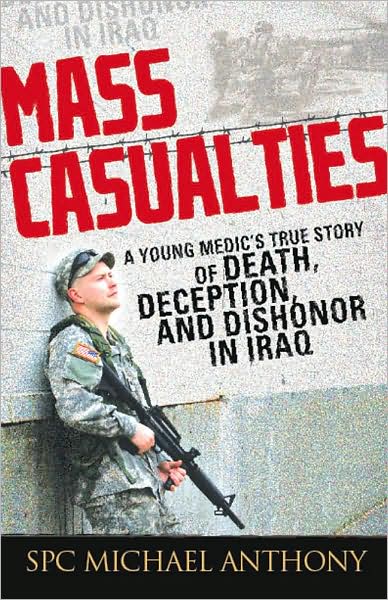
Mass Casualties
SPC Michael Anthony
Adams Media: 2009
In the realm of books about military experience, readers are far more likely to encounter accounts from embedded journalists and first person accounts from front line soldiers than they are to find a memoir from an Army surgeon. Mass Casualties, subtitled "A Young Medic's True Story of Death, Deception, and Dishonor in Iraq" is the operating room perspective from the current Iraq war.
Filled with youthful idealism about what life in the Army was life, Michael Anthony enlisted in the Army at age 17 to serve his country and follow a family tradition of military service. His year in Iraq was nothing that he expected. Anthony faced ineffective and sometimes petty leadership, other soldiers acting out and acting dishonorably, and the general danger of being in a war zone.
Viewed from the perspective of a memoir providing another wartime account, Mass Casualties is a valuable book. Anthony’s base was under repeated mortar fire and the memoir gets at the stresses placed on the soldier on base. Equally important, Mass Casualties provides a glimpse into what a poorly run and dysfunctional Army unit is like and what the impact is on the morale and psyche of the soldier.
To understand whether Anthony’s experience is an aberration or the norm of the Army, a much larger survey of returning soldiers would be required. It should safe to say, however, that even if that Michael Anthony’s experience was atypical of soldiers who were not on active patrol, it may not have been an unusual experience . . . even if the Army’s upper echelon would never, if they only knew, condone some of the poor leadership Anthony encountered.
As a memoir, and as a book of the modern military experience, Mass Casualties is not as well written as other books on the market. A memoir is not likely to hold up well next to a piece of professional journalism (think Generation Kill or The Interrogators), so that wouldn’t be a fair comparison. But, other memoirs such as My War: Killing Time in Iraq, by Colby Buzzell or Philip Caputo’s Vietnam classic A Rumor of War are more accomplished works and provide a better comparison.
What Michael Anthony offers here is a perspective easily overlooked next to a movie focusing on a bomb squad, embedded reportage, and memoir from combat soldiers patrolling the streets of Iraq or fighting in Afghanistan. Anthony’s voice here is quite valuable, especially as he recounts the experience of the Army pushing Anthrax pills on soldiers despite medical evidence suggesting serious risk.
Mass Casualties may not be a top shelf military memoir, but readers looking to understand different facets of what the modern soldier faces will do well to take a look at this book.
Reading copy provided courtesy of the author.
Monday, April 12, 2010
2010 Pulitzer Prize Winners
Via Omnivoracious, the 2010 Pulitzer Prize Winners have been announced.
Fiction: Tinkers, by Paul Harding
History: Lords of Finance: The Bankers Who Broke the World, by Liaquat Ahamed
Biography: The First Tycoon: The Epic Life of Cornelius Vanderbilt, by T.J. Stiles
General Nonfiction: The Dead Hand: The Untold Story of the Cold War Arms Race and its Dangerous Legacy, by David E. Hoffman
Poetry: Versed, by Rae Armantrout
Drama: Next to Normal, by Tom Kitt and Brian Yorkey
I was aware of the eventual History and Biography winners, but Tinkers? Never heard of it. Just reserved it at the library.
Fiction: Tinkers, by Paul Harding
History: Lords of Finance: The Bankers Who Broke the World, by Liaquat Ahamed
Biography: The First Tycoon: The Epic Life of Cornelius Vanderbilt, by T.J. Stiles
General Nonfiction: The Dead Hand: The Untold Story of the Cold War Arms Race and its Dangerous Legacy, by David E. Hoffman
Poetry: Versed, by Rae Armantrout
Drama: Next to Normal, by Tom Kitt and Brian Yorkey
I was aware of the eventual History and Biography winners, but Tinkers? Never heard of it. Just reserved it at the library.
Sunday, April 11, 2010
Thursday, April 08, 2010
New Tom Clancy: Dead or Alive
According to a Publisher’s Weekly article (via Omnivoracious), Tom Clancy is set to publish his first novel in seven years this December.
Not so!
Looks like this time around Clancy has a co-writer and I’ll be very interested to see if Clancy will return in top-form, or if we’ll have a doorstop tome with just a hint of goodness.
Either way, I’m kind of excited about this news. It’ll be very interesting to see what sort of scenario Clancy has come up with and I will definitely be reading this one.
Dead or Alive will feature all of Clancy's best-know characters, including Jack Ryan who, along with other Campus recruits, is dispatched by the new president to track down the "Emir," the mastermind of "vicious terrorist attacks on the West," according to Penguin. The new novel "is very much of the moment," Putnam head Ivan Held said. "It's Clancy's all-stars taking on the modern threat of terrorism."Now, while Clancy’s novels have generally featured moments (or novel-length chunks) of glacial pacing filled with techno / political jargon and code words, I have enjoyed nearly every novel Clancy has published and I had hopes that after The Teeth of the Tiger Clancy might re-invigorate his franchise with Jack Ryan, Jr at the forefront. Or, perhaps, write another novel on the Ding Chavez / Rainbow Six side. Instead, nothing followed and all signs pointing that to be the last novel Clancy would write / publish.
Not so!
Looks like this time around Clancy has a co-writer and I’ll be very interested to see if Clancy will return in top-form, or if we’ll have a doorstop tome with just a hint of goodness.
Either way, I’m kind of excited about this news. It’ll be very interesting to see what sort of scenario Clancy has come up with and I will definitely be reading this one.
Wednesday, April 07, 2010
finding the Best Related Book books
I've begun work to check the availability of the Hugo Nominees for Best Related Work. This is an interesting experience, at best.
Canary Fever: Reviews, by John Clute (Beccon)
Hope-In-The-Mist: The Extraordinary Career and Mysterious Life of Hope Mirrlees, by Michael Swanwick (Temporary Culture)
The Inter-Galactic Playground: A Critical Study of Children’s and Teens’ Science Fiction, by Farah Mendlesohn (McFarland)
On Joanna Russ, by Farah Mendlesohn (ed.) (Wesleyan)
The Secret Feminist Cabal: A Cultural History of SF Feminisms, by Helen Merrick (Aqueduct)
This is Me, Jack Vance! (Or, More Properly, This is “I”), by Jack Vance (Subterranean)
John Scalzi noted that while he will not be putting together the Hugo Voters Packet this year, the good people at AussieCon4 will be. While I was not a member of previous Worldcons and thus was not a beneficiary of John's hard work in putting together previous packets, I would like to thank him for his past work on this. It's a fantastic idea that helps get the work in the hands of the voters and thus allows a more informed vote. It also adds to the value of even a Supporting Membership in Worldcon.
I mention the Packet because it is my hope that the nominees for Best Related Work will be included.
Hope-in-the-Mist is completely sold out. This is Me, Jack Vance would run $40, assuming it was a volume I might have been interested in purchasing anyway (it is not). Canary Fever is another $35 (including shipping), and a book of Clute's reviews would be a tough sell for me.
Checking the online catalogs of my otherwise excellent library, I think I heard laughter in the background of my searches.
On the other hand, I did reserve On Joanna Russ from the University of Minnesota library via interlibrary loan, so I'm set there...unless I find out that the book was published too recently and they won't send it (this happens sometimes on volumes published within the first year).
This is an interesting experiment, trying to track down the Best Related Book nominees.
Canary Fever: Reviews, by John Clute (Beccon)
Hope-In-The-Mist: The Extraordinary Career and Mysterious Life of Hope Mirrlees, by Michael Swanwick (Temporary Culture)
The Inter-Galactic Playground: A Critical Study of Children’s and Teens’ Science Fiction, by Farah Mendlesohn (McFarland)
On Joanna Russ, by Farah Mendlesohn (ed.) (Wesleyan)
The Secret Feminist Cabal: A Cultural History of SF Feminisms, by Helen Merrick (Aqueduct)
This is Me, Jack Vance! (Or, More Properly, This is “I”), by Jack Vance (Subterranean)
John Scalzi noted that while he will not be putting together the Hugo Voters Packet this year, the good people at AussieCon4 will be. While I was not a member of previous Worldcons and thus was not a beneficiary of John's hard work in putting together previous packets, I would like to thank him for his past work on this. It's a fantastic idea that helps get the work in the hands of the voters and thus allows a more informed vote. It also adds to the value of even a Supporting Membership in Worldcon.
I mention the Packet because it is my hope that the nominees for Best Related Work will be included.
Hope-in-the-Mist is completely sold out. This is Me, Jack Vance would run $40, assuming it was a volume I might have been interested in purchasing anyway (it is not). Canary Fever is another $35 (including shipping), and a book of Clute's reviews would be a tough sell for me.
Checking the online catalogs of my otherwise excellent library, I think I heard laughter in the background of my searches.
On the other hand, I did reserve On Joanna Russ from the University of Minnesota library via interlibrary loan, so I'm set there...unless I find out that the book was published too recently and they won't send it (this happens sometimes on volumes published within the first year).
This is an interesting experiment, trying to track down the Best Related Book nominees.
Nebula and Hugo Award Nominee: "Act One"
“Act One”
Nancy Kress
Asimov’s: March 2009
Nominated for the Nebula Award: Novella
Nominated for the Hugo Award: Novella
There is a feeling I get from some of Nancy Kress’s recent work that she is only giving readers a fraction of the story, and the stuff that is most interesting is the stuff she is leaving out. That was part of my issue with Steal Across the Sky, and it is my biggest problem with “Act One”.
Now, let us be fair here. The story is called “Act One”, suggesting that it is the beginning of something (of a new society, promises the Asimov’s intro) and that any ending is only a preliminary ending. It is inherent to the story.
Kress sets the reader up with the introduction of Jane Snow, a beautiful fifty-something actress whose best professional days are behind her. Jane, through her manager (and the narrator) Barry, has arranged an interview with a cell of The Group, a mysterious organization devoted to changing the world by changing humanity through gene modification. The Group has began with changing children, giving them “Arlen’s Syndrome”, something they believe will change the world. Readers learn what it is a bit later in the story. Jane’s interview is to prepare for a movie script which could be her big comeback.
The story hinges on the believability of a biological vector for The Group to somehow “ripple” out into the wider world and infect and alter the rest of humanity, to force that better world into being. Science fiction and popular fiction have been riddled with enough stories of mutating contagions to make just about anything plausible. From The Stand to Wild Cards to a myriad of zombie tales, it is an easy enough leap to make for the reader.
As per usual, Kress mostly concerns herself with the human stories of Barry, Jane, and a couple of other characters. How Jane is affected by the research she has done, how Barry’s past continues to hurt him, what the children with Arlen’s Syndrome are like is the true core of the story. This is what makes a Nancy Kress story (or novel) so readable. She deals with her characters in a natural and honest manner and because the stories never get bogged down in jargon, the overall storytelling is so smooth.
The problem is that while the core stories of the protagonists are resolved, readers will still be left wondering “what next” in regards to the societal changes that have begun as a result of the actions of The Group. Whether this story is only the first act in a cycle of stories, or “Act One” is complete as Kress intended, “Act One” is ultimately unsatisfying in its conclusion. When a story reveals that something just happened that will (likely) irrevocably change the world, and then fails to show what that change looks like on a macro scale, there will be an inevitable sense of disappointment.
Nancy Kress
Asimov’s: March 2009
Nominated for the Nebula Award: Novella
Nominated for the Hugo Award: Novella
There is a feeling I get from some of Nancy Kress’s recent work that she is only giving readers a fraction of the story, and the stuff that is most interesting is the stuff she is leaving out. That was part of my issue with Steal Across the Sky, and it is my biggest problem with “Act One”.
Now, let us be fair here. The story is called “Act One”, suggesting that it is the beginning of something (of a new society, promises the Asimov’s intro) and that any ending is only a preliminary ending. It is inherent to the story.
Kress sets the reader up with the introduction of Jane Snow, a beautiful fifty-something actress whose best professional days are behind her. Jane, through her manager (and the narrator) Barry, has arranged an interview with a cell of The Group, a mysterious organization devoted to changing the world by changing humanity through gene modification. The Group has began with changing children, giving them “Arlen’s Syndrome”, something they believe will change the world. Readers learn what it is a bit later in the story. Jane’s interview is to prepare for a movie script which could be her big comeback.
The story hinges on the believability of a biological vector for The Group to somehow “ripple” out into the wider world and infect and alter the rest of humanity, to force that better world into being. Science fiction and popular fiction have been riddled with enough stories of mutating contagions to make just about anything plausible. From The Stand to Wild Cards to a myriad of zombie tales, it is an easy enough leap to make for the reader.
As per usual, Kress mostly concerns herself with the human stories of Barry, Jane, and a couple of other characters. How Jane is affected by the research she has done, how Barry’s past continues to hurt him, what the children with Arlen’s Syndrome are like is the true core of the story. This is what makes a Nancy Kress story (or novel) so readable. She deals with her characters in a natural and honest manner and because the stories never get bogged down in jargon, the overall storytelling is so smooth.
The problem is that while the core stories of the protagonists are resolved, readers will still be left wondering “what next” in regards to the societal changes that have begun as a result of the actions of The Group. Whether this story is only the first act in a cycle of stories, or “Act One” is complete as Kress intended, “Act One” is ultimately unsatisfying in its conclusion. When a story reveals that something just happened that will (likely) irrevocably change the world, and then fails to show what that change looks like on a macro scale, there will be an inevitable sense of disappointment.
Subscribe to:
Posts (Atom)