Okay. I'm way late in getting this post up.
Here's my monthly wrap-up of what I read the previous month. Links, as always, go to the reviews.
Books
24. Teckla, by Steven Brust
25. Starship: Flagship, by Mike Resnick
26. Once a Runner, by John L. Parker, Jr.
27. What I Talk About When I Talk About Running, by Haruki Murakami
28. The Pluto Files, by Neil DeGrasse Tyson
29. The Windup Girl, by Paolo Bacigalupi
30. The Shadow Pavilion, by Liz Williams
31. The Runner’s Rule Book, by Mark Remy
32. Misery, by Stephen King
33. Personal Record, by Rachel Toor
34. Judas Unchained, by Peter F. Hamilton
35. Horns, by Joe Hill
36. The Warded Man, by Peter V. Brett
Graphic Novels
30. The Umbrella Academy: Dallas, by Gerard Way
31. The Walking Dead: The Calm Before, by Robert Kirkman
32. Criminal: The Dead and the Dying, by Ed Brubaker
33. Star Wars Legacy: Storms, by John Ostrander
34. 100 Bullets: The Hard Way, by Brian Azzarello
35. Echo: Atomic Dreams, by Terry Moore
36. The Walking Dead: Made to Suffer, by Robert Kirkman
37. 100 Bullets: Strychnine Lives, by Brian Azzarello
38. Criminal: Bad Night, by Ed Brubaker
Previous Reading
January
February
Monday, April 19, 2010
Wednesday, April 14, 2010
Mass Casualties, by Michael Anthony
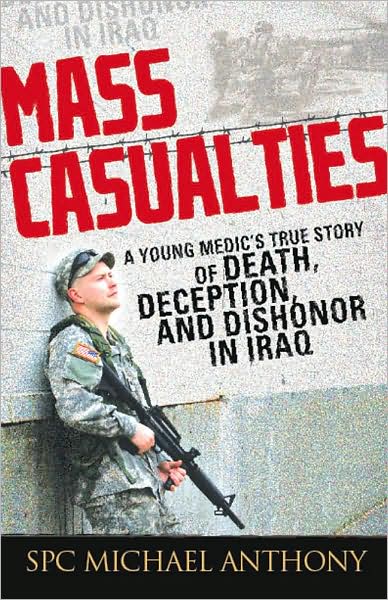
Mass Casualties
SPC Michael Anthony
Adams Media: 2009
In the realm of books about military experience, readers are far more likely to encounter accounts from embedded journalists and first person accounts from front line soldiers than they are to find a memoir from an Army surgeon. Mass Casualties, subtitled "A Young Medic's True Story of Death, Deception, and Dishonor in Iraq" is the operating room perspective from the current Iraq war.
Filled with youthful idealism about what life in the Army was life, Michael Anthony enlisted in the Army at age 17 to serve his country and follow a family tradition of military service. His year in Iraq was nothing that he expected. Anthony faced ineffective and sometimes petty leadership, other soldiers acting out and acting dishonorably, and the general danger of being in a war zone.
Viewed from the perspective of a memoir providing another wartime account, Mass Casualties is a valuable book. Anthony’s base was under repeated mortar fire and the memoir gets at the stresses placed on the soldier on base. Equally important, Mass Casualties provides a glimpse into what a poorly run and dysfunctional Army unit is like and what the impact is on the morale and psyche of the soldier.
To understand whether Anthony’s experience is an aberration or the norm of the Army, a much larger survey of returning soldiers would be required. It should safe to say, however, that even if that Michael Anthony’s experience was atypical of soldiers who were not on active patrol, it may not have been an unusual experience . . . even if the Army’s upper echelon would never, if they only knew, condone some of the poor leadership Anthony encountered.
As a memoir, and as a book of the modern military experience, Mass Casualties is not as well written as other books on the market. A memoir is not likely to hold up well next to a piece of professional journalism (think Generation Kill or The Interrogators), so that wouldn’t be a fair comparison. But, other memoirs such as My War: Killing Time in Iraq, by Colby Buzzell or Philip Caputo’s Vietnam classic A Rumor of War are more accomplished works and provide a better comparison.
What Michael Anthony offers here is a perspective easily overlooked next to a movie focusing on a bomb squad, embedded reportage, and memoir from combat soldiers patrolling the streets of Iraq or fighting in Afghanistan. Anthony’s voice here is quite valuable, especially as he recounts the experience of the Army pushing Anthrax pills on soldiers despite medical evidence suggesting serious risk.
Mass Casualties may not be a top shelf military memoir, but readers looking to understand different facets of what the modern soldier faces will do well to take a look at this book.
Reading copy provided courtesy of the author.
Monday, April 12, 2010
2010 Pulitzer Prize Winners
Via Omnivoracious, the 2010 Pulitzer Prize Winners have been announced.
Fiction: Tinkers, by Paul Harding
History: Lords of Finance: The Bankers Who Broke the World, by Liaquat Ahamed
Biography: The First Tycoon: The Epic Life of Cornelius Vanderbilt, by T.J. Stiles
General Nonfiction: The Dead Hand: The Untold Story of the Cold War Arms Race and its Dangerous Legacy, by David E. Hoffman
Poetry: Versed, by Rae Armantrout
Drama: Next to Normal, by Tom Kitt and Brian Yorkey
I was aware of the eventual History and Biography winners, but Tinkers? Never heard of it. Just reserved it at the library.
Fiction: Tinkers, by Paul Harding
History: Lords of Finance: The Bankers Who Broke the World, by Liaquat Ahamed
Biography: The First Tycoon: The Epic Life of Cornelius Vanderbilt, by T.J. Stiles
General Nonfiction: The Dead Hand: The Untold Story of the Cold War Arms Race and its Dangerous Legacy, by David E. Hoffman
Poetry: Versed, by Rae Armantrout
Drama: Next to Normal, by Tom Kitt and Brian Yorkey
I was aware of the eventual History and Biography winners, but Tinkers? Never heard of it. Just reserved it at the library.
Sunday, April 11, 2010
Thursday, April 08, 2010
New Tom Clancy: Dead or Alive
According to a Publisher’s Weekly article (via Omnivoracious), Tom Clancy is set to publish his first novel in seven years this December.
Not so!
Looks like this time around Clancy has a co-writer and I’ll be very interested to see if Clancy will return in top-form, or if we’ll have a doorstop tome with just a hint of goodness.
Either way, I’m kind of excited about this news. It’ll be very interesting to see what sort of scenario Clancy has come up with and I will definitely be reading this one.
Dead or Alive will feature all of Clancy's best-know characters, including Jack Ryan who, along with other Campus recruits, is dispatched by the new president to track down the "Emir," the mastermind of "vicious terrorist attacks on the West," according to Penguin. The new novel "is very much of the moment," Putnam head Ivan Held said. "It's Clancy's all-stars taking on the modern threat of terrorism."Now, while Clancy’s novels have generally featured moments (or novel-length chunks) of glacial pacing filled with techno / political jargon and code words, I have enjoyed nearly every novel Clancy has published and I had hopes that after The Teeth of the Tiger Clancy might re-invigorate his franchise with Jack Ryan, Jr at the forefront. Or, perhaps, write another novel on the Ding Chavez / Rainbow Six side. Instead, nothing followed and all signs pointing that to be the last novel Clancy would write / publish.
Not so!
Looks like this time around Clancy has a co-writer and I’ll be very interested to see if Clancy will return in top-form, or if we’ll have a doorstop tome with just a hint of goodness.
Either way, I’m kind of excited about this news. It’ll be very interesting to see what sort of scenario Clancy has come up with and I will definitely be reading this one.
Wednesday, April 07, 2010
finding the Best Related Book books
I've begun work to check the availability of the Hugo Nominees for Best Related Work. This is an interesting experience, at best.
Canary Fever: Reviews, by John Clute (Beccon)
Hope-In-The-Mist: The Extraordinary Career and Mysterious Life of Hope Mirrlees, by Michael Swanwick (Temporary Culture)
The Inter-Galactic Playground: A Critical Study of Children’s and Teens’ Science Fiction, by Farah Mendlesohn (McFarland)
On Joanna Russ, by Farah Mendlesohn (ed.) (Wesleyan)
The Secret Feminist Cabal: A Cultural History of SF Feminisms, by Helen Merrick (Aqueduct)
This is Me, Jack Vance! (Or, More Properly, This is “I”), by Jack Vance (Subterranean)
John Scalzi noted that while he will not be putting together the Hugo Voters Packet this year, the good people at AussieCon4 will be. While I was not a member of previous Worldcons and thus was not a beneficiary of John's hard work in putting together previous packets, I would like to thank him for his past work on this. It's a fantastic idea that helps get the work in the hands of the voters and thus allows a more informed vote. It also adds to the value of even a Supporting Membership in Worldcon.
I mention the Packet because it is my hope that the nominees for Best Related Work will be included.
Hope-in-the-Mist is completely sold out. This is Me, Jack Vance would run $40, assuming it was a volume I might have been interested in purchasing anyway (it is not). Canary Fever is another $35 (including shipping), and a book of Clute's reviews would be a tough sell for me.
Checking the online catalogs of my otherwise excellent library, I think I heard laughter in the background of my searches.
On the other hand, I did reserve On Joanna Russ from the University of Minnesota library via interlibrary loan, so I'm set there...unless I find out that the book was published too recently and they won't send it (this happens sometimes on volumes published within the first year).
This is an interesting experiment, trying to track down the Best Related Book nominees.
Canary Fever: Reviews, by John Clute (Beccon)
Hope-In-The-Mist: The Extraordinary Career and Mysterious Life of Hope Mirrlees, by Michael Swanwick (Temporary Culture)
The Inter-Galactic Playground: A Critical Study of Children’s and Teens’ Science Fiction, by Farah Mendlesohn (McFarland)
On Joanna Russ, by Farah Mendlesohn (ed.) (Wesleyan)
The Secret Feminist Cabal: A Cultural History of SF Feminisms, by Helen Merrick (Aqueduct)
This is Me, Jack Vance! (Or, More Properly, This is “I”), by Jack Vance (Subterranean)
John Scalzi noted that while he will not be putting together the Hugo Voters Packet this year, the good people at AussieCon4 will be. While I was not a member of previous Worldcons and thus was not a beneficiary of John's hard work in putting together previous packets, I would like to thank him for his past work on this. It's a fantastic idea that helps get the work in the hands of the voters and thus allows a more informed vote. It also adds to the value of even a Supporting Membership in Worldcon.
I mention the Packet because it is my hope that the nominees for Best Related Work will be included.
Hope-in-the-Mist is completely sold out. This is Me, Jack Vance would run $40, assuming it was a volume I might have been interested in purchasing anyway (it is not). Canary Fever is another $35 (including shipping), and a book of Clute's reviews would be a tough sell for me.
Checking the online catalogs of my otherwise excellent library, I think I heard laughter in the background of my searches.
On the other hand, I did reserve On Joanna Russ from the University of Minnesota library via interlibrary loan, so I'm set there...unless I find out that the book was published too recently and they won't send it (this happens sometimes on volumes published within the first year).
This is an interesting experiment, trying to track down the Best Related Book nominees.
Nebula and Hugo Award Nominee: "Act One"
“Act One”
Nancy Kress
Asimov’s: March 2009
Nominated for the Nebula Award: Novella
Nominated for the Hugo Award: Novella
There is a feeling I get from some of Nancy Kress’s recent work that she is only giving readers a fraction of the story, and the stuff that is most interesting is the stuff she is leaving out. That was part of my issue with Steal Across the Sky, and it is my biggest problem with “Act One”.
Now, let us be fair here. The story is called “Act One”, suggesting that it is the beginning of something (of a new society, promises the Asimov’s intro) and that any ending is only a preliminary ending. It is inherent to the story.
Kress sets the reader up with the introduction of Jane Snow, a beautiful fifty-something actress whose best professional days are behind her. Jane, through her manager (and the narrator) Barry, has arranged an interview with a cell of The Group, a mysterious organization devoted to changing the world by changing humanity through gene modification. The Group has began with changing children, giving them “Arlen’s Syndrome”, something they believe will change the world. Readers learn what it is a bit later in the story. Jane’s interview is to prepare for a movie script which could be her big comeback.
The story hinges on the believability of a biological vector for The Group to somehow “ripple” out into the wider world and infect and alter the rest of humanity, to force that better world into being. Science fiction and popular fiction have been riddled with enough stories of mutating contagions to make just about anything plausible. From The Stand to Wild Cards to a myriad of zombie tales, it is an easy enough leap to make for the reader.
As per usual, Kress mostly concerns herself with the human stories of Barry, Jane, and a couple of other characters. How Jane is affected by the research she has done, how Barry’s past continues to hurt him, what the children with Arlen’s Syndrome are like is the true core of the story. This is what makes a Nancy Kress story (or novel) so readable. She deals with her characters in a natural and honest manner and because the stories never get bogged down in jargon, the overall storytelling is so smooth.
The problem is that while the core stories of the protagonists are resolved, readers will still be left wondering “what next” in regards to the societal changes that have begun as a result of the actions of The Group. Whether this story is only the first act in a cycle of stories, or “Act One” is complete as Kress intended, “Act One” is ultimately unsatisfying in its conclusion. When a story reveals that something just happened that will (likely) irrevocably change the world, and then fails to show what that change looks like on a macro scale, there will be an inevitable sense of disappointment.
Nancy Kress
Asimov’s: March 2009
Nominated for the Nebula Award: Novella
Nominated for the Hugo Award: Novella
There is a feeling I get from some of Nancy Kress’s recent work that she is only giving readers a fraction of the story, and the stuff that is most interesting is the stuff she is leaving out. That was part of my issue with Steal Across the Sky, and it is my biggest problem with “Act One”.
Now, let us be fair here. The story is called “Act One”, suggesting that it is the beginning of something (of a new society, promises the Asimov’s intro) and that any ending is only a preliminary ending. It is inherent to the story.
Kress sets the reader up with the introduction of Jane Snow, a beautiful fifty-something actress whose best professional days are behind her. Jane, through her manager (and the narrator) Barry, has arranged an interview with a cell of The Group, a mysterious organization devoted to changing the world by changing humanity through gene modification. The Group has began with changing children, giving them “Arlen’s Syndrome”, something they believe will change the world. Readers learn what it is a bit later in the story. Jane’s interview is to prepare for a movie script which could be her big comeback.
The story hinges on the believability of a biological vector for The Group to somehow “ripple” out into the wider world and infect and alter the rest of humanity, to force that better world into being. Science fiction and popular fiction have been riddled with enough stories of mutating contagions to make just about anything plausible. From The Stand to Wild Cards to a myriad of zombie tales, it is an easy enough leap to make for the reader.
As per usual, Kress mostly concerns herself with the human stories of Barry, Jane, and a couple of other characters. How Jane is affected by the research she has done, how Barry’s past continues to hurt him, what the children with Arlen’s Syndrome are like is the true core of the story. This is what makes a Nancy Kress story (or novel) so readable. She deals with her characters in a natural and honest manner and because the stories never get bogged down in jargon, the overall storytelling is so smooth.
The problem is that while the core stories of the protagonists are resolved, readers will still be left wondering “what next” in regards to the societal changes that have begun as a result of the actions of The Group. Whether this story is only the first act in a cycle of stories, or “Act One” is complete as Kress intended, “Act One” is ultimately unsatisfying in its conclusion. When a story reveals that something just happened that will (likely) irrevocably change the world, and then fails to show what that change looks like on a macro scale, there will be an inevitable sense of disappointment.
Tuesday, April 06, 2010
Nebula Award Nominee: "Divining Light"
"Divining Light"
Ted Kosmatka
Asimov's: August 2008
Nominated for the Nebula Award: Novelette
Holy crap.
Seldom do I finish a story and find myself stunned, staring off into space trying to wrap my head around what I just read.
That’s just what happened with Ted Kosmatka’s superb story “Divining Light.” Kosmatka begins simply enough, with a once famous scientist receiving a research grant as a mercy from an old friend who had the means to help him out. Eric, the scientist, tells James, the friend, that he can no longer do what he once could and that he couldn’t promise he wouldn’t have another breakdown. The position in the Hansen Labs is a four month mercy.
Through the opening pages readers are introduced to some of the other researchers, a hint of their experiments, and how Eric passes the time. Kosmatka’s prose is hypnotic and even though there is very little expectation that Eric will do anything of note in his four months at the lab, Kosmatka is luring readers in, suckering them into believing that “Divining Light” is just a simple, quiet story of a guy who no longer has the capacity to do serious research passing time in a research lab and drawing a healthy salary on the basis of an old friendship. That’s the sucker’s bet.
Eric’s discovery of equipment in the lab with which he could reproduce a long-proven experiment finally piques his interest and he sets out to do just that experiment. He does not wish to disprove it. Eric had used the theory in his own work in the past. He just wishes to see it with his own eyes, to do the science himself.
This is the turning point of “Divining Light” and though Ted Kosmatka is still lulling readers with his quiet and easy prose, he is setting them up for a conclusion with profound implications for…well…if I said what the conclusion implied, some of the surprise would be spoiled. Let’s not do that.
“Divining Light” is a beautifully written and thoughtfully constructed story. The conclusion is such that many readers may well sit back and wonder if what Kosmatka posits might actually be true, if it could be real. This is the best sort of science fiction.
Ted Kosmatka
Asimov's: August 2008
Nominated for the Nebula Award: Novelette
Holy crap.
Seldom do I finish a story and find myself stunned, staring off into space trying to wrap my head around what I just read.
That’s just what happened with Ted Kosmatka’s superb story “Divining Light.” Kosmatka begins simply enough, with a once famous scientist receiving a research grant as a mercy from an old friend who had the means to help him out. Eric, the scientist, tells James, the friend, that he can no longer do what he once could and that he couldn’t promise he wouldn’t have another breakdown. The position in the Hansen Labs is a four month mercy.
Through the opening pages readers are introduced to some of the other researchers, a hint of their experiments, and how Eric passes the time. Kosmatka’s prose is hypnotic and even though there is very little expectation that Eric will do anything of note in his four months at the lab, Kosmatka is luring readers in, suckering them into believing that “Divining Light” is just a simple, quiet story of a guy who no longer has the capacity to do serious research passing time in a research lab and drawing a healthy salary on the basis of an old friendship. That’s the sucker’s bet.
Eric’s discovery of equipment in the lab with which he could reproduce a long-proven experiment finally piques his interest and he sets out to do just that experiment. He does not wish to disprove it. Eric had used the theory in his own work in the past. He just wishes to see it with his own eyes, to do the science himself.
This is the turning point of “Divining Light” and though Ted Kosmatka is still lulling readers with his quiet and easy prose, he is setting them up for a conclusion with profound implications for…well…if I said what the conclusion implied, some of the surprise would be spoiled. Let’s not do that.
“Divining Light” is a beautifully written and thoughtfully constructed story. The conclusion is such that many readers may well sit back and wonder if what Kosmatka posits might actually be true, if it could be real. This is the best sort of science fiction.
Monday, April 05, 2010
It Takes Two available, and other links
Nicola Griffith's excellent Hugo Nominated story "It Takes Two" will be available online for the duration of the voting period. You really must check it out.
I have updated the nomination list with Nicola's story as well as a bunch of other links to the zines, fan writer, and Campbell nominees. I'll take some more time tonight to link up the artists and editors as available and check on the missing story (Asimov's is sure to post it) and the novellas (questionable with three published in book form, but I wouldn't be surprised if Pyr posted the McDonald).
I have updated the nomination list with Nicola's story as well as a bunch of other links to the zines, fan writer, and Campbell nominees. I'll take some more time tonight to link up the artists and editors as available and check on the missing story (Asimov's is sure to post it) and the novellas (questionable with three published in book form, but I wouldn't be surprised if Pyr posted the McDonald).
Sunday, April 04, 2010
2010 Hugo Award Nominees
Nominees for the 2010 Hugo Awards have been announced.
For a point of comparison, here is my nomination ballot.
Best Novel
Boneshaker, by Cherie Priest (Tor)
The City & The City, by China Miéville (Del Rey; Macmillan UK)
Julian Comstock: A Story of 22nd-Century America, by Robert Charles Wilson (Tor)
Palimpsest, by Catherynne M. Valente (Bantam Spectra)
Wake, by Robert J. Sawyer (Ace; Penguin; Gollancz; Analog)
The Windup Girl, by Paolo Bacigalupi (Night Shade)
Best Novella
“Act One”, by Nancy Kress (Asimov’s 3/09)
The God Engines, by John Scalzi (Subterranean)
“Palimpsest”, by Charles Stross (Wireless)
Shambling Towards Hiroshima, by James Morrow (Tachyon)
“Vishnu at the Cat Circus”, by Ian McDonald (Cyberabad Days)
The Women of Nell Gwynne’s, by Kage Baker (Subterranean)
Best Novelette
“Eros, Philia, Agape”, by Rachel Swirsky (Tor.com 3/09)
"The Island”, by Peter Watts (The New Space Opera 2)
“It Takes Two”, by Nicola Griffith (Eclipse Three)
“One of Our Bastards is Missing”, by Paul Cornell (The Solaris Book of New Science Fiction: Volume Three)
“Overtime”, by Charles Stross (Tor.com 12/09)
"Sinner, Baker, Fabulist, Priest; Red Mask, Black Mask, Gentleman, Beast”, by Eugie Foster (Interzone 2/09)
Best Short Story
“The Bride of Frankenstein”, by Mike Resnick (Asimov’s 12/09)
“Bridesicle”, by Will McIntosh (Asimov’s 1/09)
“The Moment”, by Lawrence M. Schoen (Footprints)
“Non-Zero Probabilities”, by N.K. Jemisin (Clarkesworld 9/09)
“Spar”, by Kij Johnson (Clarkesworld 10/09)
Best Related Book
Canary Fever: Reviews, by John Clute (Beccon)
Hope-In-The-Mist: The Extraordinary Career and Mysterious Life of Hope Mirrlees, by Michael Swanwick (Temporary Culture)
The Inter-Galactic Playground: A Critical Study of Children’s and Teens’ Science Fiction, by Farah Mendlesohn (McFarland)
On Joanna Russ, by Farah Mendlesohn (ed.) (Wesleyan)
The Secret Feminist Cabal: A Cultural History of SF Feminisms, by Helen Merrick (Aqueduct)
This is Me, Jack Vance! (Or, More Properly, This is “I”), by Jack Vance (Subterranean)
Best Graphic Story
Batman: Whatever Happened to the Caped Crusader? Written by Neil Gaiman; Pencilled by Andy Kubert; Inked by Scott Williams (DC Comics)
Captain Britain And MI13. Volume 3: Vampire State Written by Paul Cornell; Pencilled by Leonard Kirk with Mike Collins, Adrian Alphona and Ardian Syaf (Marvel Comics)
Fables Vol 12: The Dark Ages Written by Bill Willingham; Pencilled by Mark Buckingham; Art by Peter Gross & Andrew Pepoy, Michael Allred, David Hahn; Colour by Lee Loughridge & Laura Allred; Letters by Todd Klein (Vertigo Comics)
Girl Genius, Volume 9: Agatha Heterodyne and the Heirs of the Storm Written by Kaja and Phil Foglio; Art by Phil Foglio; Colours by Cheyenne Wright (Airship Entertainment)
Schlock Mercenary: The Longshoreman of the Apocalypse Written and Illustrated by Howard Tayler
Best Dramatic Presentation, Long Form
Avatar Screenplay and Directed by James Cameron (Twentieth Century Fox)
District 9 Screenplay by Neill Blomkamp & Terri Tatchell; Directed by Neill Blomkamp (TriStar Pictures)
Moon Screenplay by Nathan Parker; Story by Duncan Jones; Directed by Duncan Jones (Liberty Films)
Star Trek Screenplay by Robert Orci & Alex Kurtzman; Directed by J.J. Abrams (Paramount)
Up Screenplay by Bob Peterson & Pete Docter; Story by Bob Peterson, Pete Docter, & Thomas McCarthy; Directed by Bob Peterson & Pete Docter (Disney/Pixar)
Best Dramatic Presentation, Short Form
Doctor Who: “The Next Doctor” Written by Russell T Davies; Directed by Andy Goddard (BBC Wales)
Doctor Who: “Planet of the Dead” Written by Russell T Davies & Gareth Roberts; Directed by James Strong (BBC Wales)
Doctor Who: “The Waters of Mars” Written by Russell T Davies & Phil Ford; Directed by Graeme Harper (BBC Wales)
Dollhouse: “Epitaph 1″ Story by Joss Whedon; Written by Maurissa Tancharoen & Jed Whedon; Directed by David Solomon (Mutant Enemy)
FlashForward: “No More Good Days” Written by Brannon Braga & David S. Goyer; Directed by David S. Goyer; based on the novel by Robert J. Sawyer (ABC)
Best Editor, Long Form
Lou Anders
Ginjer Buchanan
Liz Gorinsky
Patrick Nielsen Hayden
Juliet Ulman
Best Editor, Short Form
Ellen Datlow
Stanley Schmidt
Jonathan Strahan
Gordon Van Gelder
Sheila Williams
Best Professional Artist
Bob Eggleton
Stephan Martiniere
John Picacio
Daniel Dos Santos
Shaun Tan
Best Semiprozine
Ansible edited by David Langford
Clarkesworld edited by Neil Clarke, Sean Wallace, & Cheryl Morgan
Interzone edited by Andy Cox
Locus edited by Charles N. Brown, Kirsten Gong-Wong, & Liza Groen Trombi
Weird Tales edited by Ann VanderMeer & Stephen H. Segal
Best Fan Writer
Claire Brialey
Christopher J Garcia
James Nicoll
Lloyd Penney
Frederik Pohl
Best Fanzine
Argentus edited by Steven H Silver
Banana Wings edited by Claire Brialey and Mark Plummer
CHALLENGER edited by Guy H. Lillian III
Drink Tank edited by Christopher J Garcia, with guest editor James Bacon
File 770 edited by Mike Glyer
StarShipSofa edited by Tony C. Smith
Best Fan Artist
Brad W. Foster
Dave Howell
Sue Mason
Steve Stiles
Taral Wayne
The John W. Campbell Award for Best New Writer
Saladin Ahmed
Gail Carriger
Felix Gilman
Seanan McGuire
Lezli Robyn
Congratulations to all the nominees. Looks like we've got an excellent lineup of folks and works nominated.
I would like to take this moment to call special attention to Cherie Priest, Rachel Swirsky, and Nicola Griffith. Y'all are just awesome. Congrats! I am also quite pleased to see Clarkesworld and Weird Tales on the ballot for Semiprozine. Just awesome.
For a point of comparison, here is my nomination ballot.
Best Novel
Boneshaker, by Cherie Priest (Tor)
The City & The City, by China Miéville (Del Rey; Macmillan UK)
Julian Comstock: A Story of 22nd-Century America, by Robert Charles Wilson (Tor)
Palimpsest, by Catherynne M. Valente (Bantam Spectra)
Wake, by Robert J. Sawyer (Ace; Penguin; Gollancz; Analog)
The Windup Girl, by Paolo Bacigalupi (Night Shade)
Best Novella
“Act One”, by Nancy Kress (Asimov’s 3/09)
The God Engines, by John Scalzi (Subterranean)
“Palimpsest”, by Charles Stross (Wireless)
Shambling Towards Hiroshima, by James Morrow (Tachyon)
“Vishnu at the Cat Circus”, by Ian McDonald (Cyberabad Days)
The Women of Nell Gwynne’s, by Kage Baker (Subterranean)
Best Novelette
“Eros, Philia, Agape”, by Rachel Swirsky (Tor.com 3/09)
"The Island”, by Peter Watts (The New Space Opera 2)
“It Takes Two”, by Nicola Griffith (Eclipse Three)
“One of Our Bastards is Missing”, by Paul Cornell (The Solaris Book of New Science Fiction: Volume Three)
“Overtime”, by Charles Stross (Tor.com 12/09)
"Sinner, Baker, Fabulist, Priest; Red Mask, Black Mask, Gentleman, Beast”, by Eugie Foster (Interzone 2/09)
Best Short Story
“The Bride of Frankenstein”, by Mike Resnick (Asimov’s 12/09)
“Bridesicle”, by Will McIntosh (Asimov’s 1/09)
“The Moment”, by Lawrence M. Schoen (Footprints)
“Non-Zero Probabilities”, by N.K. Jemisin (Clarkesworld 9/09)
“Spar”, by Kij Johnson (Clarkesworld 10/09)
Best Related Book
Canary Fever: Reviews, by John Clute (Beccon)
Hope-In-The-Mist: The Extraordinary Career and Mysterious Life of Hope Mirrlees, by Michael Swanwick (Temporary Culture)
The Inter-Galactic Playground: A Critical Study of Children’s and Teens’ Science Fiction, by Farah Mendlesohn (McFarland)
On Joanna Russ, by Farah Mendlesohn (ed.) (Wesleyan)
The Secret Feminist Cabal: A Cultural History of SF Feminisms, by Helen Merrick (Aqueduct)
This is Me, Jack Vance! (Or, More Properly, This is “I”), by Jack Vance (Subterranean)
Best Graphic Story
Batman: Whatever Happened to the Caped Crusader? Written by Neil Gaiman; Pencilled by Andy Kubert; Inked by Scott Williams (DC Comics)
Captain Britain And MI13. Volume 3: Vampire State Written by Paul Cornell; Pencilled by Leonard Kirk with Mike Collins, Adrian Alphona and Ardian Syaf (Marvel Comics)
Fables Vol 12: The Dark Ages Written by Bill Willingham; Pencilled by Mark Buckingham; Art by Peter Gross & Andrew Pepoy, Michael Allred, David Hahn; Colour by Lee Loughridge & Laura Allred; Letters by Todd Klein (Vertigo Comics)
Girl Genius, Volume 9: Agatha Heterodyne and the Heirs of the Storm Written by Kaja and Phil Foglio; Art by Phil Foglio; Colours by Cheyenne Wright (Airship Entertainment)
Schlock Mercenary: The Longshoreman of the Apocalypse Written and Illustrated by Howard Tayler
Best Dramatic Presentation, Long Form
Avatar Screenplay and Directed by James Cameron (Twentieth Century Fox)
District 9 Screenplay by Neill Blomkamp & Terri Tatchell; Directed by Neill Blomkamp (TriStar Pictures)
Moon Screenplay by Nathan Parker; Story by Duncan Jones; Directed by Duncan Jones (Liberty Films)
Star Trek Screenplay by Robert Orci & Alex Kurtzman; Directed by J.J. Abrams (Paramount)
Up Screenplay by Bob Peterson & Pete Docter; Story by Bob Peterson, Pete Docter, & Thomas McCarthy; Directed by Bob Peterson & Pete Docter (Disney/Pixar)
Best Dramatic Presentation, Short Form
Doctor Who: “The Next Doctor” Written by Russell T Davies; Directed by Andy Goddard (BBC Wales)
Doctor Who: “Planet of the Dead” Written by Russell T Davies & Gareth Roberts; Directed by James Strong (BBC Wales)
Doctor Who: “The Waters of Mars” Written by Russell T Davies & Phil Ford; Directed by Graeme Harper (BBC Wales)
Dollhouse: “Epitaph 1″ Story by Joss Whedon; Written by Maurissa Tancharoen & Jed Whedon; Directed by David Solomon (Mutant Enemy)
FlashForward: “No More Good Days” Written by Brannon Braga & David S. Goyer; Directed by David S. Goyer; based on the novel by Robert J. Sawyer (ABC)
Best Editor, Long Form
Lou Anders
Ginjer Buchanan
Liz Gorinsky
Patrick Nielsen Hayden
Juliet Ulman
Best Editor, Short Form
Ellen Datlow
Stanley Schmidt
Jonathan Strahan
Gordon Van Gelder
Sheila Williams
Best Professional Artist
Bob Eggleton
Stephan Martiniere
John Picacio
Daniel Dos Santos
Shaun Tan
Best Semiprozine
Ansible edited by David Langford
Clarkesworld edited by Neil Clarke, Sean Wallace, & Cheryl Morgan
Interzone edited by Andy Cox
Locus edited by Charles N. Brown, Kirsten Gong-Wong, & Liza Groen Trombi
Weird Tales edited by Ann VanderMeer & Stephen H. Segal
Best Fan Writer
Claire Brialey
Christopher J Garcia
James Nicoll
Lloyd Penney
Frederik Pohl
Best Fanzine
Argentus edited by Steven H Silver
Banana Wings edited by Claire Brialey and Mark Plummer
CHALLENGER edited by Guy H. Lillian III
Drink Tank edited by Christopher J Garcia, with guest editor James Bacon
File 770 edited by Mike Glyer
StarShipSofa edited by Tony C. Smith
Best Fan Artist
Brad W. Foster
Dave Howell
Sue Mason
Steve Stiles
Taral Wayne
The John W. Campbell Award for Best New Writer
Saladin Ahmed
Gail Carriger
Felix Gilman
Seanan McGuire
Lezli Robyn
Congratulations to all the nominees. Looks like we've got an excellent lineup of folks and works nominated.
I would like to take this moment to call special attention to Cherie Priest, Rachel Swirsky, and Nicola Griffith. Y'all are just awesome. Congrats! I am also quite pleased to see Clarkesworld and Weird Tales on the ballot for Semiprozine. Just awesome.
Saturday, April 03, 2010
Dragon Prince Re-Read

Just wanted to mention that I'm beginning my re-read of Melanie Rawn's Dragon Prince and Dragon Star trilogies tonight.
Dragon Prince is one of my favorite fantasy novels and one that has lingered with me over the years. It's probably been at least ten years since I've read it, though so many of the details still come starkly across my memory. I love this book.
I'm less familiar with the other novels. I've read The Star Scroll and Sunrunner's Fire a couple of times, but have less recall (I do remember some rather important moments, though). My high school library only had copies of the first and third Dragon Star novels, so that's all I've read of those, and only once each. Except for one very memorable and heartbreaking scene in Stronghold, I'll have an almost fresh experience for the second trilogy.
Very much looking forward to this re-read.
Also, check out Michael Whelan's cover art. Gorgeous. This cover marked the first time I ever really thought about where the covers came from and notice the artist as an artist.
Friday, April 02, 2010
Small Thoughts on Running Books
I'm not quite sure what I want to call this new old feature here. Once upon a time I called it "Quick Takes", but I like the "Small Thoughts" part of the title. We'll see. Regardless, I've been lax in posting full length reviews and I want to get out a bit more of what I've been reading.
Once a Runner, by John L. Parker: I wonder how much anyone who was not a runner would enjoy this book. Once a Runner is perhaps the seminal book about running, a novel that has been praised by many an elite runner as being the most realistic depiction of what it takes to run and compete at the highest level. If I think too much about the prose, Once a Runner has flaws and the opening chapters were a bit rough. Parker settles in, though, and tells a thrilling story about an elite college athlete, some of his personal travails, and gets into his training for what is, without hyperbole, the race of his life. For runners, even those of us who couldn’t sniff high level competition, Once a Runner is a thrilling novel and it truly is the best fictional depiction of running I have come across (or expect to encounter).
The Runner’s Rule Book, by Mark Remy: The Runner’s Rule Book focuses on the unwritten “rules” of running. The courtesies. Mark Remy has put together a slim volume of semi-humorous examples of what to do and what not to do during races, training runs, and general behavior and attitude. It reads quick, but it isn’t the sort of book you read from cover to cover. It’s a book to pick up, read a few, put down, and go on with your day. Decent enough, I suppose.
Strides, by Benjamin Cheever: This one was a real disappointment. Cheever mixes some of the history of running with his own running history, and one would think this would be right up my alley. I put it down after just a few chapters. Dull.
Personal Record, by Rachel Toor: This book is a series of essays (26.2 in all) from Running Times writer Rachel Toor. Many are personal, as this is ultimately Toor’s journey through life and running, but the essays occasionally come across a touch distant and impersonal (the one about her pacing a guy through the Western States 100 notwithstanding – that one was quite moving). The essay format of Personal Record created a choppy feel to the book and what might have otherwise been a volume to recommend, was just mostly decent. A few essays were highlights (the two pacing ones, and the high school coaching experience), but as a collected whole, Personal Record didn’t thrill. One the other hand, Personal Record is worlds better than Haruki Murakami’s tedious running memoir What I Talk About When I Talk About Running.
Once a Runner, by John L. Parker: I wonder how much anyone who was not a runner would enjoy this book. Once a Runner is perhaps the seminal book about running, a novel that has been praised by many an elite runner as being the most realistic depiction of what it takes to run and compete at the highest level. If I think too much about the prose, Once a Runner has flaws and the opening chapters were a bit rough. Parker settles in, though, and tells a thrilling story about an elite college athlete, some of his personal travails, and gets into his training for what is, without hyperbole, the race of his life. For runners, even those of us who couldn’t sniff high level competition, Once a Runner is a thrilling novel and it truly is the best fictional depiction of running I have come across (or expect to encounter).
The Runner’s Rule Book, by Mark Remy: The Runner’s Rule Book focuses on the unwritten “rules” of running. The courtesies. Mark Remy has put together a slim volume of semi-humorous examples of what to do and what not to do during races, training runs, and general behavior and attitude. It reads quick, but it isn’t the sort of book you read from cover to cover. It’s a book to pick up, read a few, put down, and go on with your day. Decent enough, I suppose.
Strides, by Benjamin Cheever: This one was a real disappointment. Cheever mixes some of the history of running with his own running history, and one would think this would be right up my alley. I put it down after just a few chapters. Dull.
Personal Record, by Rachel Toor: This book is a series of essays (26.2 in all) from Running Times writer Rachel Toor. Many are personal, as this is ultimately Toor’s journey through life and running, but the essays occasionally come across a touch distant and impersonal (the one about her pacing a guy through the Western States 100 notwithstanding – that one was quite moving). The essay format of Personal Record created a choppy feel to the book and what might have otherwise been a volume to recommend, was just mostly decent. A few essays were highlights (the two pacing ones, and the high school coaching experience), but as a collected whole, Personal Record didn’t thrill. One the other hand, Personal Record is worlds better than Haruki Murakami’s tedious running memoir What I Talk About When I Talk About Running.
Thursday, April 01, 2010
The Warded Man, by Peter V. Brett

The Warded Man
Peter V. Brett
Del Rey: 2009
The Warded Man is a novel in the tradition of the epic fantasies of the 80’s and early 90’s. At the start of the novel Arlen is an eleven year old boy living in a remote village. He dreams of the wider world outside Tibbet’s Brook, of the famed Free Cities, and of becoming a Messenger, one of the hardy few who venture out into the unwarded wilderness and brave the coreling demons that come out at night and slaughter anything not safely protected by a warded a building or a warding circle. Arlen is not an orphan and there does not appear to be a prophecy suggesting that he may be one to save the world from a great evil.
Except, there is a prophecy. The villages speak of “The Deliverer”, one who will come again and drive the corelings away and essentially save the world for humanity. Arlen is a farm boy, and we know that he is the hero of the novel, so there is reason to believe that if the prophecy is true, that he may be the one.
In many ways The Warded Man skirts around the conventions of epic fantasy novels from ten to fifteen years ago. The prophecy is often dismissed by educated folk and few believe that any such redemption is possible. The demons that come out every night with the setting sun cannot be killed and they are a fact of life. The wards that protect the cities and towns are for defense only. The symbols for combat wards were lost thousands of years ago. All that is left is legend and “prophecy”, which may well just be a last bit of hope for humanity.
The story of The Warded Man is told with three protagonists and takes place over more than a decade. Besides Arlen, there is Rojer and Leesha, both young apprentices. Rojer is a jonguleur in training, basically a minstrel, and Leesha is apprenticed to the Herb Gatherer, a village wise woman. They don’t know each other, but this is the sort of novel that suggests these three will form a motley traveling party at some point in the future.
The core, no pun intended, of The Warded Man is a fairly standard and stock epic fantasy novel. Long time readers of David Eddings, Terry Brooks, Tad Williams, Raymond Feist, and Robert Jordan will be in very familiar territory. While this is not exactly a standard “quest fantasy”, the novel has that feel. In a sense, Arlen = Warrior, Rojer = Bard, Leesha = White Mage / Healer. On a basic level, there are standard roles in play here.
This is only to say that Peter Brett’s debut novel has a familiar, slightly derivative feel from the start. Readers have been here before. What works, though, is Brett’s execution. The magic system of offensive and defensive wards is very well done and Brett doesn’t attempt to describe in detail the shape and appearance of each ward or give a grimoire of what each does (though, see The Great Bazaar for just that grimoire). Instead, Brett provides the rough edges of how the system works and the effects of the wards. Also, and this is very much to the benefit of the novel, this is a world that has lost much of its ward knowledge and there is no known central repository of ward-lore. This allows for a sense of discovery and it serves the story well.
Readers looking for the minutiae of how everything works will be disappointed with The Warded Man, but everyone else will be satisfied with the level of description.
The Warded Man does not break new ground in the fantasy genre. It is very much in the tradition of what has come before and it should hold up well next to the epic of fantasy of the earlier part of the last two decades. The novel has a semi-slow start as readers sit through three separate character introductions, but the pacing picks up speed as Arlen, Rojer, and Leesha come closer to meeting up and the novel’s finale will likely thrill fans looking for a big fight.
The Warded Man is a solid, though not outstanding, piece of epic fantasy. It is a worthy debut novel from Peter Brett and is good enough to have readers anticipate what happens next in The Desert Spear.
Tuesday, March 30, 2010
Wordhord!
Yesterday I received an e-mail from Dr. Kensak, one of my former college professors at Northwestern. Got me thinking college thoughts.
I'm not sure, but I think I might have had one of Dr. Kensak's very first classes he taught at NWC. A whole class on Chaucer. Four of us started the class, only three of us finished. That class was one of the two most challenging classes I took* and was probably the most rewarding. I struggled some to read and comprehend the text, he had us memorize and recite the first stanza of the prologue in its original Middle English with correct pronunciation, and I nailed it. I think I was as proud of that memorization as anything else in college. I can still knock out a couple of butchered lines. What? It was September 2006. You do better.
I worked my ass off for that class, truly put my best effort into the papers (which didn't happen as often as it should have in other classes), and if I remember correctly, my grade reflected it.
As much as I focused on and enjoyed Dr. Fynaardt's American Lit classes (and that's where my core interest was), or the religion classes from Drs. Manetsch** and Kinsinger***
Anyway.
The English Department newsletter, which I always looked forward to when I was a student (book recommendations, yo), is now available online.
That's way cool.
So, here's the Spring 2010 issue of Wordhord.
There's book recommendations for summer reading.
Blood Brothers, by Elias Chacour
Slavery By Another Name, by Douglas A. Blackmon
We Don't Know We Don't Know, by Nick Lantz
The Lightning That Strikes the Neighbors' House, by Nick Lantz
The Disappearing Spoon, by Sam Kean
Silk Parachute, by John McPhee
The Room and the Chair, by Lorraine Adams
The Ask, by Sam Lipsyte
Beatrix Potter: A Life in Nature, by Linda J. Lear
Persepolis, by Marjane Satrapi
Writing Places, by William Zinnser
Exit Music, by Ian Rankin
A Private History of Awe, by Scott Russell Sanders
Where Clouds Are Formed, by Ofelia Zapeda
The Year's Best Science Fiction Twenty-Sixth Annual Collection, by Gardner Dozois
The Left Hand of Darkness, by Ursula K. Le Guin
The Beekeeper's Apprentice, by Laurie King
Deep Economy, by Bill McKibben
That, folks, is quite a list.
*The most difficult class was the dread Seminar in Interpretation from Dr. Westerholm. A whole class on the theory behind literary criticism? Oof. Luckily, this every other year class was offered my Senior Year rather than Junior.
**If Dr. Manetsch was teaching in the Twin Cities metro, I would absolutely take one of his classes right now, ten years later. Assuming it didn't mess with my work schedule.
***Mitch Kinsinger was awesome. Really liked him. I had him in his first year teaching at Northwestern, and my final year.
I'm not sure, but I think I might have had one of Dr. Kensak's very first classes he taught at NWC. A whole class on Chaucer. Four of us started the class, only three of us finished. That class was one of the two most challenging classes I took* and was probably the most rewarding. I struggled some to read and comprehend the text, he had us memorize and recite the first stanza of the prologue in its original Middle English with correct pronunciation, and I nailed it. I think I was as proud of that memorization as anything else in college. I can still knock out a couple of butchered lines. What? It was September 2006. You do better.
I worked my ass off for that class, truly put my best effort into the papers (which didn't happen as often as it should have in other classes), and if I remember correctly, my grade reflected it.
As much as I focused on and enjoyed Dr. Fynaardt's American Lit classes (and that's where my core interest was), or the religion classes from Drs. Manetsch** and Kinsinger***
Anyway.
The English Department newsletter, which I always looked forward to when I was a student (book recommendations, yo), is now available online.
That's way cool.
So, here's the Spring 2010 issue of Wordhord.
There's book recommendations for summer reading.
Blood Brothers, by Elias Chacour
Slavery By Another Name, by Douglas A. Blackmon
We Don't Know We Don't Know, by Nick Lantz
The Lightning That Strikes the Neighbors' House, by Nick Lantz
The Disappearing Spoon, by Sam Kean
Silk Parachute, by John McPhee
The Room and the Chair, by Lorraine Adams
The Ask, by Sam Lipsyte
Beatrix Potter: A Life in Nature, by Linda J. Lear
Persepolis, by Marjane Satrapi
Writing Places, by William Zinnser
Exit Music, by Ian Rankin
A Private History of Awe, by Scott Russell Sanders
Where Clouds Are Formed, by Ofelia Zapeda
The Year's Best Science Fiction Twenty-Sixth Annual Collection, by Gardner Dozois
The Left Hand of Darkness, by Ursula K. Le Guin
The Beekeeper's Apprentice, by Laurie King
Deep Economy, by Bill McKibben
That, folks, is quite a list.
*The most difficult class was the dread Seminar in Interpretation from Dr. Westerholm. A whole class on the theory behind literary criticism? Oof. Luckily, this every other year class was offered my Senior Year rather than Junior.
**If Dr. Manetsch was teaching in the Twin Cities metro, I would absolutely take one of his classes right now, ten years later. Assuming it didn't mess with my work schedule.
***Mitch Kinsinger was awesome. Really liked him. I had him in his first year teaching at Northwestern, and my final year.
Small Thoughts on Big Books
So, while I flitter away at thinking about writing a couple of reviews that I’ve been sitting on for a while, here’s some quick hits on three books I recently finished. Sort of.
Judas Unchained: I rather like Peter F. Hamilton’s work. He writes these big, sprawling space opera / science fiction novels that span multiple worlds with big galactic threats. Judas Unchained is the second half of the story began in Pandora’s Star. It’s another fat 800+ page novel. Unlike his Night’s Dawn trilogy, the ending of Judas Unchained is more organic and believable than the disappointing conclusion of The Naked God. I half-wanted to dive right into Hamilton’s next trilogy, still set in this Commonwealth Universe, but I do need a break before I attempt to tackle another massive Hamiltonian text. Good stuff, but it takes a bit to get through.
Horns: Joe Hill’s second full length novel is another winner. Mark that down. Winner. Horns flips around in time a bit, and is something of a love story between Ig and Merrin, except we find out quite quickly that Merrin was brutally murdered and even though Ig didn’t do it, most folks think he did. Well, Ig grows these horns on his head which cause people to confess their darkest secrets and tell the nastiest truth. The opening is flat out entertaining as Ig’s family and some acquaintances spill the beans. By the end, it’s a dark and nasty tale that is also, as I’ve been told, a tragic love story. This has a shot to be on some Year’s Best lists at the end of the year. Here’s the deal: You see Joe Hill’s name, you’ll want to read it. The man is quality.
Pygmy: Sigh. And then there is Chuck Palahniuk. He had a very strong start to his career with Fight Club and Survivor, and even though things began to feel “samey” with Choke and Lullaby, Palahniuk was still a name to make me take notice. He was writing stuff that I just wasn’t seeing elsewhere. He’s losing me right now. Pygmy is written in this pidgin English dialect of an exchange student coming to America for the first time. Now, conceptually Pygmy has a damn good story that I’d really, really like to read. The exchange student is part of a cell planning a massive terrorist attack. This should be in Palahniuk’s wheel house. I just can’t get past the narration / dialect. The whole thing is told in that broken and misplaced style of English that you would expect from someone who has only barely and just learned the language. It’s rough going and, I checked, it doesn’t improve later in the novel. I know this part of the point, but I can’t get past it. I praised Jeff VanderMeer’s chopped sentences in Finch, but there was something of a rhythm to Finch. I can’t find the rhythm here. Pass.
Judas Unchained: I rather like Peter F. Hamilton’s work. He writes these big, sprawling space opera / science fiction novels that span multiple worlds with big galactic threats. Judas Unchained is the second half of the story began in Pandora’s Star. It’s another fat 800+ page novel. Unlike his Night’s Dawn trilogy, the ending of Judas Unchained is more organic and believable than the disappointing conclusion of The Naked God. I half-wanted to dive right into Hamilton’s next trilogy, still set in this Commonwealth Universe, but I do need a break before I attempt to tackle another massive Hamiltonian text. Good stuff, but it takes a bit to get through.
Horns: Joe Hill’s second full length novel is another winner. Mark that down. Winner. Horns flips around in time a bit, and is something of a love story between Ig and Merrin, except we find out quite quickly that Merrin was brutally murdered and even though Ig didn’t do it, most folks think he did. Well, Ig grows these horns on his head which cause people to confess their darkest secrets and tell the nastiest truth. The opening is flat out entertaining as Ig’s family and some acquaintances spill the beans. By the end, it’s a dark and nasty tale that is also, as I’ve been told, a tragic love story. This has a shot to be on some Year’s Best lists at the end of the year. Here’s the deal: You see Joe Hill’s name, you’ll want to read it. The man is quality.
Pygmy: Sigh. And then there is Chuck Palahniuk. He had a very strong start to his career with Fight Club and Survivor, and even though things began to feel “samey” with Choke and Lullaby, Palahniuk was still a name to make me take notice. He was writing stuff that I just wasn’t seeing elsewhere. He’s losing me right now. Pygmy is written in this pidgin English dialect of an exchange student coming to America for the first time. Now, conceptually Pygmy has a damn good story that I’d really, really like to read. The exchange student is part of a cell planning a massive terrorist attack. This should be in Palahniuk’s wheel house. I just can’t get past the narration / dialect. The whole thing is told in that broken and misplaced style of English that you would expect from someone who has only barely and just learned the language. It’s rough going and, I checked, it doesn’t improve later in the novel. I know this part of the point, but I can’t get past it. I praised Jeff VanderMeer’s chopped sentences in Finch, but there was something of a rhythm to Finch. I can’t find the rhythm here. Pass.
Monday, March 29, 2010
New Ted Chiang!
Folks, SubPress is publishing a new Ted Chiang novella.
The last time they did that, they gave is "The Merchant and the Alchemist's Gate".
This time, "The Lifecycle of Software Objects". This is all you need to know.
But, if you really need to know more (and you don't, the words "Ted" and "Chiang" are enough), here is the product description:
The last time they did that, they gave is "The Merchant and the Alchemist's Gate".
This time, "The Lifecycle of Software Objects". This is all you need to know.
But, if you really need to know more (and you don't, the words "Ted" and "Chiang" are enough), here is the product description:
What’s the best way to create artificial intelligence? In 1950, Alan Turing wrote, “Many people think that a very abstract activity, like the playing of chess, would be best. It can also be maintained that it is best to provide the machine with the best sense organs that money can buy, and then teach it to understand and speak English. This process could follow the normal teaching of a child. Things would be pointed out and named, etc. Again I do not know what the right answer is, but I think both approaches should be tried.”I don't know about you, but I'll be pre-ordering this one.
The first approach has been tried many times in both science fiction and reality. In this new novella, at over 30,000 words, his longest work to date, Ted Chiang offers a detailed imagining of how the second approach might work within the contemporary landscape of startup companies, massively-multiplayer online gaming, and open-source software. It’s a story of two people and the artificial intelligences they helped create, following them for more than a decade as they deal with the upgrades and obsolescence that are inevitable in the world of software. At the same time, it’s an examination of the difference between processing power and intelligence, and of what it means to have a real relationship with an artificial entity.
Thursday, March 25, 2010
Interviews!
I've recently run across a few good interviews I wanted to highlight.
Newsarama interviews George R. R. Martin and Daniel Abraham on finally concluding the graphic novel Wild Cards: The Hard Call (written by Abraham). I hadn't been following the comics and just assumed it had been completed. Guess there had been some issues with Dabel Brothers.
Lou Anders interviews John Picacio over at Tor.com. This is more of a conversation and it's about Picacio's various work on Michael Moorcock covers.
Sarah Pinborough is interviewed at Floor to Ceiling Books. I've read two of Pinborough's stories (The Language of Dying, and "Our Man in the Sudan") and think she's fantastic, so I'm happy to come across the interview.
Also, Jason Baki at Kamvision interviews Pinborough. Very different interview from the other.
John Scalzi is interviewed at the Nebula Awards site by Tehani Wessely.
Also at The Nebula Awards, Charles Tan interviews Ted Kosmatka: Kosmatka is nominated this year for "Divining Light" and you may also know him for his excellent "Prophet of Flores".
Newsarama interviews George R. R. Martin and Daniel Abraham on finally concluding the graphic novel Wild Cards: The Hard Call (written by Abraham). I hadn't been following the comics and just assumed it had been completed. Guess there had been some issues with Dabel Brothers.
Lou Anders interviews John Picacio over at Tor.com. This is more of a conversation and it's about Picacio's various work on Michael Moorcock covers.
Sarah Pinborough is interviewed at Floor to Ceiling Books. I've read two of Pinborough's stories (The Language of Dying, and "Our Man in the Sudan") and think she's fantastic, so I'm happy to come across the interview.
Also, Jason Baki at Kamvision interviews Pinborough. Very different interview from the other.
John Scalzi is interviewed at the Nebula Awards site by Tehani Wessely.
Also at The Nebula Awards, Charles Tan interviews Ted Kosmatka: Kosmatka is nominated this year for "Divining Light" and you may also know him for his excellent "Prophet of Flores".
Nebula Award Nominee: "I Remember the Future"
“I Remember the Future”
Michael Burstein
I Remember the Future: Apex Publications 2009
Nominated for the Nebula Award: Short Story
Burstein’s story opens with a mournful statement of a writer helping to create fantastic visions of the future and lamenting that few people care about those visions anymore, or care about making them real. That statement is then followed by a passage from a fictional science fiction novel from the fictional writer Abraham Beard. This passage features future explorers coming across a cache of “the ancient lost library of New Earth” and they feel hope they will be able to find “the location of the original human home world”.
This sets the stage for the rest of the story. Burstein alternates between the narration of an old man with a visiting daughter, and various passages from other Abraham Beard novels which mirror the preceding scene.
What the reader gets is the perspective of a man who lives more in his stories than he does in his real life, which is also borne out in the conversation between the man and his daughter. It’s a sad story of an elderly science fiction writer, but it is sadder from the daughter’s perspective than the narrator’s because, outside of one or two brief lines left unexamined, the narrator doesn’t seem to quite realize the effect he has had on his daughter.
The mirroring effect of the fictional passages with the real world narration is a bit too neat. This is the intent, obviously, because the Beard (the old man, this isn’t much of a spoiler) spends more time in his imagination than in his life, but the parallels don’t work. They set up the ending, but each passage of Beard’s fiction serves to distract from the more immediate story of a man and his daughter. It is that personal story that is stronger than the framing devices and the Beard passages only brings the overall story of “I Remember the Future” down.
Not recommended.
Michael Burstein
I Remember the Future: Apex Publications 2009
Nominated for the Nebula Award: Short Story
Burstein’s story opens with a mournful statement of a writer helping to create fantastic visions of the future and lamenting that few people care about those visions anymore, or care about making them real. That statement is then followed by a passage from a fictional science fiction novel from the fictional writer Abraham Beard. This passage features future explorers coming across a cache of “the ancient lost library of New Earth” and they feel hope they will be able to find “the location of the original human home world”.
This sets the stage for the rest of the story. Burstein alternates between the narration of an old man with a visiting daughter, and various passages from other Abraham Beard novels which mirror the preceding scene.
What the reader gets is the perspective of a man who lives more in his stories than he does in his real life, which is also borne out in the conversation between the man and his daughter. It’s a sad story of an elderly science fiction writer, but it is sadder from the daughter’s perspective than the narrator’s because, outside of one or two brief lines left unexamined, the narrator doesn’t seem to quite realize the effect he has had on his daughter.
The mirroring effect of the fictional passages with the real world narration is a bit too neat. This is the intent, obviously, because the Beard (the old man, this isn’t much of a spoiler) spends more time in his imagination than in his life, but the parallels don’t work. They set up the ending, but each passage of Beard’s fiction serves to distract from the more immediate story of a man and his daughter. It is that personal story that is stronger than the framing devices and the Beard passages only brings the overall story of “I Remember the Future” down.
Not recommended.
Wednesday, March 24, 2010
2010 PEN / Faulkner Award for Fiction Winner
I managed to miss the announcement and it took a side note on Omnivoracious to bring this to my attention, but the winner of the PEN / Faulkner Award for Fiction was announced.
I posted the list of nominees a month ago.
The winner: War Dances, by Sherman Alexie.
I'll be checking that one out soon.
I'll also be checking out some of the another nominees. I've rather enjoyed Barbara Kingsolver's novels and I'm excited for The Lacuna.
I posted the list of nominees a month ago.
The winner: War Dances, by Sherman Alexie.
I'll be checking that one out soon.
I'll also be checking out some of the another nominees. I've rather enjoyed Barbara Kingsolver's novels and I'm excited for The Lacuna.
Nebula Award Nominee: "Going Deep"
“Going Deep”
James Patrick Kelly
Asimov’s: June 2009
Nominated for the Nebula Award: Short Story
I get the feeling that the average James Patrick Kelly story is a perfectly serviceable, no frills, science fiction tale which doesn’t call attention to itself. It doesn’t stand out from the crowd, except that it is much better than merely competent, but never great. The story will seem simple and easy, though thousands of lesser writers would be well served to emulate the craft of James Patrick Kelly.
That’s what I’m getting here from “Going Deep”, the story of a child in the twenty second century cloned from a “spacer” woman on a long flight. Much of the story is set in the mundane aspects of her life as she struggles against knowing that her mother / clone is returning and the expectations that this causes. Mariska is coming of legal age (13, though she comes across as somewhat older and more mature).
Readers learn a bit about this Lunar society, a hint of the technological advances, and not much about the wider world. “Going Deep” is fairly tightly contained on Mariska. Readers will likely wish Kelly was telling more about the wider setting, but he seldom does.
“Going Deep” is a small, quiet, competent story that will excite nobody, not even in the sense of wanting to share “Going Deep” with others. There is nothing wrong with this story, but it doesn’t rise above mere technical skill on the prose level.
James Patrick Kelly
Asimov’s: June 2009
Nominated for the Nebula Award: Short Story
I get the feeling that the average James Patrick Kelly story is a perfectly serviceable, no frills, science fiction tale which doesn’t call attention to itself. It doesn’t stand out from the crowd, except that it is much better than merely competent, but never great. The story will seem simple and easy, though thousands of lesser writers would be well served to emulate the craft of James Patrick Kelly.
That’s what I’m getting here from “Going Deep”, the story of a child in the twenty second century cloned from a “spacer” woman on a long flight. Much of the story is set in the mundane aspects of her life as she struggles against knowing that her mother / clone is returning and the expectations that this causes. Mariska is coming of legal age (13, though she comes across as somewhat older and more mature).
Readers learn a bit about this Lunar society, a hint of the technological advances, and not much about the wider world. “Going Deep” is fairly tightly contained on Mariska. Readers will likely wish Kelly was telling more about the wider setting, but he seldom does.
“Going Deep” is a small, quiet, competent story that will excite nobody, not even in the sense of wanting to share “Going Deep” with others. There is nothing wrong with this story, but it doesn’t rise above mere technical skill on the prose level.
Tuesday, March 23, 2010
Nebula Award Nominee: "The Hooves and Hovel of Abdel Jameela"
"The Hooves and Hovel of Abdel Jameela"
Saladin Ahmed
Clockwork Phoenix 2
Norilana Books: 2009
Nominated for the Nebula Award: Short Story
Narrated by a young "physicker" temporarily exiled from the palace in Baghdad, "The Hooves and Hovel of Abdel Jameela" tells a story set in the provincial village of Beit Zujaaj. The narrator refers to the locals as "bumpkins" and longs for the "colors of Baghdad", but Beit Zujaaj is his penance for seeking to rise too far above his station.
He is warned about Abdel Jameela, an old hermit living with his wife up on a hill. Stories of Abdel and his mysterious wife abound, many derisively calling her a witch.
Ahmed's story tells of the meeting of the narrator and Abdel and the impossible request made by the hermit.
"The Hooves and Hovel of Abdel Jameela" has an intense tonal shift from when the narrator is in the village to when he arrives at Abdel's hilltop home. The quiet superiority of the narration changes to horror and it is that shift which turned an otherwise pedestrian story to something much more interesting. Without that shift, this would have been a dull piece of fiction. With it, Saladin Ahmed addresses provincial superstition, personal morality, and he does so with style.
While this is still not a story to ultimately evoke strong reactions from readers, it ends stronger than it began. This is the least of the four Nebula stories I've read so far, but Saladin Ahmed is a writer to keep an eye on.
Saladin Ahmed
Clockwork Phoenix 2
Norilana Books: 2009
Nominated for the Nebula Award: Short Story
Narrated by a young "physicker" temporarily exiled from the palace in Baghdad, "The Hooves and Hovel of Abdel Jameela" tells a story set in the provincial village of Beit Zujaaj. The narrator refers to the locals as "bumpkins" and longs for the "colors of Baghdad", but Beit Zujaaj is his penance for seeking to rise too far above his station.
He is warned about Abdel Jameela, an old hermit living with his wife up on a hill. Stories of Abdel and his mysterious wife abound, many derisively calling her a witch.
Ahmed's story tells of the meeting of the narrator and Abdel and the impossible request made by the hermit.
"The Hooves and Hovel of Abdel Jameela" has an intense tonal shift from when the narrator is in the village to when he arrives at Abdel's hilltop home. The quiet superiority of the narration changes to horror and it is that shift which turned an otherwise pedestrian story to something much more interesting. Without that shift, this would have been a dull piece of fiction. With it, Saladin Ahmed addresses provincial superstition, personal morality, and he does so with style.
While this is still not a story to ultimately evoke strong reactions from readers, it ends stronger than it began. This is the least of the four Nebula stories I've read so far, but Saladin Ahmed is a writer to keep an eye on.
Wednesday, March 17, 2010
Teckla, by Steven Brust

Teckla
Steven Brust
Ace: 1987
Sometimes I think I shouldn't read Jo Walton's Tor.com posts because even though she turns me on to all sorts of awesome books, I struggle to then write about them. That's where I've been at with Teckla. I finished the book and have been staring at it for a week now, unsure where to begin. I'll begin with Jo Walton. Think of this as part of a conversation.
Walton says,
The first time I read Teckla (1987) I hated it. Hated it. I like it now, but it took quite a lot of time for me to come around to it.
Teckla is set in the same fun fantasy world of Dragaera as the first two books of the series, but unlike the romps that are Jhereg and Yendi it’s a real downer.
My reaction was less strong than Walton's, but I understand where she is coming from. The Vlad Taltos novels jump around in time a bit, but Teckla can be considered a direct sequel to Jhereg. It does require, at the very least, to have read Jhereg to have a stronger emotional resonance. Teckla is a novel which deals with the deteriorating relationship between Vlad and his wife Cawti. Vlad and Cawti met when Cawti killed Vlad (see Yendi). They were both assassins and they are both human in a non-human ruled society. That's not the basis of their relationship, but it serves as a starting point for talking about it. When they met, after Vlad was resurrected, Vlad and Cawti were particular people. They were who they were. As time passed, though, Cawti became involved with Easterner (read, human) rebels in Adrilankha. Vlad was still an assassin for the house of Jhereg, a human working for the Dragaerans.
People change, become more and other from who they once were.
That's part of the story Teckla is telling, from Vlad's perspective of his wife doing something he very much does not agree with and which he cannot be a part of. It's the story of his frustration, and hers. Of his desire to keep her and keep her safe, or hers to improve the lot of the Easterner ghetto of Ardilankha.
Walton called Teckla "a real downer", and she's right. Much of the fun and excitement of the first two novels is missing here. Vlad's not happy and this series is narrated from Vlad's perspective (to whom is an interesting question that has not been addressed and isn't really the focus here). The narrative is shaped by Vlad's perspective on what is happening and yes, things are a bit depressed.
The thing is, Brust’s storytelling is as strong as ever. Teckla is a very tightly contained novel. Vlad’s allies of power (the Morrolan, Aliera, and company) don’t show up and the real conflict of the novel is Vlad’s emotional one. Yes, there are physical threats to overcome, but this is about Vlad and Cawti, not about assassination – though, to be fair, I’m not sure Jhereg or Yendi were really about assassination either. Interesting how Brust is pulling off a series centered on an assassin where the assassinations are very much not the focus of the story. It works.
So, Teckla. This one likely needs a re-read. I’m fairly neutral on it, perhaps because of the draining emotional baggage of a failing marriage. Vlad comes across as being somewhat emotionally tired and somewhat deadened in Teckla, not knowing exactly how to fix things or even what needs fixing. Coming from the perspective of Vlad, the reader picks up on this quite quickly. Unlike Jo Walton’s first experience with the novel, Teckla did not evoke a strong response from me. Teckla simmers and likely will be best appreciated when viewed through the lens of the larger story.
Previous Reviews
Jhereg
Yendi
Tuesday, March 16, 2010
what i bought
In lieu of actual content (working on it, sort of), here's what I picked up from the Night Shade sale.
Eclipse One, by Jonathan Strahan (editor)
The Best Science Fiction and Fantasy of the Year, Volume 4, by Jonathan Strahan (editor)
Imaro Two: The Quest for Cush, by Charles Saunders
Maul, by Tricia Sullivan
The two from Strahan completes my set of each series (great stuff there, by the way). I am so very much excited to get my hands on Imaro Two (loved the first), and Maul was the same sort of "why the hell not?" purchase that led me to Imaro, though I know nothing about Maul and I knew something about Imaro.
Also, and not really related, I ordered Elizabeth Bear's Bone and Jewel Creatures from SubPress. The limited edition that'll net me a bonus chapbook. 'Cause Bear is awesome.
Eclipse One, by Jonathan Strahan (editor)
The Best Science Fiction and Fantasy of the Year, Volume 4, by Jonathan Strahan (editor)
Imaro Two: The Quest for Cush, by Charles Saunders
Maul, by Tricia Sullivan
The two from Strahan completes my set of each series (great stuff there, by the way). I am so very much excited to get my hands on Imaro Two (loved the first), and Maul was the same sort of "why the hell not?" purchase that led me to Imaro, though I know nothing about Maul and I knew something about Imaro.
Also, and not really related, I ordered Elizabeth Bear's Bone and Jewel Creatures from SubPress. The limited edition that'll net me a bonus chapbook. 'Cause Bear is awesome.
Monday, March 15, 2010
Night Shade Sale!
Night Shade Books is having a 50% off sale on all titles (in stock and pre-orders). All you have to do is order any four titles.
I took advantage of this sale last year and came out with three Strahan books (Eclipse Two and Vols 1 &3 of his Best of) and Imaro.
This year I'm thinking Imaro 2, Eclipse One, Strahan's Best of Vol 4, and hell, I don't know. Maybe the first of the new Catherynne Valente novels. Maybe I'll pre-order Eclipse Four. (Yes, I do own Eclipse Three, reviewed it, even). If Night Shade had published the third Imaro novel I would grab that for sure.
I took advantage of this sale last year and came out with three Strahan books (Eclipse Two and Vols 1 &3 of his Best of) and Imaro.
This year I'm thinking Imaro 2, Eclipse One, Strahan's Best of Vol 4, and hell, I don't know. Maybe the first of the new Catherynne Valente novels. Maybe I'll pre-order Eclipse Four. (Yes, I do own Eclipse Three, reviewed it, even). If Night Shade had published the third Imaro novel I would grab that for sure.
Sunday, March 14, 2010
Partridge interviews Lansdale
In a taste of absolute awesomeness, Norman Partridge has a short interview with Joe Lansdale.
Yeah, I'm not sure I can handle it either.
Yeah, I'm not sure I can handle it either.
Friday, March 12, 2010
Forthcoming 2010: Q2
Welcome to the latest installment of "Stuff I'm Looking Forward To This Year". As always, I take my information from the Locus Forthcoming list, plus a little bit of extra research when I'm aware of things that should be on the Locus list and are not.
April
The Best Science Fiction and Fantasy of the Year, Volume 4, by Jonathan Strahan (editor): The premiere Year's Best collection. Strahan = must buy anthology.
Bitter Seeds, by Ian Tregillis: I have an ARC of this and don't really know anything about it, but Tregillis is one of the Wild Cards writers and I've enjoyed what he's done on that series. Very interested to see what he does on his own.
May
Ark, by Stephen Baxter: This is the release of the quarter for me. This is the sequel to Flood, which I thought was fantastic.
Under Heaven, by Guy Gavriel Kay: I've only read Ysabel from Kay, but that was good enough that I want to check out more.
Recovering Apollo 8 and Other Stories, by Kristine Kathryn Rusch: I thought the title novella was the best of the 2008 Hugo nominated novellas, and though I'm not over-familiar with Rusch's work (have a copy of Diving Into the Wreck I need to read soon), I believe this will be a strong collection published by Golden Gryphon.
June
Leviathan Wept and Other Stories, by Daniel Abraham: Haven't read the man's novels, but what short fiction I have read from Abraham has been consistently excellent - with extra high marks to "The Cambist and Lord Iron", the Hugo and World Fantasy Award nominated novelette.
Who Fears Death, by Nnedi Okorafor: I need to read more Okorafor. She's excellent.
Clementine, by Cherie Priest: A new Clockwork Century set novel from Cherie Priest (the setting of the outstanding Boneshaker). I've already pre-ordered this from SubPress. It'll help whet my appetite for Dreadnought.
The Third Bear, by Jeff VanderMeer: After Finch, I'm digging on really seeing what else VanderMeer has done. I'll cop to being a little mixed on some of the other stuff I've seen from him, but Finch requires me to take another look.
This quarter isn't quite as stacked (for me) as the first quarter was, but there is some good stuff here.
April
The Best Science Fiction and Fantasy of the Year, Volume 4, by Jonathan Strahan (editor): The premiere Year's Best collection. Strahan = must buy anthology.
Bitter Seeds, by Ian Tregillis: I have an ARC of this and don't really know anything about it, but Tregillis is one of the Wild Cards writers and I've enjoyed what he's done on that series. Very interested to see what he does on his own.
May
Ark, by Stephen Baxter: This is the release of the quarter for me. This is the sequel to Flood, which I thought was fantastic.
Under Heaven, by Guy Gavriel Kay: I've only read Ysabel from Kay, but that was good enough that I want to check out more.
Recovering Apollo 8 and Other Stories, by Kristine Kathryn Rusch: I thought the title novella was the best of the 2008 Hugo nominated novellas, and though I'm not over-familiar with Rusch's work (have a copy of Diving Into the Wreck I need to read soon), I believe this will be a strong collection published by Golden Gryphon.
June
Leviathan Wept and Other Stories, by Daniel Abraham: Haven't read the man's novels, but what short fiction I have read from Abraham has been consistently excellent - with extra high marks to "The Cambist and Lord Iron", the Hugo and World Fantasy Award nominated novelette.
Who Fears Death, by Nnedi Okorafor: I need to read more Okorafor. She's excellent.
Clementine, by Cherie Priest: A new Clockwork Century set novel from Cherie Priest (the setting of the outstanding Boneshaker). I've already pre-ordered this from SubPress. It'll help whet my appetite for Dreadnought.
The Third Bear, by Jeff VanderMeer: After Finch, I'm digging on really seeing what else VanderMeer has done. I'll cop to being a little mixed on some of the other stuff I've seen from him, but Finch requires me to take another look.
This quarter isn't quite as stacked (for me) as the first quarter was, but there is some good stuff here.
Thursday, March 11, 2010
Nebula Award Nominee: "Bridesicle"
"Bridesicle"
Will McIntosh
Asimov's: January 2009
Nominated for the Nebula Award: Short Story
A bridesicile. Frozen bride. That's the imagery the title suggests and Will McIntosh's story is exactly that, only one word doesn't provide the whole picture.
This is Mira's story. The short version is that Mira was killed in a car accident and, some decades later, is being re-awakened by various men as "dates" to see if she might be a good match for them if they were to pay a lot of money to revive her all the way back to life. When the men are done with their dates, Mira is returned to death.
"Bridesicle" is inherently creepy. The facility is, essentially, a meat-market for the men to find themselves a bride who really doesn't have any other options. If the alternative is to stay dead, the dead women have little incentive to not agree to any proposals that might come their way. There is an air of desperation here, for the men and the dead women.
Mira embodies that desperation, because though she isn't looking for a husband (and likely, few of the women are), she doesn't want to be turned off again and returned to dead. So, "Bridesicle" is creepy. Yet, there is a sweetness to the story and something of a friendship develops over the course of "Bridesicle" between Mira and one of the men.
Told from Mira's perspective, "Bridsicle" is in turns harrowing, disturbing, sad, and rather sweet. This is one of those stories that catches the reader off guard and slips its hooks in.
"Bridesicle" was a story I wanted more from, though it is easy to recognize that McIntosh told all the story that needed to be told and anything more would be too much.
Very impressed with this one.
I wonder, though, is there a similar facility for men who died and may yet be revived?
Will McIntosh
Asimov's: January 2009
Nominated for the Nebula Award: Short Story
A bridesicile. Frozen bride. That's the imagery the title suggests and Will McIntosh's story is exactly that, only one word doesn't provide the whole picture.
This is Mira's story. The short version is that Mira was killed in a car accident and, some decades later, is being re-awakened by various men as "dates" to see if she might be a good match for them if they were to pay a lot of money to revive her all the way back to life. When the men are done with their dates, Mira is returned to death.
"Bridesicle" is inherently creepy. The facility is, essentially, a meat-market for the men to find themselves a bride who really doesn't have any other options. If the alternative is to stay dead, the dead women have little incentive to not agree to any proposals that might come their way. There is an air of desperation here, for the men and the dead women.
Mira embodies that desperation, because though she isn't looking for a husband (and likely, few of the women are), she doesn't want to be turned off again and returned to dead. So, "Bridesicle" is creepy. Yet, there is a sweetness to the story and something of a friendship develops over the course of "Bridesicle" between Mira and one of the men.
Told from Mira's perspective, "Bridsicle" is in turns harrowing, disturbing, sad, and rather sweet. This is one of those stories that catches the reader off guard and slips its hooks in.
"Bridesicle" was a story I wanted more from, though it is easy to recognize that McIntosh told all the story that needed to be told and anything more would be too much.
Very impressed with this one.
I wonder, though, is there a similar facility for men who died and may yet be revived?
Wednesday, March 10, 2010
Nebula Award Nominee: "Spar"
"Spar"
Kij Johnson
Clarkesworld: October 2009
Nominated for the Nebula Award: Short Story
It begins, as all stories do, with a single sentence.
Oh. Well, this clearly isn’t going to be just another story.
Kij Johnson’s “Spar” is a claustrophobic story set in a life capsule, the result of “a mid-space collision between their ship and the alien's, simultaneously a statistical impossibility and a fact.” There is the narrator and there is the alien and there is very little room for anything else. Though there is a prurient nature to the story, and a good deal of uncomfortable and unpleasant alien sex, “Spar” isn’t really about that. It just happens to be included.
“Spar” can be read as a horror story. The sex isn’t the horror, though perhaps it is, as well. Imagine being a survivor of a wreck. You are alone in lifeboat for weeks upon weeks. No human contact and very few possibilities to even move around. All that you have is what is in your mind, and the more time that passes the more even that betrays you. Now, add another creature to this cramped life vessel. An alien, though it could just as well be a plant. There is no communication, no apparent sentience. Only, periodic penetration.
This is a terrifying story. “Spar” is an ugly story. It is also a wonderfully horrifying story. From the first sentence, “Spar” is a very graphic story, but once you get past the obvious graphic-ness, there is a painful story of loss twisted inside.
Excellent story, but many readers may well be turned off by the graphic nature of the content.
The latest issue of Clarkesworld Magazine has an interview with Kij Johnson where she talks a bit more about "Spar" (and some of her other stories)
Kij Johnson
Clarkesworld: October 2009
Nominated for the Nebula Award: Short Story
It begins, as all stories do, with a single sentence.
In the tiny lifeboat, she and the alien fuck endlessly, relentlessly.
Oh. Well, this clearly isn’t going to be just another story.
Kij Johnson’s “Spar” is a claustrophobic story set in a life capsule, the result of “a mid-space collision between their ship and the alien's, simultaneously a statistical impossibility and a fact.” There is the narrator and there is the alien and there is very little room for anything else. Though there is a prurient nature to the story, and a good deal of uncomfortable and unpleasant alien sex, “Spar” isn’t really about that. It just happens to be included.
“Spar” can be read as a horror story. The sex isn’t the horror, though perhaps it is, as well. Imagine being a survivor of a wreck. You are alone in lifeboat for weeks upon weeks. No human contact and very few possibilities to even move around. All that you have is what is in your mind, and the more time that passes the more even that betrays you. Now, add another creature to this cramped life vessel. An alien, though it could just as well be a plant. There is no communication, no apparent sentience. Only, periodic penetration.
This is a terrifying story. “Spar” is an ugly story. It is also a wonderfully horrifying story. From the first sentence, “Spar” is a very graphic story, but once you get past the obvious graphic-ness, there is a painful story of loss twisted inside.
Excellent story, but many readers may well be turned off by the graphic nature of the content.
The latest issue of Clarkesworld Magazine has an interview with Kij Johnson where she talks a bit more about "Spar" (and some of her other stories)
Tuesday, March 09, 2010
Final 2010 Hugo Nomination Ballot
I submitted my final Hugo nomination ballot last night. I didn't quite get through as many new stories or novels since I posted my preliminary ballot, but on the whole, I'm happy with what I have here.
I will be very interested to see the final ballot and how many of my nominations make the ballot.
Novel
Boneshaker, by Cherie Priest
By the Mountain Bound, by Elizabeth Bear
Finch, by Jeff VanderMeer
The Quiet War, by Paul McAuley
Warbreaker, by Brandon Sanderson
Novella
“Getaway”, by Emma Bull (Shadow Unit)
“The Language of Dying”, by Sarah Pinborough (PS Publishing)
“Starfall”, by Stephen Baxter (PS Publishing)
"The God Engines”, by John Scalzi (Subterranean Press)
“Sugar”, by Leah Bobet (Shadow Unit)
Novelette
“First Flight”, by Mary Robinette Kowal (Tor.com)
“Eros, Philia, Agape”, by Rachel Swirsky (Tor.com)
“It Takes Two”, by Nicola Griffith (Eclipse Three)
“The Best Monkey”, by Daniel Abraham (The Solaris Book of New Science Fiction, Vol 3)
Short Story
”Snow Dragons”, by Elizabeth Bear (Subterranean)
“…That Has Such People In It”, by Jennifer Pelland (Apex Digest)
“Nine Sundays in a Row”, by Kris Dikeman (Strange Horizons)
”Spar”, by Kij Johnson (Clarkesworld)
“Bespoke”, by Genevieve Valentine (Strange Horizons)
-shit, wait, is the Dikeman story eligible? Did I just mess that up? No matter. It's a really good story. You should go read it.
Best Related Work
No Nomination
Best Graphic Story
DMZ: No Future, by Brian Wood
Unknown Soldier: Haunted House, by Joshua Dysart
I Kill Giants, by Joe Kelly
Air: Flying Machine, by G. Willow Wilson
The Umbrella Academy: Dallas, by Gerard Way
Best Dramatic Presentation: Long Form
District 9
Moon
Pandorum
Ponyo
Up
Best Dramatic Presentation: Short Form
Sarah Connor Chronicles: “Born to Run”
Lost: “The Life and Death of Jeremy Bentham”
Lost: “The Incident”
Best Editor: Short Form
Jonathan Strahan
John Joseph Adams
John Klima
George R. R. Martin
Ann VanderMeer
Best Editor: Long Form
Lou Anders
Liz Gorinsky
Anne Groell
Juliet Ulman
Jeremy Lassen
Best Professional Artist
Raphael Lacoste
Sparth
Melanie Delon
John Picacio
Dan Dos Santos
Best Semiprozine
Electric Velocipede
Clarkesworld
Shadow Unit
Fantasy Magazine
Apex Magazine
Best Fanzine
SF Signal
File 770
Best Fan Writer
Larry Nolan
Adam Whitehead
Niall Harrison
Abigail Nussbaum
Joe Sherry
Okay, this is going to happen once, and once only. I am just enough of an arsehole to nominate myself one time. See, I figure it like this: after the awards are announced and the lists of all of the works and the folks garnering any votes are released...I expect to see a 1 next to my name. That's okay. I just want to see it once. It's obviously not an accomplishment, which is why I'm only going to do it once, but it'll still amuse me and be fun to see. Next year I'll find a real fifth.
Best Fan Artist
Kate Beaton
John W. Campbell Award
Kelly Barnhill
I've looked at the list of folks eligible for the Campbell this year and I recognize very few names, and most of the ones I do recognize, I haven't read. Except for Kelly Barnhill. She's fantastic and I would love to see her on the final ballot.
I will be very interested to see the final ballot and how many of my nominations make the ballot.
Novel
Boneshaker, by Cherie Priest
By the Mountain Bound, by Elizabeth Bear
Finch, by Jeff VanderMeer
The Quiet War, by Paul McAuley
Warbreaker, by Brandon Sanderson
Novella
“Getaway”, by Emma Bull (Shadow Unit)
“The Language of Dying”, by Sarah Pinborough (PS Publishing)
“Starfall”, by Stephen Baxter (PS Publishing)
"The God Engines”, by John Scalzi (Subterranean Press)
“Sugar”, by Leah Bobet (Shadow Unit)
Novelette
“First Flight”, by Mary Robinette Kowal (Tor.com)
“Eros, Philia, Agape”, by Rachel Swirsky (Tor.com)
“It Takes Two”, by Nicola Griffith (Eclipse Three)
“The Best Monkey”, by Daniel Abraham (The Solaris Book of New Science Fiction, Vol 3)
Short Story
”Snow Dragons”, by Elizabeth Bear (Subterranean)
“…That Has Such People In It”, by Jennifer Pelland (Apex Digest)
“Nine Sundays in a Row”, by Kris Dikeman (Strange Horizons)
”Spar”, by Kij Johnson (Clarkesworld)
“Bespoke”, by Genevieve Valentine (Strange Horizons)
-shit, wait, is the Dikeman story eligible? Did I just mess that up? No matter. It's a really good story. You should go read it.
Best Related Work
No Nomination
Best Graphic Story
DMZ: No Future, by Brian Wood
Unknown Soldier: Haunted House, by Joshua Dysart
I Kill Giants, by Joe Kelly
Air: Flying Machine, by G. Willow Wilson
The Umbrella Academy: Dallas, by Gerard Way
Best Dramatic Presentation: Long Form
District 9
Moon
Pandorum
Ponyo
Up
Best Dramatic Presentation: Short Form
Sarah Connor Chronicles: “Born to Run”
Lost: “The Life and Death of Jeremy Bentham”
Lost: “The Incident”
Best Editor: Short Form
Jonathan Strahan
John Joseph Adams
John Klima
George R. R. Martin
Ann VanderMeer
Best Editor: Long Form
Lou Anders
Liz Gorinsky
Anne Groell
Juliet Ulman
Jeremy Lassen
Best Professional Artist
Raphael Lacoste
Sparth
Melanie Delon
John Picacio
Dan Dos Santos
Best Semiprozine
Electric Velocipede
Clarkesworld
Shadow Unit
Fantasy Magazine
Apex Magazine
Best Fanzine
SF Signal
File 770
Best Fan Writer
Larry Nolan
Adam Whitehead
Niall Harrison
Abigail Nussbaum
Joe Sherry
Okay, this is going to happen once, and once only. I am just enough of an arsehole to nominate myself one time. See, I figure it like this: after the awards are announced and the lists of all of the works and the folks garnering any votes are released...I expect to see a 1 next to my name. That's okay. I just want to see it once. It's obviously not an accomplishment, which is why I'm only going to do it once, but it'll still amuse me and be fun to see. Next year I'll find a real fifth.
Best Fan Artist
Kate Beaton
John W. Campbell Award
Kelly Barnhill
I've looked at the list of folks eligible for the Campbell this year and I recognize very few names, and most of the ones I do recognize, I haven't read. Except for Kelly Barnhill. She's fantastic and I would love to see her on the final ballot.
Monday, March 08, 2010
Nebula Award Nominee: The God Engines

The God Engines
John Scalzi
Subterranean Press: 2009
Nominated for the Nebula Award: Novella
John Scalzi has been criticized in the past for his use of a singular voice in his novels; that his characters nearly all come across with the same wise-cracking tone. Whether or not the accusation is true, it is not one which can be leveled at The God Engines. Compared to his previous work, The God Engines is a radical departure for John Scalzi, though he continues to be able to craft a strong opening line to hook the reader.
It was time to whip the god.
Oh, yes. It was time to whip the god. The god in question was a captive god in servitude. The god’s capitulations powered the ship in some unknown manner and this god was fractious. The opening premise of The God Engines has Tephe, the ship’s captain, requiring the god to obey and using physical coercion to make him do so. What follows is a battle of wills, an examination of religion in this fantasy world, and a questioning of what is truth. It’s also a good story.
The God Engines represents John Scalzi stretching himself as a writer. His five previous novels all share a similarity of tone and style, and though Scalzi may rightly be proud of pulling off the voice of a teenage girl in Zoe’s Tale, Zoe Boutin-Perry is still very much in the mode of the wise-cracking protagonists of the series. Interestingly enough, the other piece of fiction which represents John Scalzi stepping away from what may be viewed from outside as his “comfort zone” is his previous SubPress novella The Sagan Diary. There Scalzi wrote what was a series of very personal diary entries from his character Jane Sagan and it was nothing like the Old Man’s War novels and it was very, very good.
Here John Scalzi tries his hand at fantasy for the first time and, unlike so much of his science fiction, his characters in The God Engines are not fast talking and wise-cracking. They are quite serious and the overall tone of the novella is much darker than anything Scalzi has previously published.
Readers may have been concerned whether John Scalzi could pull off something so different from what he did so well.
The answer is yes, yes he can.
There is a central conceit to The God Engines which is set up at the end of the first chapter and which this review is studiously not talking about. It is a part of the discovery of the story, and though knowing it spoils nothing, some things are still better off waiting to learn only when they are revealed as part of the story. There are plenty of surprises to be had in The God Engines and John Scalzi continually confounds any expectations of which direction the story is going.
The God Engines is quite an excellent novella and I hope Scalzi takes the time to perhaps write additional stories in this milieu, or to just continue to write stories so different from his bread-and-butter. They tend to turn out when he does.
Sunday, March 07, 2010
February 2010 Reading
Here's my monthly wrap-up of what I read the previous month. Links, as always, go to the reviews.
Books
15. A Brother’s Price, by Wen Spencer
16. Noonshade, by James Barclay
17. Kitty’s House of Horrors, by Carrie Vaughn
18. Company of Liars, by Karen Maitland
19. Flood, by Stephen Baxter
20. Victory of Eagles, by Naomi Novik
21. 50/50, by Dean Karnazes
22. Nightchild, by James Barclay
23. The God Engines, by John Scalzi
Graphic Novels
20. 100 Bullets: Samurai, by Brian Azzarello
21. The Walking Dead: The Heart’s Desire, by Robert Kirkman
22. Criminal: Coward, by Ed Brubaker
23. Infinite Crisis, by Geoff Johns
24. Incognito, by Ed Brubaker
25. The Umbrella Academy: Apocalypse Suite, by Gerard Way
26. The Walking Dead: The Best Defense, by Robert Kirkman
27. Gotham Central: In the Line of Duty, by Ed Brubaker and Greg Rucka
28. Criminal: Lawless, by Ed Brubaker
29. The Walking Dead: This Sorrowful Life, by Robert Kirkman
Previous Reading
January
Books
15. A Brother’s Price, by Wen Spencer
16. Noonshade, by James Barclay
17. Kitty’s House of Horrors, by Carrie Vaughn
18. Company of Liars, by Karen Maitland
19. Flood, by Stephen Baxter
20. Victory of Eagles, by Naomi Novik
21. 50/50, by Dean Karnazes
22. Nightchild, by James Barclay
23. The God Engines, by John Scalzi
Graphic Novels
20. 100 Bullets: Samurai, by Brian Azzarello
21. The Walking Dead: The Heart’s Desire, by Robert Kirkman
22. Criminal: Coward, by Ed Brubaker
23. Infinite Crisis, by Geoff Johns
24. Incognito, by Ed Brubaker
25. The Umbrella Academy: Apocalypse Suite, by Gerard Way
26. The Walking Dead: The Best Defense, by Robert Kirkman
27. Gotham Central: In the Line of Duty, by Ed Brubaker and Greg Rucka
28. Criminal: Lawless, by Ed Brubaker
29. The Walking Dead: This Sorrowful Life, by Robert Kirkman
Previous Reading
January
The Taborin Scale
My review of the new Lucius Shepard novella The Taborin Scale is up at the Sacramento Book Review.
If you're so inclined...
If you're so inclined...
Saturday, March 06, 2010
things that amuse only me
I went to Barnes and Noble this afternoon to celebrate my birthday the only way a birthday should be celebrated - I wanted to buy books. Specifically, the new Elizabeth Bear novel Chill. They had it, so I bought it.
What amused me, though, is the progression of "from the author of" notes on the front cover.
Let's pretend that I don't already know that Elizabeth Bear is made of 120 proof awesomesauce.
Chill: from the author of Dust.
Hmm. Okay. I'll check out Dust.
Dust: from the author of Undertow.
Hmm, okay. Still not sure who Elizabeth Bear is. I'll check Undertow.
Undertow: from the author of Carnival.
Carnival: from the author of Worldwired.
Here I chuckled. Now, I don't own the Jenny Casey trilogy (of which Worldwired is the excellent conclusion), but I would wager the progression concludes like this:
Worldwired: from the author of Scardown
Scardown: from the author of Hammered.
Hammered:....
And there the progression breaks down because Hammered was her first book.
Why am I amused? I have no freaking clue. Too much pizza and root beer? Perhaps.
I still need to read Dust before I crack Chill, but that's okay. And Carnival, but that's not part of a series.
I also picked up a deeply discounted hardcover of The Plague of Doves, by Louise Erdrich and a regular price trade paper of The Unforgiving Minute, by Craig Mullaney
What amused me, though, is the progression of "from the author of" notes on the front cover.
Let's pretend that I don't already know that Elizabeth Bear is made of 120 proof awesomesauce.
Chill: from the author of Dust.
Hmm. Okay. I'll check out Dust.
Dust: from the author of Undertow.
Hmm, okay. Still not sure who Elizabeth Bear is. I'll check Undertow.
Undertow: from the author of Carnival.
Carnival: from the author of Worldwired.
Here I chuckled. Now, I don't own the Jenny Casey trilogy (of which Worldwired is the excellent conclusion), but I would wager the progression concludes like this:
Worldwired: from the author of Scardown
Scardown: from the author of Hammered.
Hammered:....
And there the progression breaks down because Hammered was her first book.
Why am I amused? I have no freaking clue. Too much pizza and root beer? Perhaps.
I still need to read Dust before I crack Chill, but that's okay. And Carnival, but that's not part of a series.
I also picked up a deeply discounted hardcover of The Plague of Doves, by Louise Erdrich and a regular price trade paper of The Unforgiving Minute, by Craig Mullaney
Wednesday, March 03, 2010
I Remember the Future on the Cheap
Okay, so I'm still a little disappointed that Burstein is not permitting his Nebula nominated story "I Remember the Future" to be freely read. That's fine. I'm over it, and this is probably going to be the last time I bring that up. I feel like a broken record and, honestly, I'm beginning to annoy myself.
The reason I am posting, however, is because Apex is running a sale via Drive Thru Sci Fi. All of the titles available to download (ebooks, y'all) are only $1.00. This includes Burstein's collection I Remember the Future.
So, despite my being a cantankerous bastard, I bought it. Yeah, it's a PDF and I hate those, and I'm sort of / kind of proving Burstein right in that I bought the collection for one story. Of course, I only paid one dollar for it and I wouldn't have paid the original $5.00 price for it because I'm just not that interested in the whole thing. I do applaud Apex's pricing model for the ebook (PDF or not), and had Gratia Placenti or Aegri Somnia been available, I probably would have sprung for them. Probably at the $5 mark as well, and I don't have a reader and don't really like reading fiction online (Shadow Unit notwithstanding).
If you have the itch to read the Nebula nominated "I Remember the Future", or the other stories in the collection (the PDF is something like 420 pages worth of content), this is probably your best bet to get it on the cheap.
The reason I am posting, however, is because Apex is running a sale via Drive Thru Sci Fi. All of the titles available to download (ebooks, y'all) are only $1.00. This includes Burstein's collection I Remember the Future.
So, despite my being a cantankerous bastard, I bought it. Yeah, it's a PDF and I hate those, and I'm sort of / kind of proving Burstein right in that I bought the collection for one story. Of course, I only paid one dollar for it and I wouldn't have paid the original $5.00 price for it because I'm just not that interested in the whole thing. I do applaud Apex's pricing model for the ebook (PDF or not), and had Gratia Placenti or Aegri Somnia been available, I probably would have sprung for them. Probably at the $5 mark as well, and I don't have a reader and don't really like reading fiction online (Shadow Unit notwithstanding).
If you have the itch to read the Nebula nominated "I Remember the Future", or the other stories in the collection (the PDF is something like 420 pages worth of content), this is probably your best bet to get it on the cheap.
Monday, March 01, 2010
Mary Robinette Kowal issue over at Apex Online
(via Mary Robinette Kowal)
The latest issue of Apex Online is a Mary Robinette Kowal issue. Y’all know how I feel about Mary’s work, right?
There are two new stories and two stories from the vault.
The New
"The Bride Replete"
"Beyond the Garden Close"
The Less New
"Scenting the Dark"
"Horizontal Rain"
“Horizontal Rain” is one of the first of Mary’s stories I read and I’m a big fan of that one. Dude, it has trolls and it's set in Iceland. What more do you need?
So – here’s your chance to catch two stories you may have missed the first time and also to read two brand spankin’ new stories from Campbell Award winning author Mary Robinette Kowal.
Go now.
The latest issue of Apex Online is a Mary Robinette Kowal issue. Y’all know how I feel about Mary’s work, right?
There are two new stories and two stories from the vault.
The New
"The Bride Replete"
"Beyond the Garden Close"
The Less New
"Scenting the Dark"
"Horizontal Rain"
“Horizontal Rain” is one of the first of Mary’s stories I read and I’m a big fan of that one. Dude, it has trolls and it's set in Iceland. What more do you need?
So – here’s your chance to catch two stories you may have missed the first time and also to read two brand spankin’ new stories from Campbell Award winning author Mary Robinette Kowal.
Go now.
Subscribe to:
Posts (Atom)