Showing posts with label The Black Company. Show all posts

Wednesday, January 21, 2009

Soldiers Live, by Glen Cook


Soldiers Live
Glen Cook
Tor: 2000


Though there are two more Black Company novels rumored to be on the horizon, Soldiers Live is currently the final novel of the Black Company. Soldiers Live does not exactly bring everything full circle. The Company is about the intermingling of tradition and change, of past and present. Soldiers Live embodies this idea. When Glen Cook first published The Black Company he created a distinct cast of characters who comprised the core of the Company: Captain, Croaker, One Eye, Goblin, Elmo, Lieutenant, the Captain, Silent. Through these characters, and others, Glen Cook built the identity of the Company. The Black Company was a mercenary company, though. They were always at war in the employ of somebody, at least in the opening volumes of the series. In war, people die. Soldiers die. The original cast, which I am quite sure was beloved by many fans, was depleted. The Black Company was a mercenary company and when one soldier falls another soldier steps into his (or her) place. Over the years, over the eight previous novels (plus an offshoot novel), the overall cast of the Company has changed.

After being on the back burner for the previous four novels (for a variety of reasons the last four novels have been narrated by Lady, Murgen, and Sleepy), Croaker is back as the Annalist of the Black Company. Croaker was the original narrator of the series back when he was Annalist and medic. Glen Cook’s vision of the series, his storytelling, is strongest when Croaker narrates.

Soldiers Live picks up several years after the conclusion of Water Sleeps. The Company is building their strength in a world behind a Shadowgate, the world where the Nyueng Bao likely originated from. They intend (and do) return to their own world to finish their fight against Soulcatcher, Mogaba, the Daughter of Night (the long ago kidnapped of Croaker and Lady), and Narayan Singh (the one who kidnapped the kid), and to finally stop the Goddess Kina from returning and bringing about the world destroying Year of the Skulls. Soldiers Live is a novel of conclusions, of endings. For Croaker the story is personal. The most important aspect is that it is his daughter in question, the one he never had a chance to meet because of Narayan Singh. The other important part of the novel, for Croaker and for longtime fans, is that Soldiers Live gives the first glimpse of Khatovar. The Black Company is known as the last Free Company of Khatovar, though nobody knows what that means anymore given that it has been 500 years since the Black Company left Khatovar. Khatovar has long been an obsession of Croaker’s. What Glen Cook shows the readers is not at all what might be expected, and yet it is more poignant and powerful because of that surprise.

Glen Cook resolves all of the major plot threads that had been left dangling for several volumes, but he does so in a way that feels like this is the way the stories should tie together, that he isn’t just jamming everything in to satisfy the patient reader. After ten volumes Glen Cook cannot possibly make Soldiers Live feel completely fresh, but one thing that Cook has done a good job of (even when a couple of the books kind of sucked) was making sure that he does not simply tell the same story over and over. Croaker has changed over the years. Lady has changed. Soulcatcher has not (interestingly enough). The Black Company itself, under command of Sleepy, has drastically changed and by the end of Soldiers Live the readers sees that change will not cease. The Company at the end of the novel is not the Company we were first introduced to. This is perhaps Cook’s greatest accomplishment with The Chronicles of the Black Company, that he constantly shakes up the status quo and is not afraid to take chances.

While coming back to Croaker could be viewed as a chance to capture what made the series so great to begin with (Murgen’s two volumes really were a mess), it was an appropriate choice. It was a chance to bring the narration full circle and through the much older eyes of Croaker, show the changes that have taken place. Sleep or Suvrin would not able to show the contrast nearly as well as Croaker. Between Water Sleeps and Soldiers Live, Glen Cook has given The Black Company a fitting send off. He has Croaker repeat throughout the novel “Soldiers Live. And wonder why” as a bit of a mantra, of sorrow and question, and of acceptance that frequently the characters will never know the reason why things occurred. They just get on with their job.

That is Soldiers Live.

If there really will be two more novels of the Black Company I will welcome them. If not, Soldiers Live is a very good way to say goodbye. Nearly everything that needed to be addressed in the novel and the series was addressed, or at least touched on.

It was worth the journey.
Monday, December 24, 2007

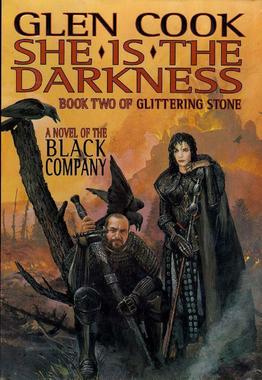
She Is the Darkness, by Glen Cook


She Is the Darkness
Glen Cook
1997


Murgen once again narrates this Chronicle of the Black Company. She is the Darkness is the second book of the Glittering Stone sequence which will wrap up the Black Company series, at least until Cook publishes more stories. The Company is under siege from Longshadow and The Howler and they are about to turn the tide of the battle through the rising powers of Lady and also through the timewalking of Murgen. I’ve read the book and Murgen’s odd ability doesn’t make any more sense to me, either. She is the Darkness keeps the Company pretty much all in one spot (except for Goblin, who is off doing something). Murgen is grieving the loss of his wife, Croaker and Lady are no longer desperate to get their child back but rather have focused on revenge against the Strangler who took their daughter. Kina, the Destroyer Goddess is influencing events and seeking to get back. Soulcatcher, the Taken we met in the first book and Lady’s sister, has her own agenda, and Croaker isn’t telling anybody anything.

I can imagine how confusing this may sound to someone with no familiarity with The Black Company, but I have to say that this is still confusing and I’ve read all of the Black Company novels. This was my biggest problem with She Is the Darkness. Because Murgen was kept in the dark about much of what was going on, the reader is kept in the dark. We see things through Murgen’s perspective and this is very limiting. Croaker even complains about how Murgen is writing the Annals (which is essentially what we are reading).

The events of the novel are unclear, there is a strong sense of dues ex machina running through the novel, and unlike previous novels there is a feeling of stagnation, that little is truly happening. That is, until the very end.

She Is the Darkness was simply a disappointing novel and one that if it were not part of the overall excellent Black Company sequence, I would have stopped reading midway through the book. The pacing is at a crawl, the explanations either obvious or non existent, very little action (in the sense that the characters are not really doing anything other than waiting), and the book is just not up to the standard of Cook’s earlier Black Company novels.

I have heard that the final two Black Company novels are much stronger than these last two I have read, so I still have hopes that Cook will wrap things up and deliver a good story.

Sunday, September 02, 2007

The Silver Spike, by Glen Cook

The Silver Spike
Glen Cook
Tor: 1989


When the Dominator was destroyed and Croaker left with Lady and the tattered remains of the Black Company and went south to bring the Annals back to Khatovar, some stayed behind. Raven, Case, Darling, and Silent remained in the north. Darling and Silent went East. Raven, after failing Darling one too many times, was no longer welcome around Darling until he pulled his life back together. Raven and Case stayed in the area, then traveled a little to the south.

After The White Rose Glen Cook followed The Black Company with Shadow Games, but around the same time he published Shadow Games he also published The Silver Spike. The Silver Spike is not part of the Black Company series proper, being a bit of an offshoot. It tells the story of those left behind. The Silver Spike lets the reader know that while Croaker and Lady are journeying south the world up north has not stopped and simply killing (again) The Dominator and driving the spike into the tree does not stop the evil.

Cook weaves two storylines together, as usual. First, and most obvious, is that of Raven and Case. Case narrates. Case states early on that Raven wanted him to keep a journal. Clearly, Glen Cook is following the journal / Annalist format of the other Black Company novels and is keeping things consistent. Will Raven follow Darling? Will he ever figure things out? Will Case leave Raven? What is the Dark Evil of this novel? Cook gets to it in his own time and through the other storyline. Smeds and Tully figure out how to make a big score. They'll take the silver spike of the title and sell it to the highest bidder. Simple. Except in the taking of the spike somehow The Limper is freed and everybody is looking for Smeds, Tully, Old Man Fish, and Timmy (they got partners). Eventually the storylines meet up and eventually Raven is reunited with Darling, though it is not the reunion he might have hoped for, and eventually Glen Cook builds to a great big battle against a Great Big Evil.

Somehow this all seems so much less important than the battles Croaker and the Black Company are going through down south. Yes, this is an offshoot novel, a side story, and yes there is a Great Big Evil, a crazed Limper, and the return of Toadkiller Dog. Old Man Fish is a very enigmatic character and Case's story is fine. Glen Cook tells, as usual, a straightforward story. Even though the reader does not quite know everything that is going on there are not big mysteries throughout the novel (other than what happens next). Cook does not engage in narrative trickery or obfuscate the story like Steven Erikson does by hinting at things and never explaining them. Cook tells his story and gets it done with. The issue here is that the story, or perhaps just the storytelling, was not as accomplished as it is in other Black Company novels. While the Black Company reader may wonder what ever happened to Raven, Silent, and Darling while Croaker and the Company are moving towards Khatovar, Cook reveals too much. Perhaps this is a story that did not need to be told and while Cook did the best he could with it, the best work follows the Black Company itself.

What Glen Cook does well is in giving all characters a chance to shine. Case was introduced in The White Rose, but he gets top billing here. Smeds, and Old Man Fish get prominent roles, Darling returns and her storyline plays out. Cook gives previously minor characters more supporting and larger roles. He does this in his other Black Company novels, too, and this keeps things from being stagnant.

While The Silver Spike is still a fast paced action / adventure in the style of The Black Company, it is not nearly as strong as the main Black Company sequence. It just does not stand up with the best of The Black Company. That's fine, but I had hoped for more. A less successful Black Company novel is still a good story. Cook has just told better stories than this one.

Friday, August 24, 2007

Dreams of Steel, by Glen Cook


Dreams of Steel
Glen Cook
Tor: 1990


The Black Company has been decimated at Dejagore, Croaker is presumed dead, and as far as Lady knows she is only survivor. Lady, once the enemy of the Company, lately Croaker's Lieutenant and lover, is now Captain. In essence, she is the Company. Goblin, One Eye, and Murgen are nowhere to be seen. Lady sets about to rebuild the Company the only way she knows how: through terror and fear. Lady intends to fulfill the contract with Taglios and bring the annals south to Khatovar, but to do this she needs to rebuild the Company and destroy the Shadowmasters (some of her former Soultaken back when she was The Lady).

The major change of Dreams of Steel is that Croaker is no longer narrator. Rather, Lady narrates the tale and through her perspective we see the rebuilding of the Company and the violence and darkness required to do so. There is a mild shift of tone with Lady as narrator, but overall there is not a significant difference. It is still a Black Company novel and no matter who the narrator is the novel reads as such. That is to say: Blunt, to the point, military action, plotting, and flat out strong storytelling on Cook's part. What is truly different is that unlike the previous Black Company novels, in Dreams of Steel the Company is Lady. Croaker is out, and while we see reports of Goblin, One Eye, and Murgen, they are separated from Lady. The Company is essentially starting from scratch here. Lady does have help, though, from local assassin priests and the trio of Blade, Swan, and Mather whom we met in the last novel Shadows Linger. While the cast is different from before, there is a strong cast of characters here. Further, we get more hints and teases on the origins of the Company and it is one which may break Croaker's heart when he learns of it.

Dreams of Steel is a strong, fast paced novel. Five novels in Glen Cook is delivering powerful works of fiction and creating a series which should have far more recognition than it currently does. Whether at full strength or decimated, The Black Company is always worth reading about and Dreams of Steel is no different.

This is the Fifth Novel of the Black Company, the Second Book of the South, and the prelude to the Glittering Stone trilogy to wrap it all up. Dreams of Steel is worth every moment.