Showing posts with label Catching Up. Show all posts

Monday, February 27, 2012

One Eyed Jacks

This is more of an acknowledgment than anything else. I read One Eyed Jacks over the summer and since I plan to start stepping back into the Wild Cards series, I want to at least mention this volume of one of my favorite series. You can also consider this part of my occasional posts covering what I read while in Texas. Very occasional posts, at that.


One Eyed Jacks is the eighth (out of 21, so far) novel in George R. R. Martin’s Wild Cards shared world milieu. Sadly, it is one of the least successful so far. While each book has something I don't care about (like the Ti Malice storyline of Down and Dirty), most are strengthened by some aspect that I adore. One Eyed Jacks is missing that bit of specialness.  Plus, One Eyed Jacks has more Tachyon and Blaise (not a good thing in my book). Also, jumpers. The jumpers are a group of aces who can “jump” their consciousness into the bodies of other people and completely take them over. Conceptually, it’s a fascinating idea because if you consider that they can also take over other aces and the accompanying powers, there’s a lot of damage these little bastards can do with minimal personal repercussions.

Thing is, there are repercussions because when the jumpers pick on the wrong aces or the wrong people, somebody is going to come looking for answers. In this case, Blaise. Yes, that damned Blaise – the sociopathic son of Dr. Tachyon and who perpetually has storylines I find intensely uninteresting. I’m sure others take nasty delight in the appearance of any Blaise storyline. Wild Cards has plenty to offer. While I enjoyed how aspects of the Jumper / Blaise story resolved, it’s just more Blaise with the suggestion that he will continue to take a prominent role in the coming volumes.

Other storylines in the novel feature Jerry Strauss, once The Projectionist who was trapped in the body of a giant ape, now Mr. Nobody, working as something of a private investigator in love with his brother’s wife; Dr. Tachyon’s new chief surgeon Dr. Cody Havero; and The Oddity. Stephen Leigh’s Oddity story “Sixteen Candles” is a poignant and painful story. It’s also damn good.

While I want to see how the jumper concept works itself out, One Eyed Jacks did not have me clamoring to pick up Jokertown Shuffle to get the next installment of the story.

Despite this, Wild Cards remains an impressive achievement of shared world collaboration. George R. R. Martin has done well to keep it going over the years, even if there is the occasional dip in quality. If you’re looking for a starting point for the series and shudder at the thought at starting with the first book and slogging through twenty more volumes, start with Inside Straight. It may be the eighteenth volume, but it serves as a reintroduction to the world with a new cast of characters and new story arcs. I highly recommend it (and the whole series).


Previous Wild Cards Reviews:
Wild Cards (bk 1)
Aces High (bk 2)
Jokers Wild (bk 3)
Aces Abroad (bk 4)
Down and Dirty (bk 5)
Ace in the Hole (bk 6)
Inside Straight (bk 18) 
Busted Flush (bk 19)

Tuesday, November 15, 2011

Kitty's Big Trouble, by Carrie Vaughn

I want to catch up on some of the books I've read during the last four months. I won't be able to write in depth about most of these books because it's been too long. This may be more of a series where I talk about what I think about when I think about these books. If that makes sense.

This is the third in that series of posts.


I read Kitty's Big Trouble back in July. I've been reading Carrie Vaughn for the last five years and Vaughn has maintained my interest and excitement from the first book. Kitty's Big Trouble is the ninth novel in the series and continues Vaughn's expansion of the scope of Kitty's world.

Kitty's Big Trouble opens with Kitty's belief that William Tecumseh Sherman was really a werewolf and her investigation into that, but it extends into San Francisco to get deeper into the looming war with Roman and is minions. Vaughn explores the depth of what Kitty (and the reader) knows of the supernatural in this world.

After all these months, what I most want to convey about Kitty's Big Trouble is that there is no drop in quality in this ninth Kitty Norville novel. Vaughn continues to deliver a fast paced, entertaining story which builds what the reader knows of the world while not neglecting the ever developing characterization of all the recurring characters.

When I stop to think about it, Kitty's Big Trouble reads as an episode in a television series. The novel itself is a singular episode which tells a particular story and has a beginning, middle, and end. Carrie Vaughn puts the story first and doesn't fail to tell a good one. But, the novel also succeeds in the context of the larger Kitty Norville series. Kitty Norville is not a static character, but rather develops based on experience. The Kitty readers met back in Kitty and the Midnight Hour is not the same Kitty in these more recent novels, though the journey is clear. Bit by bit, Carrie Vaughn explores this world which seems so similar to our own, if not for the presence of the supernatural. Kitty, like the readers, have only scratched the surface of what all is out there. This is the heart of the sense of discovery in the Kitty Norville series. Through the “Adventure of the Week” stories, Vaughn works the larger thematic, character, and overall series arcs to deliver a multi-layered experience.

Or: It's just good, y'all.

Kitty Steals the show is due out in Spring 2012.


Previous Reviews
Kitty and the Midnight Hour
Kitty Goes to Washington
Kitty Takes a Holiday
Kitty and the Silver Bullet
Kitty and the Dead Man's Hand
Kitty Raises Hell
Kitty's House of Horrors
Kitty Goes to War

Saturday, November 05, 2011

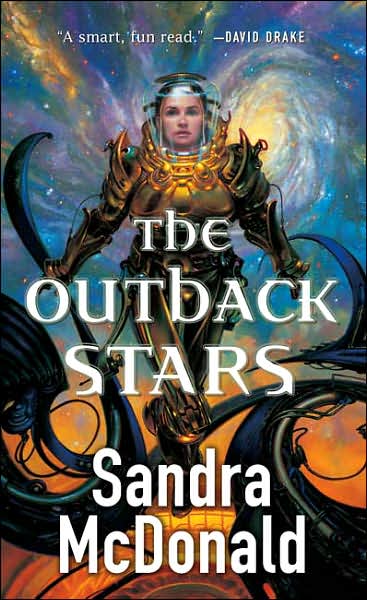
The Outback Stars, by Sandra McDonald

I want to catch up on some of the books I've read during the last four months. I won't be able to write in depth about most of these books because it's been too long. This may be more of a series where I talk about what I think about when I think about these books. If that makes sense.

First up was David Gemmell's Legend.

Next up is The Outback Stars, by Sandra McDonald. I read this at the end of September.


Sandra McDonald described The Outback Stars and its two sequels as “sf military romances” and, well, fair enough. That aspect is certainly present in The Outback Stars. The more I think about that description, the better it fits. The Outback Stars is all three, with no one part of that overwhelming the others.

From the back cover:

Lieutentant Jodenny Scott is a Hero. She has the medals to prove it – and the scars.

She's cooling her heels on Kookaburra, recovering from the fiery loss of her last ship, the Yangtze, and she's bored – so bored, in fact, that she takes a berth on the next ship out. That's a mistake. The Aral Sea isn't anyone's idea of a get-well tour.

Jodenny's handed a division full of misfits, incompetents, and criminals. She thinks she can handle it. She's wrong. Aral Sea isn't a happy ship. And it's about to get a lot unhappier.

What I think about when I think about The Outback Stars is the interpersonal drama of The Aral Sea, Jodenny's struggle to bring a sense of military discipline and decorum back to her new unit and how she is undermined by others who should be leaders. McDonald goes much deeper than that, in the end, but the day to day struggle of Lt Scott was the core of what worked best for me. McDonald herself is a former Navy officer and that working knowledge of the day to day life of a junior officer comes through in her writing. She isn't writing dry military minutiae, either. There is real conflict that is core to the story being told in the novel. It works.

There really isn't a weak aspect of the novel. The SF, military, and romantic elements of The Outback Stars all come together to tell a singular story which I really didn't want to end. Fantastic novel and one which I wish I didn't wait so long to read. The Outback Stars was one of those novels that was on my list of books I'll get to “sometime soon”. Sometime soon became several years. Now I only need not to wait so long to read the sequel. Very good stuff here.

Thursday, November 03, 2011

Legend, by David Gemmell

I want to catch up on some of the books I've read during the last four months. I won't be able to write in depth about most of these books because it's been too long. This may be more of a series where I talk about what I think about when I think about these books. If that makes sense.

First up is a book that I read in mid-September: Legend, by David Gemmell

People have tried to get me to pick up Legend for years now. Every few months there would be a comment here insisting that I give the book a shot because I am sure to love it. We'll see. I might not have picked it up but I was in a situation where the only real access I had to books was a rare trip to a Half Priced Books and hope they have something decent. The result of one of those trips included Legend. Without much else to read and with the novel priced at $3, why not?

Originally published in 1984, Legend is a specific type of epic fantasy: which is to say, the ultra-heroic type where the hero is a hero and always does what is right and is capable of great feats. When I wrote about James Barclay's Chronicles of the Raven trilogy, I mentioned that I considered the Raven novels to be something of a bridge between quest fantasies of the 80's / 90's and the modern quest fantasies. Though I didn't realize it at the time, Legend is the beginning of that conversation of how that epic fantasy storytelling would shift.

Had Gemmell written about “Druss the Legend” earlier in the character's life, we would have been given a story of heroic feats of a young man at the height of his powers. There would have been a sense of obviousness in the story. Where Gemmell begins to twist things is that Druss here is an old man. Druss is something of a Clint Eastwood type character. You know he can kick the ass of men half his age, but you also know that people are going to want to test him even as they whisper about his legend. That's Druss and that's a major facet of Legend.

Having a somewhat “elderly” warrior means that there will always be a question on whether Druss's body will hold up to he demands of it and therein lies the tension. There's also a siege defending against vastly superior forces and the way Gemmell closes the novel is...interesting, but at its heart, Legend is heroic epic fantasy where things are a little too simple, too pat, and in many cases, too obvious. On the other hand, Legend does not pretend to be anything other than what it is.

There is a place for this type of fantasy. Certainly there is a market for it, and the David Gemmell Legend Award celebrates epic fantasy and Gemmell's legacy. I'm just not sure this is what I want to read on a regular basis.